




Apple Is the Second-Worst-Performing Dow Jones Stock So Far in 2026. Is the Sell-Off a Buying Opportunity?
Key Points
Apple stock is cooling off after a rapid run-up in the second half of last year.
A Gemini-powered Siri upgrade could come in February.
Apple shares are far from cheap.
- 10 stocks we like better than Apple ›
Less than one month into the new year, Apple (NASDAQ: AAPL) is already down 8.8% year to date at the time of this writing, compared to a 1% gain in the S&P 500 (SNPINDEX: ^GSPC).
That makes Apple the second-worst-performing component of the Dow Jones Industrial Average.
Where to invest $1,000 right now? Our analyst team just revealed what they believe are the 10 best stocks to buy right now. Continue »
Here's what's driving the sell-off, and if the mega-cap tech stock is a buy now.
Image source: Getty Images.
Context is key
Always take context into account when evaluating a stock's performance within a specific window, such as year to date or a year.
Apple sold off in the first half of 2025 due to tariff-related fears of eroding margins that never came true. The stock then gained 32.5% in the second half of the year. So heading into 2026, the company had added more than $1 trillion in market cap in a matter of months.
The stock is still up big over the last seven months, even when factoring in its pullback so far this year. It's up to investors to decide how much of the gain is warranted.
Apple is making a splash with AI
On Jan. 12, Alphabet and Apple published a joint statement announcing the integration of Google's Gemini models and cloud technology into the next generation of Apple Foundation Models. Reports indicate that a Gemini-powered version of Siri could come as soon as February.
Having a voice-controlled artificial intelligence (AI) assistant is a brilliant move on Apple's part. Manually-controlled AI functionality may be off-putting to some users, but narrating commands to an assistant could make AI more approachable for users who aren't tech savvy. It's also a good way for the company to gradually phase in AI rather than launching big, overwhelming upgrades.
Apple is known for taking its time with product launches, which is something long-term investors can appreciate. Instead, it aims to maximize the overall impact of a product or a product line's life cycle.
And that was certainly the case last year with the iPhone 17, which featured significant improvements in its camera, processing, and design but lacked the AI showstopper that some investors wanted.
Still, the iPhone 17 came out in September 2025, and investors cheered strong demand and a return to meaningful earnings growth, which Apple had been lacking for years.
Fundamentals are improving
As you can see in the following chart, Apple's earnings soared during the pandemic as consumers shifted purchasing from services to products, but then stagnated. Its recent results have given its earnings and operating margins a much-needed jolt.
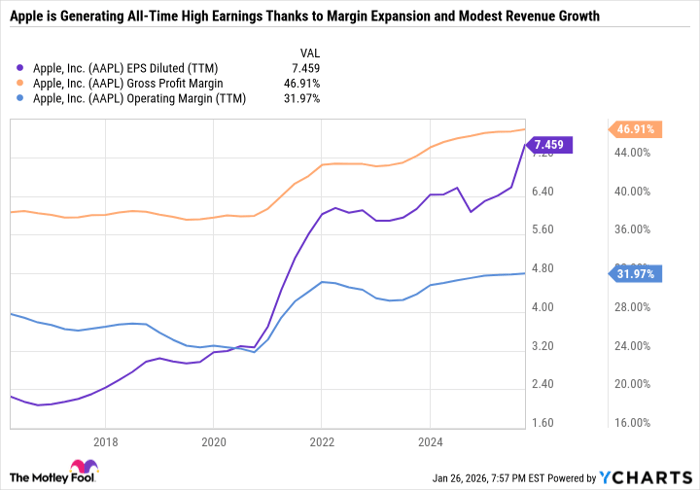
AAPL EPS Diluted (TTM) data by YCharts; TTM = trailing 12 months.
Apple's product revenue grew 4.1% in fiscal 2025, and services revenue jumped 13.5%.
For the fiscal year, products raked in a highly impressive 36.8% gross margin, but services were even better at 75.4%. And with services now making up 26.2% of total sales, margins could continue to expand.
Overall, Apple's results have been solid. And that's without factoring in the growth potential of what is likely to be a big calendar year for the company with AI-powered software upgrades and an iPhone purpose-built for AI integration, which may also feature its first-ever foldable design.
Higher-end versions of the iPhone 18 are expected to be powered by Taiwan Semiconductor Manufacturing's 2-nanometer chips, which will make it by far the most expensive iPhone ever, but will also drastically improve processing and battery life.
Apple's valuation is elevated
With earnings growth and margins improving, the stock may become more appealing to growth investors. But its valuation is expensive, given that analyst estimates have the company growing earnings by only 10.3% in fiscal 2026 and 10.5% in fiscal 2027.
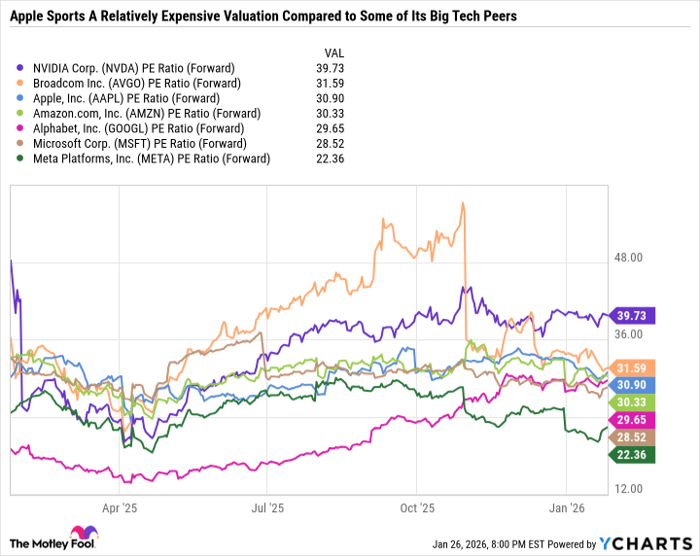
NVDA PE Ratio (Forward) data by YCharts; PE = price to earnings.
Even after its recent sell-off, Apple has a 30.9 forward price-to-earnings ratio (P/E) -- which is more expensive than Amazon, Alphabet, Microsoft, and Meta Platforms. Even Broadcom, which is growing at a breakneck pace and is also high-margin, has a 31.6 forward P/E. And Nvidia -- which converts over half of its revenue into after-tax net income and is also growing at a breakneck pace -- has a forward P/E under 40.
I would choose every stock in that chart over Apple because they all have strong competitive moats and more attractive valuations relative to their growth potential. Another distinct difference between Apple and other major tech stocks is its business model.
Apple is heavily dependent on consumer spending. In fiscal 2025, it demonstrated remarkable resilience in its core North American market, and strong growth in Europe and Asia (outside of China).
But China sales declined, and it remains to be seen if U.S. consumers will continue paying higher prices for Apple's AI-integrated devices, especially given that the cost of living continues to outpace wage growth. By comparison, big tech companies that rely mainly on business-to-business sales aren't as sensitive to weakness in consumer spending.
Keep Apple on a watch list (for now)
Apple is a decent stock to buy in 2026, but it's not all that compelling. Investors can buy a high-octane growth stock like Broadcom for a similar valuation, or get far more balanced earnings growth from Microsoft, or high margins and solid earnings from Meta at a far less expensive valuation.
The slower a company's earnings growth, the more critical you should be of its valuation. And in Apple's case, it's somewhere between a tech stock and a consumer-facing company.
In terms of consumer-facing companies, I would much rather buy high-yield dividend stocks like Coca-Cola and Procter & Gamble, which are passive-income powerhouses at far more attractive valuations than Apple.
That said, investors who believe in Apple's ability to capitalize on AI may still want to consider buying Apple now. And if there is a sell-off in AI stocks or a pullback in hyperscaler spending on AI, I would expect Apple to hold up far better than companies that have been pouring capital into long-term AI investments. Apple has an impeccable balance sheet and consistently generates gobs of free cash flow, which it uses to buy back stock and invest in long-term projects.
In sum, there are worse ideas than buying Apple after its latest pullback, but it's not a screaming buying opportunity by any means.
Should you buy stock in Apple right now?
Before you buy stock in Apple, consider this:
The Motley Fool Stock Advisor analyst team just identified what they believe are the 10 best stocks for investors to buy now… and Apple wasn’t one of them. The 10 stocks that made the cut could produce monster returns in the coming years.
Consider when Netflix made this list on December 17, 2004... if you invested $1,000 at the time of our recommendation, you’d have $461,527!* Or when Nvidia made this list on April 15, 2005... if you invested $1,000 at the time of our recommendation, you’d have $1,155,666!*
Now, it’s worth noting Stock Advisor’s total average return is 950% — a market-crushing outperformance compared to 197% for the S&P 500. Don't miss the latest top 10 list, available with Stock Advisor, and join an investing community built by individual investors for individual investors.
See the 10 stocks »
*Stock Advisor returns as of January 29, 2026.
Daniel Foelber has positions in Nvidia and Procter & Gamble and has the following options: short February 2026 $150 calls on Procter & Gamble. The Motley Fool has positions in and recommends Alphabet, Amazon, Apple, Meta Platforms, Microsoft, Nvidia, Salesforce, and Taiwan Semiconductor Manufacturing. The Motley Fool recommends Broadcom. The Motley Fool has a disclosure policy.
Recommended Articles


