




The Top "Magnificent Seven" Stocks to Buy in 2026, According to Wall Street
Key Points
Wall Street is least bullish about Alphabet, Tesla, and Apple in the new year.
However, analysts project big gains for Amazon, Meta, and Microsoft.
Nvidia is Wall Street's favorite "Magnificent Seven" stock for 2026.
- 10 stocks we like better than Nvidia ›
The S&P 500 (SNPINDEX: ^GSPC) finished 2025 up 16%. Certain members of the widely followed index, though, delivered much more impressive gains last year.
For example, two members of the so-called "Magnificent Seven" stocks generated especially stellar returns. Shares of Google parent Alphabet (NASDAQ: GOOG) (NASDAQ: GOOGL) skyrocketed 65% higher, while Nvidia (NASDAQ: NVDA) continued its winning ways with a gain of 39%.
Where to invest $1,000 right now? Our analyst team just revealed what they believe are the 10 best stocks to buy right now, when you join Stock Advisor. See the stocks »
In retrospect, Alphabet and Nvidia were the top Magnificent Seven stocks for investors to buy at the beginning of 2025. What are the top Magnificent Seven stocks to buy in 2026? Here's what Wall Street thinks.
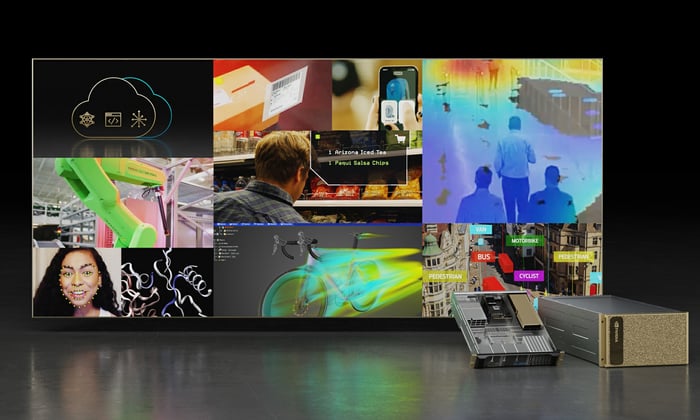
Image source: Nvidia.
Less magnificence than the others?
There's a Bible verse that says that the "first shall be last." Wall Street appears to subscribe to this view with the Magnificent Seven stocks in the new year.
Although Alphabet was the biggest winner of the group in 2025, analysts don't have high expectations for it in 2026. The average 12-month price target for the stock is only slightly above Alphabet's current share price.
However, analysts don't seem to agree that "the last shall be first." Tesla (NASDAQ: TSLA) was the third-worst-performing stock in the Magnificent Seven last year. Wall Street believes Elon Musk's company will be the second-worst performer of the group in 2026, with a consensus price target reflecting a potential upside of around 10%.
Wall Street doesn't believe that the strong momentum Apple (NASDAQ: AAPL) enjoyed in the second half of 2025 will extend throughout 2026. The average price target for the iPhone maker is 11% higher than Apple's current share price.
Wall Street's "magnificent four"
However, analysts expect that Amazon (NASDAQ: AMZN) will shake off the doldrums it experienced last year. The consensus price target for the e-commerce and cloud services giant indicates a potential upside of over 20%.
Wall Street seems to believe that Meta Platforms (NASDAQ: META) will gain more momentum. Meta delivered a return of nearly 13% in 2025. The average 12-month price target for the stock is 28% above the current share price.
Microsoft (NASDAQ: MSFT) remains a Wall Street darling. Of the 57 analysts surveyed by S&P Global (NYSE: SPGI) in January, all but two of them rated Microsoft as a "buy" or "strong buy." The consensus price target for the stock reflects the view that it will soar roughly 31% higher over the next 12 months.
That leaves only one remaining Magnificent Seven stock – Nvidia. Analysts expect the GPU maker to deliver another year of sizzling returns in 2026. The average price target for Nvidia reflects a potential upside of almost 37%, only slightly below its 39% gain last year.
Is Wall Street right?
If Wall Street is on the right track, investors should scoop up shares of Nvidia, Microsoft, and Meta in early 2026. And they should probably avoid Alphabet. But is Wall Street right?
I suspect that analysts are correct in predicting that Nvidia will again be a significant winner this year. The demand for the company's GPUs doesn't appear likely to slow anytime soon. Nvidia is even reasonably valued based on its growth prospects, with a forward price-to-earnings ratio of 24.2.
Wall Street's enthusiasm about Microsoft also seems warranted, in my opinion. I expect that the rising adoption of agentic AI will serve as a tailwind for Microsoft's Azure cloud platform in 2026. It should be a similar story for Amazon Web Services (AWS).
I agree with the bullish take on Meta as well. While the company's advertising revenue on Facebook, Instagram, and other social media platforms should grow nicely this year, Meta could also have a gold mine on its hands with its smart glasses.
Analysts' lower expectations for Tesla make sense to me. I can also understand why they don't think that Apple will deliver outsize gains this year, although I remain confident that Apple's long-term prospects are strong.
My biggest qualm with Wall Street's projections for the Magnificent Seven stocks centers on Alphabet. Google Cloud continues to grow at a faster rate than AWS and Microsoft Azure. Google Gemini 3.0 appears to be a rousing success. Google's Search revenue and profits are growing, with the introduction of generative AI boosting traffic. Waymo is leading the way in the robotaxi market. Google's Tensor Processing Units (TPUs) are gaining traction with major customers.
Nvidia and Microsoft may outperform Alphabet this year. However, I think this stock is a more magnificent pick for 2026 than Wall Street gives it credit.
Should you buy stock in Nvidia right now?
Before you buy stock in Nvidia, consider this:
The Motley Fool Stock Advisor analyst team just identified what they believe are the 10 best stocks for investors to buy now… and Nvidia wasn’t one of them. The 10 stocks that made the cut could produce monster returns in the coming years.
Consider when Netflix made this list on December 17, 2004... if you invested $1,000 at the time of our recommendation, you’d have $482,451!* Or when Nvidia made this list on April 15, 2005... if you invested $1,000 at the time of our recommendation, you’d have $1,133,229!*
Now, it’s worth noting Stock Advisor’s total average return is 968% — a market-crushing outperformance compared to 197% for the S&P 500. Don't miss the latest top 10 list, available with Stock Advisor, and join an investing community built by individual investors for individual investors.
See the 10 stocks »
*Stock Advisor returns as of January 12, 2026.
Keith Speights has positions in Alphabet, Amazon, Apple, Meta Platforms, and Microsoft. The Motley Fool has positions in and recommends Alphabet, Amazon, Apple, Meta Platforms, Microsoft, Nvidia, S&P Global, and Tesla. The Motley Fool recommends the following options: long January 2026 $395 calls on Microsoft and short January 2026 $405 calls on Microsoft. The Motley Fool has a disclosure policy.
Recommended Articles


