




1 Must-Own Artificial Intelligence Stock for the Next Decade
Key Points
The global semiconductor market could grow in value to $2 trillion by 2040.
Taiwan Semiconductor Manufacturing dominates the foundry industry, and produces most of the AI chips sold today.
Although there may be volatility along the way, TSMC is well positioned for profitable growth over the next 10 years.
- 10 stocks we like better than Taiwan Semiconductor Manufacturing ›
U.N. economic experts forecast that the artificial intelligence (AI) market will grow in value to $4.8 trillion by 2033, and it's likely to grow far larger than that in the decade that follows. Along the way, it's going to produce some life-changing investment opportunities, just as the internet era did before it.
Moreover, you don't necessarily need to succeed in predicting the next big thing to profit from it. Some AI stocks already stand out as no-brainer winners for the future.
Where to invest $1,000 right now? Our analyst team just revealed what they believe are the 10 best stocks to buy right now, when you join Stock Advisor. See the stocks »
Taiwan Semiconductor Manufacturing (NYSE: TSM), often referred to as TSMC, is one of them. It's arguably the ideal pick-and-shovel stock for the AI era. The company has immense growth potential and has already begun to show signs of realizing it.

Image source: Getty Images
Dominating a $2 trillion market opportunity
It may not seem like it yet, but artificial intelligence systems are destined to be embedded in far more places than data centers. Over the coming years, we can expect AI to infiltrate many existing industries and also to create new ones. Autonomous vehicles and humanoid robotics are already on the way.
The common denominator among data centers, AI models, robots, self-driving vehicles, and the rest of that developing technology? Semiconductors, aka chips. Research from Deloitte estimates that the global semiconductor industry could grow from $627 billion in 2024 to $1 trillion by 2030, and to $2 trillion by 2040.
Most companies that sell chips don't actually manufacture them. Instead, they design them, but outsource production to a foundry specialist. TSMC has long been the global leader in that business, with an estimated market share of 72% as of the third quarter of 2025.
TSMC's market share has actually increased since the AI boom began a few years ago. The company's advanced production technologies and capacity to manufacture large quantities of high-end chips give it tremendous competitive advantages over other foundries.
It also means that TSMC should capture a significant portion of the new growth that will flow into the industry as global semiconductor demand increases in the coming years.
The investment cycle likely isn't over yet
The semiconductor industry has historically been cyclical, experiencing boom and bust phases as investments in chips fluctuate and production capacity lags and then exceeds demand. You can see how TSMC's revenue growth has followed that pattern over time. It's fair to wonder how long the current AI investment cycle will last, especially as some tech companies face questions about how they will fund their ambitious data center plans.
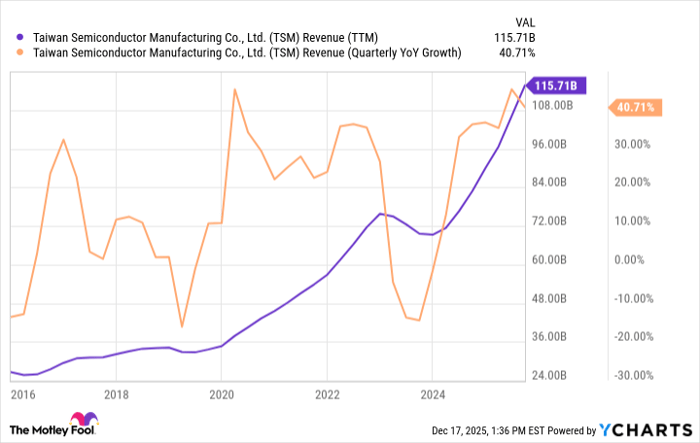
TSM Revenue (TTM) data by YCharts.
While the current AI chip cycle will eventually turn over, it doesn't seem like it's on its last legs yet.
Nvidia has touted a $500 billion order book through the end of next year for its current top-of-the-line Blackwell GPUs and the Rubin architecture chips that will succeed them next year. Some hyperscalers, such as Amazon and Alphabet, have developed their own custom AI accelerator chips. Yet TSMC manufactures them, too.
In short, regardless of which chipmaker is selling a particular AI chip, TSMC is likely to have manufactured it.
How to profit amid potential volatility
Even if AI infrastructure investments slow, it doesn't mean long-term investors should abandon Taiwan Semiconductor Manufacturing. Despite short-term fluctuations in its growth, the company's revenue has increased by 335% over the past decade. As long as the industry continues to grow over the long term, TSMC should grow with it.
The stock trades at a price-to-earnings ratio of 28 times full-year earnings estimates. That's a compelling valuation for a company that analysts estimate will grow earnings by 28% annually over the next three to five years.
Admittedly, it's also possible that its earnings could be near their peak for the current investment cycle. If AI spending declines and TSMC's revenue growth slows, that will hurt the stock's valuation and share price. Rather than trying to time these things, investors who want to add TSMC to their portfolios would probably be better off using dollar-cost averaging, building their investment slowly and reducing their risk of buying at a short-term peak.
Unless the AI megatrend completely unravels, which doesn't seem likely given the public and private sector commitments to developing AI technology, TSMC is likely to see enough growth over the next decade to make it worthwhile to ride out the inevitable peaks and valleys.
Should you buy stock in Taiwan Semiconductor Manufacturing right now?
Before you buy stock in Taiwan Semiconductor Manufacturing, consider this:
The Motley Fool Stock Advisor analyst team just identified what they believe are the 10 best stocks for investors to buy now… and Taiwan Semiconductor Manufacturing wasn’t one of them. The 10 stocks that made the cut could produce monster returns in the coming years.
Consider when Netflix made this list on December 17, 2004... if you invested $1,000 at the time of our recommendation, you’d have $509,039!* Or when Nvidia made this list on April 15, 2005... if you invested $1,000 at the time of our recommendation, you’d have $1,109,506!*
Now, it’s worth noting Stock Advisor’s total average return is 972% — a market-crushing outperformance compared to 193% for the S&P 500. Don't miss the latest top 10 list, available with Stock Advisor, and join an investing community built by individual investors for individual investors.
See the 10 stocks »
*Stock Advisor returns as of December 21, 2025.
Justin Pope has positions in Alphabet. The Motley Fool has positions in and recommends Alphabet, Amazon, Nvidia, and Taiwan Semiconductor Manufacturing. The Motley Fool has a disclosure policy.
Recommended Articles


