




Billionaire Ken Griffin Just Bought a Quantum Computing Stock That Could Soar by as Much as 101%, According to Wall Street
Key Points
D-Wave Quantum is developing computing systems that use quantum annealing technology.
Wall Street is bullish on D-Wave stock, but its valuation suggests a correction could be coming.
- 10 stocks we like better than D-Wave Quantum ›
When it comes to famous investment personalities, names such as Warren Buffett or Jamie Dimon usually get mentioned first. In the world of hedge funds, though, Ken Griffin is the cream of the crop.
Griffin founded Citadel in 1990, shortly after graduating from Harvard. Since its inception, that hedge fund has generated compound annualized returns of nearly 20% -- roughly double the performance of the S&P 500. Even more important, as those greater returns compound over time, they add up to results that far exceed the market. Considering the magnitude of Citadel's outperformance, it would be fair to say that Griffin and his team are expert stock pickers.
Where to invest $1,000 right now? Our analyst team just revealed what they believe are the 10 best stocks to buy right now, when you join Stock Advisor. See the stocks »
According to its latest 13F filing, in the third quarter, Citadel purchased 169,057 shares of D-Wave Quantum (NYSE: QBTS), increasing its stake in the quantum computing pure play by 201%.
Among Wall Street analysts covering the stock, the average 12-month price target is $38, which implies 59% upside from its current level. Nathaniel Bolton of Needham is even more bullish, projecting up to 101% upside, with a price target of $48.
With all that in mind, is now a good time to follow Griffin's lead into D-Wave Quantum?
What does D-Wave Quantum do?
The company is developing quantum computers that use a technique called quantum annealing. Unlike the gate-based approaches employed by most other quantum computer developers, D-Wave's machines target narrower classes of optimization and probabilistic sampling problems, finding solutions that will be among the most optimal for them.
That narrower range of use cases, however, does include a host of complex problems faced by companies in the logistics, manufacturing, supply chains, and telecom industries, as well as in city planning.

Image source: Getty Images.
D-Wave insiders are selling like there's no tomorrow
On the surface, it would appear that D-Wave has identified some practical use cases for its quantum technology -- and they are tasks that even a classical supercomputer would struggle with. However, while the company's revenue growth trajectory is impressive, it's piling up losses.

QBTS Revenue (TTM) data by YCharts.
My interpretation of the financial profile shown in the charts above is that D-Wave's traction remains limited. In other words, the company's technology hasn't yet found broad commercial adoption -- hence, sales are negligible. At the same time, investing in research and development (R&D) to build these quantum systems requires heavy ongoing outlays.
With large-scale enterprise adoption of its systems still years away under the best-case scenario, D-Wave's unit economics don't look too compelling. Perhaps this is a driving factor behind insiders -- including the CEO, CFO, and several board members -- selling shares this year.
Is now a good time to buy D-Wave Quantum stock?
In addition to holding D-Wave stock, Citadel also owns a combination of call and put options in the quantum computing business.
While it's impossible to know exactly which option chains Citadel owns and at what strike prices, my hunch is that it's hedged to make money whether D-Wave stock rises or falls. Building positions in your portfolio with both options and outright shares is a fairly complex approach that is not suitable for the average investor.
Moreover, it's not the best idea to buy any stock simply because Citadel has a position or Wall Street analysts are predicting further upside. Instead, smart investors should focus more on classic valuation assessments.
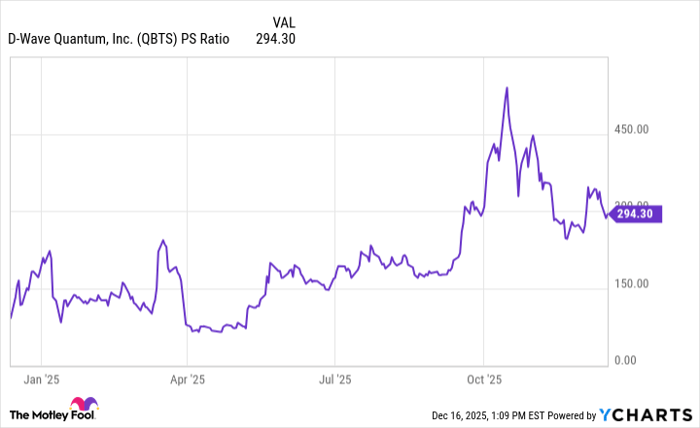
QBTS PS Ratio data by YCharts.
As of Dec. 16, D-Wave boasted a price-to-sales ratio (P/S) of 294. While the shares could be headed higher in the near term, history shows that valuation multiples of this magnitude aren't sustainable.
After the dot-com bubble burst in early 2000, even the highest-flying darlings of the early internet era saw their valuations plummet by nearly 80%. In the long run, I think a similar outcome is far more likely for D-Wave than a further climb.
Only day traders and those willing to accept outsized volatility and risk should consider buying D-Wave stock. For most retail investors, there are more prudent opportunities in the quantum computing realm that don't require complicated trade structures akin to Griffin's position.
Should you buy stock in D-Wave Quantum right now?
Before you buy stock in D-Wave Quantum, consider this:
The Motley Fool Stock Advisor analyst team just identified what they believe are the 10 best stocks for investors to buy now… and D-Wave Quantum wasn’t one of them. The 10 stocks that made the cut could produce monster returns in the coming years.
Consider when Netflix made this list on December 17, 2004... if you invested $1,000 at the time of our recommendation, you’d have $511,196!* Or when Nvidia made this list on April 15, 2005... if you invested $1,000 at the time of our recommendation, you’d have $1,047,897!*
Now, it’s worth noting Stock Advisor’s total average return is 951% — a market-crushing outperformance compared to 192% for the S&P 500. Don't miss the latest top 10 list, available with Stock Advisor, and join an investing community built by individual investors for individual investors.
See the 10 stocks »
*Stock Advisor returns as of December 19, 2025.
Adam Spatacco has no position in any of the stocks mentioned. The Motley Fool has no position in any of the stocks mentioned. The Motley Fool has a disclosure policy.
Recommended Articles


