




2 ETFs That Are Good Bets To Beat the S&P 500 in 2026
Key Points
The AI boom has lifted the S&P 500 to major gains over the last three years.
Small-cap stocks have underperformed, and they're now trading at a big discount.
Chip stock also looks set to continue their outperformance.
- 10 stocks we like better than iShares Trust - iShares Russell 2000 ETF ›
The S&P 500 is set to close out another winning year, up 15.6% through 2015, and the broad market index is showing once again why it's a smart investment.
The index funds that track the S&P 500 offer exposure to 500 of the top U.S. stocks, and the fund managers regularly rebalance the index, ensuring that laggards are removed and new winners are added.
Where to invest $1,000 right now? Our analyst team just revealed what they believe are the 10 best stocks to buy right now. Continue »
However, while the S&P 500 is a great long-term investment, there are ETFs that outperform it. Let's take a look at two that look poised to do just that.

Image source: Getty Images.
1. iShares Russell 2000 ETF
One aspect that has defined the current bull market is that large-cap stocks, represented by the S&P 500, have significantly outperformed small-cap stocks and the Russell 2000 index, which tracks small caps.
As you can see from the chart below, the S&P 500 has nearly doubled the gains of the Russell 2000 since the end of 2022.
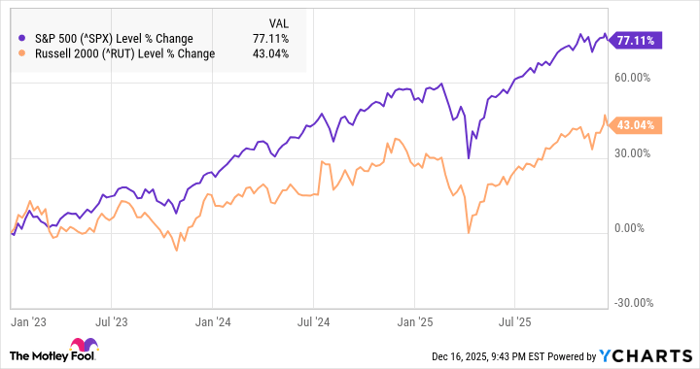
^SPX data by YCharts
That gap isn't surprising. After all, the current bull market has been led by the "Magnificent Seven," which has contributed most of the gains on the S&P 500.
However, the iShares Russell 2000 ETF (NYSEMKT: IWM), the biggest Russell 2000 ETF, looks like a good bet to beat the S&P 500 in 2026 for two main reasons. First, gains in a bull market tend to broaden as it matures, and, assuming the bull market continues, that seems likely to happen here.
While the "Magnificent Seven" continue to deliver solid growth, smaller software companies and other stocks are starting to take advantage of AI, and that shift should benefit small-cap stocks.
The other reason is that the Russell 2000 is now significantly cheaper than the S&P 500. The iShares Russell 2000 ETF now trades at a price-to-earnings ratio of just 18.3, compared to the Vanguard S&P 500 ETF at 28.7, meaning the IWM is nearly 40% cheaper than a comparable S&P 500 ETF.
As valuation concerns increase, that discrepancy should also favor a rotation into small-cap stocks, helping them narrow the gap that's emerged over the last few years.
2. VanEck Semiconductor ETF
One of the top-performing ETFs of the last decade is the VanEck Semiconductor ETF (NASDAQ: SMH). This year, the ETF is up 44% year-to-date, trouncing the S&P 500. Over the last decade, the VanEck Semiconductor ETF has jumped 1,180% as the semiconductor sector has boomed.
However, the ETF looks like it's in position for another winning year as the fund isn't as expensive as you might think, trading at a P/E ratio of 39.7, which is comparable to other tech-heavy ETFs like the Vanguard Growth ETF and even the Invesco QQQ Trust.
The VanEck Semiconductor ETF is stacked with the chip stocks leading the AI boom, led by Nvidia, Taiwan Semiconductor, and Broadcom, and those companies are delivering the kind of growth that justifies a premium valuation. Nvidia's revenue growth just accelerated to 62%, and TSMC is the world's dominant chip manufacturer. Broadcom may be the most diversified chip stock around, and its revenue growth improved to 28% in its most recent quarter.
The VanEck Semiconductor ETF should be a strong performer as long as the AI boom continues, and the S&P 500 is relying on the same momentum to drive it higher.
Nvidia CEO Jensen Huang recently called out AI doubters, saying instead of a bubble, he sees a turning point in AI, where more companies take advantage of it.
If that's the case, the SMH ETF looks like a good bet to outperform the index funds again.
Should you buy stock in iShares Trust - iShares Russell 2000 ETF right now?
Before you buy stock in iShares Trust - iShares Russell 2000 ETF, consider this:
The Motley Fool Stock Advisor analyst team just identified what they believe are the 10 best stocks for investors to buy now… and iShares Trust - iShares Russell 2000 ETF wasn’t one of them. The 10 stocks that made the cut could produce monster returns in the coming years.
Consider when Netflix made this list on December 17, 2004... if you invested $1,000 at the time of our recommendation, you’d have $509,955!* Or when Nvidia made this list on April 15, 2005... if you invested $1,000 at the time of our recommendation, you’d have $1,089,460!*
Now, it’s worth noting Stock Advisor’s total average return is 968% — a market-crushing outperformance compared to 193% for the S&P 500. Don't miss the latest top 10 list, available with Stock Advisor, and join an investing community built by individual investors for individual investors.
See the 10 stocks »
*Stock Advisor returns as of December 18, 2025.
Jeremy Bowman has positions in Broadcom, Nvidia, Taiwan Semiconductor Manufacturing, and VanEck ETF Trust-VanEck Semiconductor ETF. The Motley Fool has positions in and recommends Nvidia, Taiwan Semiconductor Manufacturing, and Vanguard Index Funds-Vanguard Growth ETF. The Motley Fool recommends Broadcom. The Motley Fool has a disclosure policy.
Recommended Articles


