




The Ultimate High-Yield Drug Stock to Buy With $1,000 Right Now
Key Points
Pfizer has a substantial 6.6% dividend yield but a payout ratio exceeding 100%.
Eli Lilly has a payout ratio of roughly 30%, but its dividend yield is a tiny 0.6%.
Long-term income investors can find the middle ground with a 3.4% yield and a 45% payout ratio from Merck.
- 10 stocks we like better than Merck ›
Dividend investors need to be cautious about reaching too far for yield since this can open them up to added risks. At the same time, they must ensure that they are generating an attractive enough income stream to make the investment worthwhile. One pharmaceutical stock stands out to income seekers today with its balance between risk and reward.
The boring middle could be the best option
Investors looking for the best-performing pharmaceutical company today will probably be drawn to Eli Lilly (NYSE: LLY). The company's GLP-1 weight-loss drugs are smashing it, with Mounjaro sales up 109% year over year in the third quarter of 2025 and Zepbound sales higher by an even larger 185%. There's just one problem: Investors are well aware of the company's success.
Where to invest $1,000 right now? Our analyst team just revealed what they believe are the 10 best stocks to buy right now, when you join Stock Advisor. See the stocks »

Image source: Getty Images.
Eli Lilly's dividend payout ratio is a very reasonable 30% or so. The company is likely to be a reliable dividend payer, except that its yield is a miserly 0.6%. Most income seekers won't be interested in that small a yield. How about Pfizer's (NYSE: PFE) 6.6% yield?
There are several issues with Pfizer. First, its payout ratio is over 100% right now. Second, the company is facing some important patent cliffs over the next few years as key drugs Ibrance, Eliquis, and Vyndaqel lose their patent protections between 2027 and 2028. Third, the company's GLP-1 drug candidate didn't work out, so the company is now scrambling to reenter the weight-loss market through acquisitions and partnerships.
Pfizer is highly likely to survive, but the next few years could be difficult. Given the lofty payout ratio, meanwhile, the safety risks with the dividend can't be ignored for anyone who is relying on its income to live.
Merck (NYSE: MRK) offers dividend investors an attractive middle ground in the pharmaceutical sector.
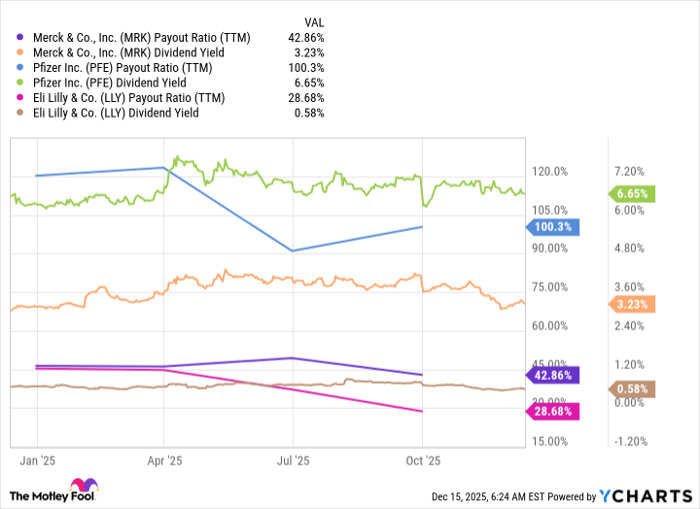
Data by YCharts; TTM = trailing 12 months.
Merck: A better risk-reward option
Merck's dividend yield is roughly 3.4%. That's not as high as what you would get from Pfizer, but it is significantly higher than Eli Lilly's yield. That 3.4% is also roughly three times the tiny 1.1% or so offered by the S&P 500 index right now.
When you add in the roughly 45% payout ratio, Merck's dividend also looks like it will be safe and dependable. If you are a dividend investor looking for drug exposure, Merck looks like a happy middle ground between risk and reward.
That said, Merck isn't risk-free. For example, its important drug Keytruda will lose patent protection in 2028. However, it holds international patents that will run through the early 2030s, as well as another version of the drug with patent protections extending into the late 2030s. Therefore, the headwinds from patent losses may not be as significant as those Pfizer is facing.
However, that hasn't stopped Merck from making important moves. For example, it recently agreed to acquire Cidara Therapeutics for around $9 billion. Cidara brings with it a promising drug for the treatment of the flu. Like Pfizer, Merck has a long history of surviving and thriving in the drug sector.
The primary reason Merck is a more attractive prospect than Pfizer is straightforward: Merck is operating from a stronger financial position to support its dividend. If Pfizer's efforts in the GLP-1 space don't pan out and its patent cliff hits full force, the high payout ratio could quickly become a problem. When Merck's patent cliff comes around, it just has more wiggle room.
Err on the side of caution if you need the dividends
A $1,000 investment in Merck will let you buy roughly 10 shares of the stock. The key here, however, is that the income you'll generate from those shares will be both substantial and well supported by the company's business.
Merck isn't the best-performing drug company, nor is it the highest-yielding drug company. However, if you use your dividends to pay for living expenses, it could be the ultimate high-yield drug stock to buy right now.
Should you buy stock in Merck right now?
Before you buy stock in Merck, consider this:
The Motley Fool Stock Advisor analyst team just identified what they believe are the 10 best stocks for investors to buy now… and Merck wasn’t one of them. The 10 stocks that made the cut could produce monster returns in the coming years.
Consider when Netflix made this list on December 17, 2004... if you invested $1,000 at the time of our recommendation, you’d have $505,695!* Or when Nvidia made this list on April 15, 2005... if you invested $1,000 at the time of our recommendation, you’d have $1,080,694!*
Now, it’s worth noting Stock Advisor’s total average return is 962% — a market-crushing outperformance compared to 193% for the S&P 500. Don't miss the latest top 10 list, available with Stock Advisor, and join an investing community built by individual investors for individual investors.
See the 10 stocks »
*Stock Advisor returns as of December 17, 2025.
Reuben Gregg Brewer has no position in any of the stocks mentioned. The Motley Fool has positions in and recommends Merck and Pfizer. The Motley Fool has a disclosure policy.
Recommended Articles


