




Bitcoin Stocks 2025 Collective Plunge, Still Worth Investing in Future?
Latest Bitcoin Stock News
TradingKey - Since October 2025, Bitcoin ( BTC) prices have continuously declined, falling from a peak of $125,000 to approximately $80,000, marking a six-month low with a maximum drawdown of 36%.
Affected by this Bitcoin price decline, Bitcoin stock prices have generally weakened, especially those of the leading Bitcoin holding company, Strategy ( MSTR ), which has seen its price nearly "halved," falling from $340 to approximately $160, reaching a new low since October 2024 and completely erasing all gains since Trump's presidential election victory.
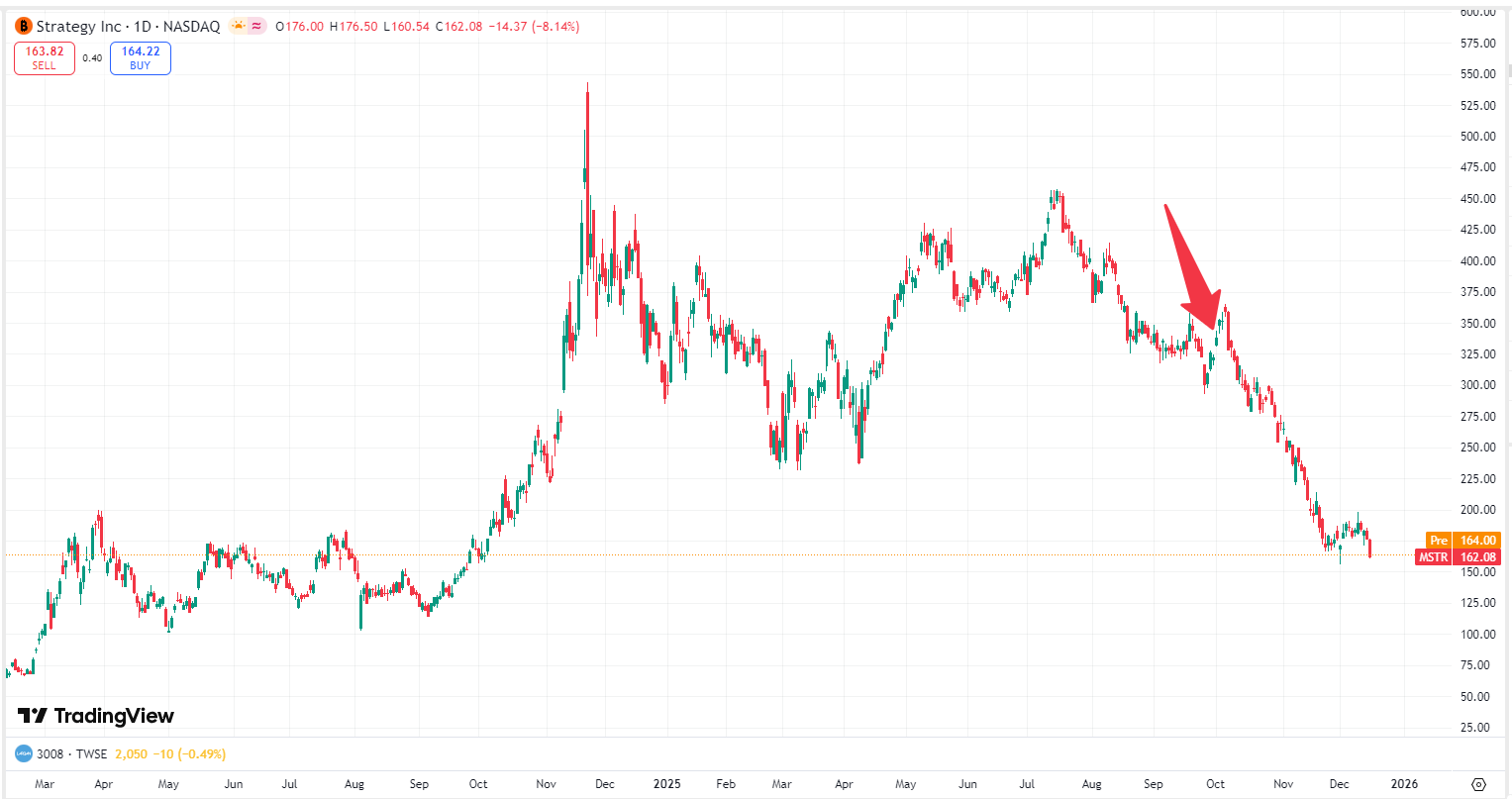 MicroStrategy Stock Price Chart, Source: TradingView.
Concurrently, other Bitcoin-related stocks have also experienced significant drawdowns, such as Marathon Holdings ( MARA) which plummeted nearly 40%, Gemini (GEMI) which fell over 60%, and Bullish (BLSH) which dropped over 50%. This sudden market upheaval has rattled investors, leading to widespread speculation and questioning: Is this the end of the current bull market, or merely a healthy technical correction? Will Bitcoin stock prices recover? Are they still worth investing in for the future? This article will thoroughly analyze the reasons behind the Bitcoin stock price crash, future market trends, and investment recommendations, to help you make informed investment decisions.
What are Bitcoin stocks?
From a narrow perspective, Bitcoin stocks refer to the shares of publicly traded companies that directly hold Bitcoin, such as MicroStrategy (MSTR), Tesla ( TSLA ), GameStop Corp (GME), and others. These companies are among the more popular Digital Asset Treasuries (DATs) this year, differing only in that they solely or primarily hold Bitcoin.
From a broad perspective, Bitcoin stocks refer to shares of publicly traded companies that do not hold Bitcoin but are involved in Bitcoin-related businesses These stocks can be further categorized into different types based on their specific Bitcoin operations, including but not limited to: Bitcoin mining stocks, Bitcoin brokerage stocks, Bitcoin exchange stocks, Bitcoin wallet stocks, and so on. Simply put, Bitcoin stocks are shares of companies involved in Bitcoin-related businesses, including holding, trading, mining, and providing a variety of services.
How do Bitcoin stocks differ from Bitcoin?
From the above, it can be seen that Bitcoin stocks have a certain correlation with Bitcoin, but they are not the same thing. So, what are the exact differences between the two?
Item | Bitcoin Stocks | Bitcoin |
Nature | Company Equity | Cryptocurrency |
Investment Object | Invests in a company's operational capabilities, financial health, and business model | Directly invests in Bitcoin |
Source of Value | Company performance, value of Bitcoin holdings, stock market environment | Scarcity, market supply and demand, crypto cycle |
Revenue Model | Stock price appreciation + potential dividends from some companies | Price appreciation, no dividends |
Trading Market | Traditional stock exchanges such as Nasdaq, NYSE | Binance ( BNB ), Coinbase ( COIN) and other cryptocurrency exchanges |
Exchange Hours | Fixed trading hours, primarily divided into three segments: 09:30-16:00 (main trading), 16:00-20:00 (after-hours trading), 04:00-09:30 (pre-market trading) | 24/7 trading |
Risk Characteristics | In addition to the inherent risks of Bitcoin, investors also bear the operational risks of the company | Severe price volatility, technical vulnerabilities, private key custody risk |
Regulation | Traditional securities regulatory framework | Crypto asset regulatory framework |
What are Bitcoin stocks?
Based on business type, Bitcoin stocks are primarily divided into four categories, predominantly listed in the United States, as follows:
Category | Core Business and Characteristics | Representative Cases |
Bitcoin DAT Stocks | Directly Hold Bitcoin | MicroStrategy (MSTR), Bullish (BLSH), Tesla (TSLA), GameStop (GME), American Bitcoin (ABTC), Galaxy Digital Holdings (GLXY), among others. |
Bitcoin Mining Stocks | Engaged in Bitcoin Mining Operations | Marathon (MARA), Riot Platforms ( RIOT ), Bit Digital (BTBT), CleanSpark ( CLSK ), Hut 8 Mining ( HUT ), Cipher Mining ( CIFR) among others. |
Bitcoin Trading Stocks | Offer Bitcoin Trading Services | Coinbase (COIN), Robinhood (HOOD), Block ( XYZ ), Gemini (GEMI), among others. |
Other Services | Primarily provide critical technological or hardware support for the Bitcoin ecosystem | Nvidia ( NVDA ), AMD |
Among these U.S. Bitcoin stocks, Bitcoin DAT stocks account for the largest number, followed by Bitcoin mining stocks. According to CoinGecko data, as of December 17, there are approximately 130 Bitcoin DAT stocks. It is important to note that a single company may have multiple business operations; for example, Coinbase not only offers trading services but also directly holds a substantial amount of Bitcoin; furthermore, Marathon (MARA) provides mining services while also holding Bitcoin.
How have Bitcoin stock prices performed?
In January 2025, following Trump's presidential inauguration, Bitcoin-related stocks generally weakened due to profit-taking, experiencing substantial pullbacks. In April 2025, Bitcoin-related stocks bottomed out and rebounded, with prices rallying higher. During August to October, these stock prices strengthened further, even breaking through historical highs.
 Stock Price Chart for Coinbase, Strategy, Marathon, etc. Source: TradingView.
On October 1st, Bitcoin's price surged to $125,000, followed by a sustained correction, which dragged down Bitcoin-related stocks, causing declines of varying degrees. Year-to-date, Strategy has fallen 44% cumulatively, Marathon Holdings is down 38%, Gemini (GEMI) has dropped 67%, and Bullish (BLSH) has decreased by 52%.
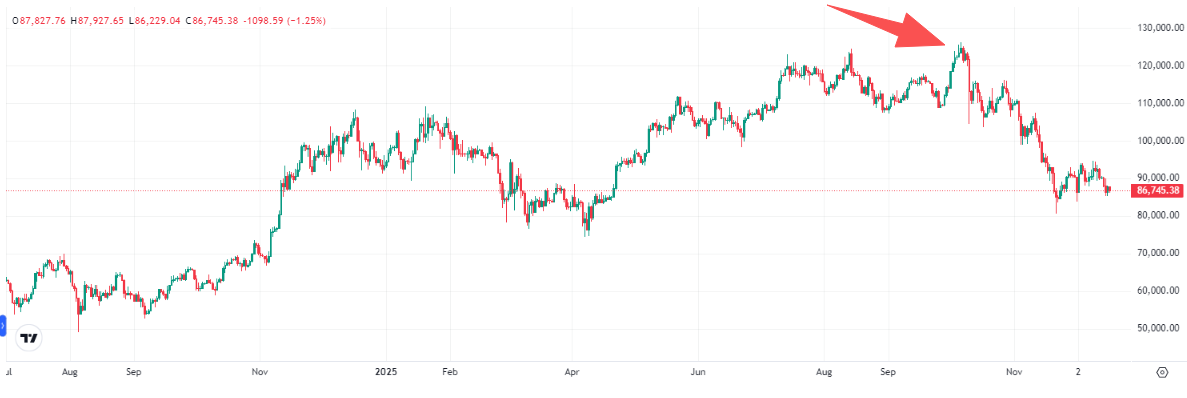 Bitcoin Price Chart. Source: TradingView.
Why Have Bitcoin Stocks Fallen So Sharply?
Although Bitcoin-related stocks are primarily U.S. equities, the three major U.S. indices have performed robustly, consistently reaching new highs. This indicates that their stock price declines are not attributable to a broader market downturn. Year-to-date, the Nasdaq Composite has surged nearly 20%, the S&P 500 has gained almost 16%, and the Dow Jones Industrial Average has risen over 13%.
After excluding broader stock market environmental factors, it can be largely concluded that the direct catalyst for the volatility in Bitcoin-related stock prices is Bitcoin itself, and the underlying logic is quite straightforward. As evident from the aforementioned sources of value, the value of these companies is primarily derived from their corporate performance and the value of their Bitcoin holdings, all of which are dependent on Bitcoin.
On October 1st, Bitcoin surged to $125,000, setting a new high, but this rally proved unsustainable, subsequently experiencing a retracement of over 30%. This completely erased its gains since 2025, leading to a cumulative decline of over 6%. Although Bitcoin's decline was not substantial, these Bitcoin-related stocks, particularly Strategy, exhibit a high leverage effect, further amplifying their losses during the downturn. A deeper underlying cause is the escalating macroeconomic pressure, which has led investors to divest from risk assets, making Bitcoin also a sell-off target.
Are Bitcoin stocks still worth investing in?
Despite significant declines observed across most Bitcoin-related stocks in 2025, individual stock prices demonstrated robust or exceptional performance. For instance, Coinbase only declined 1%, outperforming Bitcoin, while Robinhood surged over 200%, significantly leading other Bitcoin-related stocks. Both are considered high-quality assets. This indicates that, Bitcoin-related stocks providing trading services outperformed mining stocks and Digital Asset Trust (DAT) type stocks, and therefore warrant priority attention.
Although Bitcoin mining stocks, especially DAT stocks, performed relatively poorly and significantly lagged Bitcoin, they could yield outsized returns through leverage if Bitcoin's price recovers. Currently, proponents of the 'Bitcoin four-year cycle invalidation' theory widely believe that Bitcoin will break its quadrennial bear market cycle, leading to an extended bull run in the crypto market. A notable example is the crypto asset management firm Grayscale, which previously published a report forecasting Bitcoin's price to reach a new all-time high in the first half of 2026. Should Bitcoin's future price trajectory align with Grayscale's predictions, the prices of Bitcoin-related stocks are also anticipated to rebound or even establish new record highs.
Recommended Articles


