




Does Warren Buffett Know Something Wall Street Doesn't? 3 Massive Warnings From the Oracle of Omaha
Key Points
Buffett has successfully outperformed the S&P 500 for decades with his patient approach to investing.
His actions at Berkshire Hathaway paint a clear picture of the opportunities available in the market.
Buffett gave us a measuring stick for market valuations, and it's sending a clear signal today.
- 10 stocks we like better than Berkshire Hathaway ›
Warren Buffett is one of the most influential investors in history, and he has the track record to back it up. He founded Buffett Partnership Ltd. in 1956 and achieved compound annual returns exceeding 30% through the 1960s. He dissolved the partnership at the end of that decade and sent investors shares of Berkshire Hathaway (NYSE: BRK.A) (NYSE: BRK.B), of which the partnership had acquired a majority stake in the mid-1960s. Since taking over the failing textile business, Buffett has led a transformation of Berkshire and helped generate annualized returns of nearly 20% per year for six decades for anyone who held onto their Berkshire shares.
Indeed, Buffett is one of the longest-tenured and most successful investors of all time. With his time as Berkshire's CEO coming to a close, he continues to offer investment advice through both action and insight. Currently, there are three Buffett warnings about the current state of the stock market. And investors can't afford to ignore them.
Where to invest $1,000 right now? Our analyst team just revealed what they believe are the 10 best stocks to buy right now. Continue »
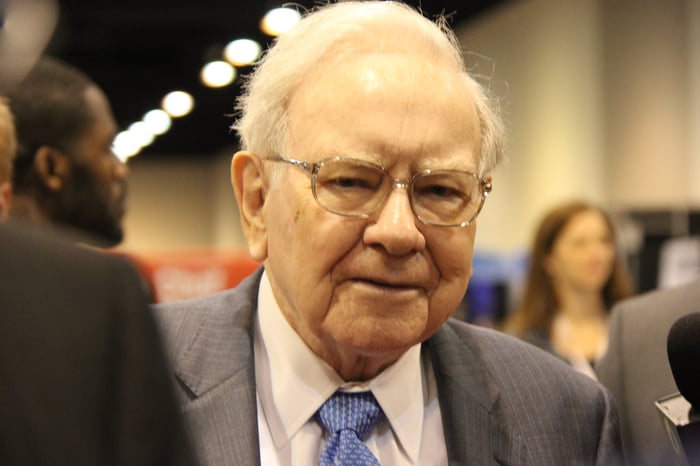
Image source: The Motley Fool.
1. Berkshire's newest record
Berkshire Hathaway set a new record for cash and cash equivalents held on its balance sheet as of the end of the third quarter. The company ended the period with $354.3 billion in cash and Treasury bills (excluding Treasuries payable and cash for the railroad business).
That's especially notable because Berkshire Hathaway's marketable equity portfolio is worth about $314.5 billion, as of this writing. In other words, Berskshire is holding more cash than stocks right now.
Berkshire got to this point because it has been selling some of the company's largest holdings, including shares of Apple and Bank of America. Both have seen their stock prices climb considerably over the last few years, and Buffett and his team may think their stock prices have become stretched relative to their underlying financials. Berkshire likely also sees an opportunity to capitalize on low corporate tax rates. At the same time, new stock purchases have been few and far between. And with $354 billion to invest, Buffett and his team have only a handful of options to put significant portions of that cash pile to work.
The lack of significant stock purchases, combined with the sale of his largest positions, is a warning from Buffett and his team that most stocks, especially large companies, are currently overvalued.
2. Buffett doesn't even want to buy his favorite stock
Berkshire Hathaway used to have a strict share repurchase policy that didn't allow it to buy back shares above a certain valuation. However, the board of directors eliminated that restriction in 2018, allowing Buffett to buy shares of Berkshire Hathaway when he believed the stock was trading below its intrinsic value. He made a habit of buying back shares nearly every quarter since.
But Buffett hasn't authorized a share repurchase since early 2024. As we know, it's not as if Berkshire doesn't have the cash available to retire its shares. Instead, it's an admission from Buffett that even Berkshire stock itself isn't an attractive investment right now.
That suggests Buffett doesn't just see the high-flying growth stocks that have come to dominate the market over the last few years as expensive. Even the stalwart value stock that is Berkshire Hathaway is pricey in today's market. That said, Berkshire holds several expensive stocks in its marketable equity portfolio, including Apple, which may be inflating its book value.
The fact that Buffett thinks Berkshire Hathaway stock is currently overvalued is emblematic of the market as a whole. Many stocks with limited exposure to the biggest growth trends have seen their prices bid up despite no fundamental earnings catalysts.
3. "Playing with fire"
In a 2001 article for Fortune Magazine, Buffett discussed one of his favorite market indicators for determining whether stocks are overvalued. It takes the combined market cap of the country's businesses divided by the gross national product. It's since been dubbed the Buffett indicator.
"The ratio has certain limitations in telling you what you need to know. Still, it is probably the best single measure of where valuations stand at any given moment," Buffett wrote. He noted that if the ratio approaches 200%, as it did during the dot-com bubble, "you are playing with fire." The current ratio stands around 223%.
There are a handful of reasons why the ratio should be higher now than it has historically been, including lower interest rates and increased investment in U.S. stocks from both U.S. and foreign households. Offsetting those factors are things like more big U.S. companies staying private for longer. As a result, stocks appear extremely expensive at present, based on the Buffett indicator.
Combined with the actions Buffett has taken at Berkshire Hathaway, it's clear Buffett -- who's stepping down as Berkshire Hathaway CEO at the end of this month -- sees very few opportunities for great returns in the current market. Investors should heed the warning by curbing their expectations and diligently researching potential investments to ensure good value. Buffett's investments have performed best while the market struggles to move forward, as his patience is rewarded. Following his approach could lead to similar results for readers going forward.
Should you invest $1,000 in Berkshire Hathaway right now?
Before you buy stock in Berkshire Hathaway, consider this:
The Motley Fool Stock Advisor analyst team just identified what they believe are the 10 best stocks for investors to buy now… and Berkshire Hathaway wasn’t one of them. The 10 stocks that made the cut could produce monster returns in the coming years.
Consider when Netflix made this list on December 17, 2004... if you invested $1,000 at the time of our recommendation, you’d have $540,587!* Or when Nvidia made this list on April 15, 2005... if you invested $1,000 at the time of our recommendation, you’d have $1,118,210!*
Now, it’s worth noting Stock Advisor’s total average return is 991% — a market-crushing outperformance compared to 195% for the S&P 500. Don’t miss out on the latest top 10 list, available when you join Stock Advisor.
See the 10 stocks »
*Stock Advisor returns as of December 1, 2025
Bank of America is an advertising partner of Motley Fool Money. Adam Levy has positions in Apple. The Motley Fool has positions in and recommends Apple and Berkshire Hathaway. The Motley Fool has a disclosure policy.
Recommended Articles


