




Where Will Centrus Energy Be in 5 Years?
Key Points
Centrus Energy operates across the nuclear supply chain, primarily focusing on providing low-enriched uranium and enrichment services.
The company is the only U.S. entity licensed to produce high-assay, low-enriched uranium (HALEU), crucial for next-generation reactors.
Centrus outsources its uranium, but it is focusing on building out its Piketon, Ohio, plant to meet demand and secure U.S. domestic production.
- 10 stocks we like better than Centrus Energy ›
As artificial intelligence (AI) becomes more mainstream, its insatiable energy demand will reshape global infrastructure priorities. Nuclear energy, which is scalable, carbon-free, and geopolitically resilient, is emerging as one key component of this transformation.
Unlike intermittent renewables, nuclear offers the baseload stability needed to power AI data centers and advanced manufacturing. At the same time, reshoring crucial supply chains, like uranium enrichment sources and reactor components, has become a strategic imperative for national security.
Where to invest $1,000 right now? Our analyst team just revealed what they believe are the 10 best stocks to buy right now, when you join Stock Advisor. See the stocks »
This is where Centrus Energy's (NYSEMKT: LEU) opportunity lies. The company operates across the nuclear and uranium supply chain and could emerge as a key player in helping the U.S. reshore and strengthen its nuclear position.
However, it has its work cut out for it over the next several years. If you're thinking of buying Centrus Energy stock today, here's what the next five years have in store for it.
What Centrus Energy does
Centrus Energy supplies nuclear fuel components and provides enrichment and technical services for customers.
Its low-enriched uranium (LEU) segment accounts for the majority of the company's revenue. In this segment, it sells LEU, the fissile component of most nuclear fuel, to utilities that operate commercial nuclear power plants. To meet its delivery obligations to customers, the company procures uranium and related products from overseas suppliers.
In its technical solutions segment, it provides advanced uranium enrichment for the nuclear industry and the U.S. government, along with advanced manufacturing, engineering, and other technical services to both government and private sector customers. A significant portion of this segment's revenue is derived from the high-assay, low-enriched uranium (HALEU) operation contract with the Department of Energy.
One thing investors should keep in mind is that there are currently no commercially active HALEU reactors. The only HALEU reactors are test reactors, and these may not be operational until the late 2020s or early 2030s.
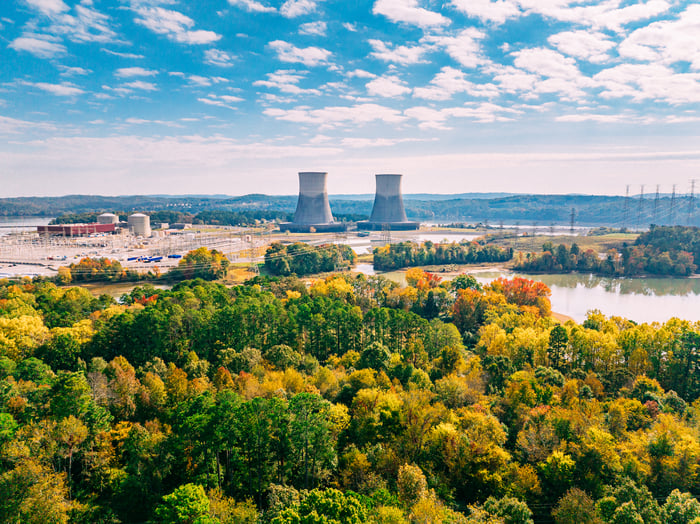
Image source: Getty Images.
Centrus has this major advantage
Centrus Energy is the only Nuclear Regulatory Commission (NRC) licensed producer of HALEU for both commercial and national security applications, and it's the only company known to produce HALEU outside of Russia. This position is vital because it will be a necessary fuel for next-generation nuclear reactors.
Centrus is also the only American company with a proven enrichment technology capable of meeting both commercial and national security needs, making it a crucial piece in the domestic nuclear supply chain. Stifel analysts say that it is "uniquely positioned" to rebuild the nuclear enrichment supply chain.
Here's what the next five years have in store
The first thing that will affect Centrus and others in the nuclear industry is the U.S. ban on Russian LEU imports. This ban, which took effect in August 2024, will be fully phased in by 2028, when waivers allowing limited Russian deliveries expire. This creates a significant need to replace about 25% of enriched uranium currently imported from Russia.
The company has two commercial agreements to sell LEU, one of which is with Texex, a Russian entity. In the long term, Centrus aims to produce LEU and HALEU in-house using its advanced centrifuge technology. To do this, it will need to expand the uranium enrichment capacity at its Piketon, Ohio, plant.
This expansion hinges on Energy Department funding, private investment, and long-term customer commitments. If successful, Centrus could transition from reseller to a producer, reducing dependence on foreign enrichment.
It projects the first new production cascade (which is a series of centrifuges used to enrich uranium) at Piketon to be operational in 42 months, or three and a half years, after the necessary government funds and commercial commitments are officially secured and the build-out is fully mobilized. After that, the second cascade will take six months, and each successive cascade will take two-month increments.

Image source: Getty Images.
This could be significant because HALEU is widely viewed as a cornerstone fuel for the next generation of advanced nuclear reactors. That's because it allows for more-compact reactor cores, higher efficiency, longer refueling cycles, and greater design flexibility compared to today's standard LEU. This makes it especially promising for small modular reactors, micro-reactors, and advanced fast designs that aim to deliver safer, more flexible, and more cost-competitive nuclear energy.
A few companies are developing HALEU or HALEU-capable reactor designs, including TerraPower, Kairos Power, Westinghouse Electric, and Oklo. Related to this, Centrus has an agreement with TerraPower to explore collaboration aimed at ensuring HALEU supply for the latter's Natrium demonstration reactor, which is scheduled to begin operation in 2030.
A nuclear stock worth monitoring
Centrus has a strong position in the nuclear supply chain. But, developing its Piketon plant will require significant time and investment, and that will depend on securing the necessary funding and actually completing the work.
On top of that, its shares have become expensive, priced at 101 times this year's projected earnings per share. While the valuation has me hesitant about buying the stock right now, I believe nuclear power is the future, and Centrus Energy could be an important player, which is why I'm keeping a close eye on this stock.
Should you invest $1,000 in Centrus Energy right now?
Before you buy stock in Centrus Energy, consider this:
The Motley Fool Stock Advisor analyst team just identified what they believe are the 10 best stocks for investors to buy now… and Centrus Energy wasn’t one of them. The 10 stocks that made the cut could produce monster returns in the coming years.
Consider when Netflix made this list on December 17, 2004... if you invested $1,000 at the time of our recommendation, you’d have $646,805!* Or when Nvidia made this list on April 15, 2005... if you invested $1,000 at the time of our recommendation, you’d have $1,123,113!*
Now, it’s worth noting Stock Advisor’s total average return is 1,055% — a market-crushing outperformance compared to 189% for the S&P 500. Don’t miss out on the latest top 10 list, available when you join Stock Advisor.
See the 10 stocks »
*Stock Advisor returns as of October 20, 2025
Courtney Carlsen has no position in any of the stocks mentioned. The Motley Fool has no position in any of the stocks mentioned. The Motley Fool has a disclosure policy.
Recommended Articles


