



US yields slip as Powell signals patience, US Dollar pulls back from highs

Source Fxstreet
  • Treasury yields ease after Powell says Fed can be patient and policy remains appropriate.
  • DXY edges down to 99.51 after peaking at 99.63; Greenback under pressure from falling yields.
  • Powell warns tariffs may hinder progress on Fed’s goals, adding to uncertainty over policy path.

The US Treasury yields edged lower across the whole curve, down an average of two and a half to three basis points so far after plunging over seven basis points earlier. However, as Fed Chair Powell answered a question regarding the Fed leaning towards one side of the dual mandate, he said that it is too early to predict.

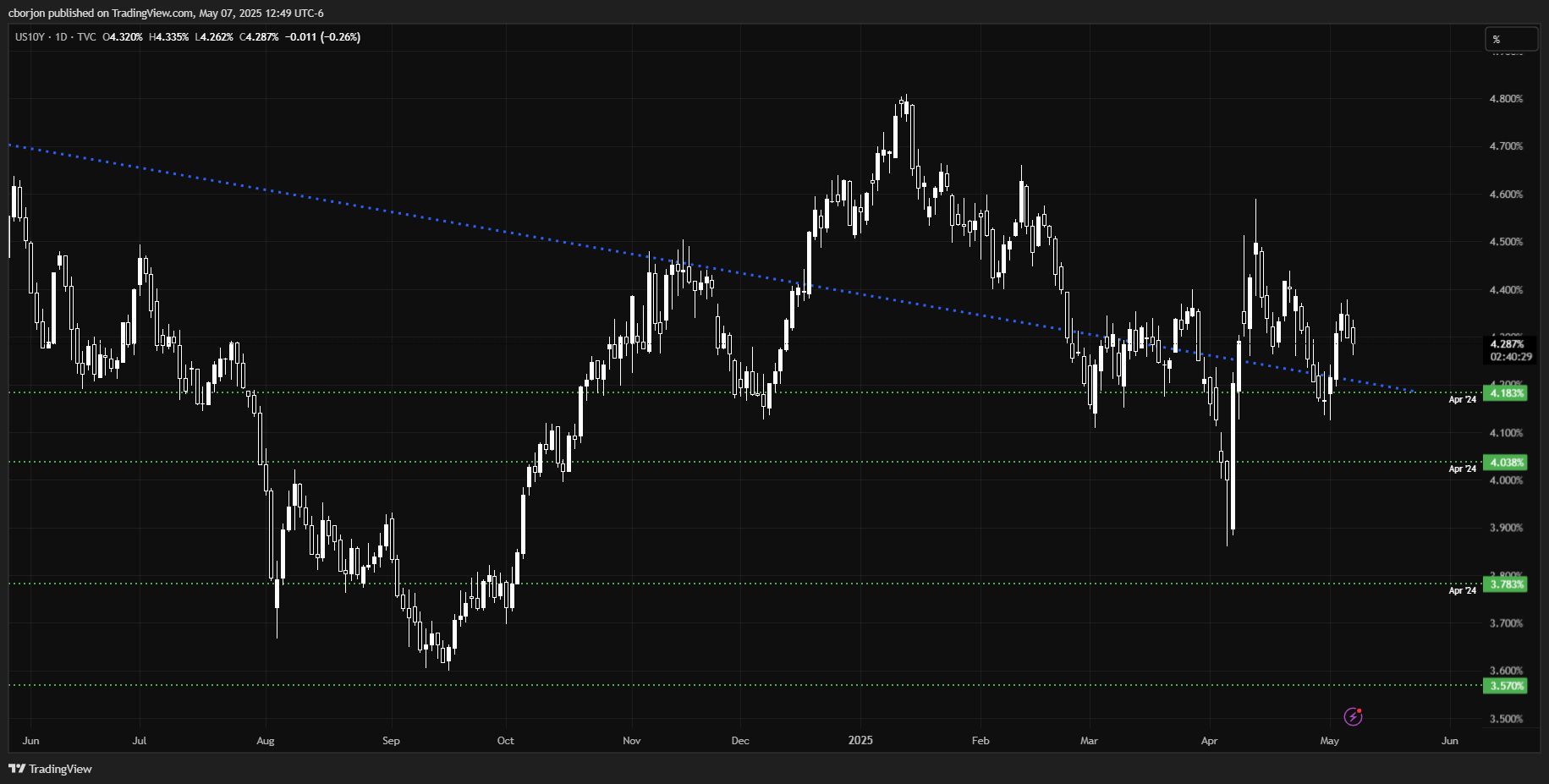
10-year yield falls to 4.27% after Chair Powell downplays urgency for action

The US 10-year Treasury yield falls two and a half basis points to 4.271% at the time of writing, weighing on the Greenback, which has so far retreated from daily highs of 99.63, as depicted by the US Dollar Index (DXY).

The DXY, which tracks the performance of the buck’s value against a basket of currencies, is at 99.51 up 0.12%.

The Fed Chair, Jerome Powell, said that the Fed is in no hurry and can be patient. He noted that current monetary policy is appropriate and that if things develop, “we can move quickly as appropriate.” Powell added, “We won’t make progress on our goals this year if tariffs remain.”

US 10-year yield daily chart
Fed FAQs

Monetary policy in the US is shaped by the Federal Reserve (Fed). The Fed has two mandates: to achieve price stability and foster full employment. Its primary tool to achieve these goals is by adjusting interest rates. When prices are rising too quickly and inflation is above the Fed’s 2% target, it raises interest rates, increasing borrowing costs throughout the economy. This results in a stronger US Dollar (USD) as it makes the US a more attractive place for international investors to park their money. When inflation falls below 2% or the Unemployment Rate is too high, the Fed may lower interest rates to encourage borrowing, which weighs on the Greenback.

The Federal Reserve (Fed) holds eight policy meetings a year, where the Federal Open Market Committee (FOMC) assesses economic conditions and makes monetary policy decisions. The FOMC is attended by twelve Fed officials – the seven members of the Board of Governors, the president of the Federal Reserve Bank of New York, and four of the remaining eleven regional Reserve Bank presidents, who serve one-year terms on a rotating basis.

In extreme situations, the Federal Reserve may resort to a policy named Quantitative Easing (QE). QE is the process by which the Fed substantially increases the flow of credit in a stuck financial system. It is a non-standard policy measure used during crises or when inflation is extremely low. It was the Fed’s weapon of choice during the Great Financial Crisis in 2008. It involves the Fed printing more Dollars and using them to buy high grade bonds from financial institutions. QE usually weakens the US Dollar.

Quantitative tightening (QT) is the reverse process of QE, whereby the Federal Reserve stops buying bonds from financial institutions and does not reinvest the principal from the bonds it holds maturing, to purchase new bonds. It is usually positive for the value of the US Dollar.

Disclaimer: For information purposes only. Past performance is not indicative of future results.
placeholder
US Dollar's Decline Predicted in 2026: Morgan Stanley's Outlook on Currency VolatilityMorgan Stanley forecasts a 5% drop in the dollar by mid-2026, attributed to continued Fed rate cuts. A recovery may follow as growth improves and funding currency dynamics shift favorably toward the euro and Swiss franc.
Author  Mitrade
Nov 25, Tue
Morgan Stanley forecasts a 5% drop in the dollar by mid-2026, attributed to continued Fed rate cuts. A recovery may follow as growth improves and funding currency dynamics shift favorably toward the euro and Swiss franc.
placeholder
Gold's Historic 2025 Rally: Can the Momentum Last Through 2026?Following a historic surge in 2025 that saw prices climb over 60% and break records more than 50 times, gold investors are now looking ahead to assess whether the precious metal can sustain its momentum into 2026. Despite outperforming most major asset classes and heading for its best annual performance since 1979, analysts are divided on the outlook—with some seeing further room for gains and others cautioning that risks are rising.
Author  Mitrade
Dec 09, Tue
Following a historic surge in 2025 that saw prices climb over 60% and break records more than 50 times, gold investors are now looking ahead to assess whether the precious metal can sustain its momentum into 2026. Despite outperforming most major asset classes and heading for its best annual performance since 1979, analysts are divided on the outlook—with some seeing further room for gains and others cautioning that risks are rising.
placeholder
Oracle's Weak Earnings Prompt Concerns Over AI Spending, Pressuring Nvidia and Industry RivalsOracle's disappointing earnings and soaring expenses have raised fears about AI spending sustainability, causing Nvidia and other related stocks to decline amidst heightened competition and concerns over mounting debt.
Author  Mitrade
Dec 11, Thu
Oracle's disappointing earnings and soaring expenses have raised fears about AI spending sustainability, causing Nvidia and other related stocks to decline amidst heightened competition and concerns over mounting debt.
placeholder
Asian Stocks Retreat as Tech Woes and China's Economic Concerns Weigh HeavyMost Asian markets fell on Monday, led by declining technology shares amid weak U.S. earnings guidance. Chinese stocks showed relative resilience, but wider economic fears suggest increased stimulus pressures.
Author  Mitrade
5 hours ago
Most Asian markets fell on Monday, led by declining technology shares amid weak U.S. earnings guidance. Chinese stocks showed relative resilience, but wider economic fears suggest increased stimulus pressures.
placeholder
XRP Spot ETFs Notch 30 Straight Days of Inflows, Bucking Wider Crypto TrendSince their debut on November 13, U.S.-listed spot exchange-traded funds (ETFs) for XRP have recorded net inflows for 30 consecutive trading days, a steady performance that stands in contrast to the more volatile flows seen in larger bitcoin and ether funds.
Author  Mitrade
3 hours ago
Since their debut on November 13, U.S.-listed spot exchange-traded funds (ETFs) for XRP have recorded net inflows for 30 consecutive trading days, a steady performance that stands in contrast to the more volatile flows seen in larger bitcoin and ether funds.
Related Instrument
goTop
quote