




Dow Jones Industrial Average breaks higher after US CPI beat
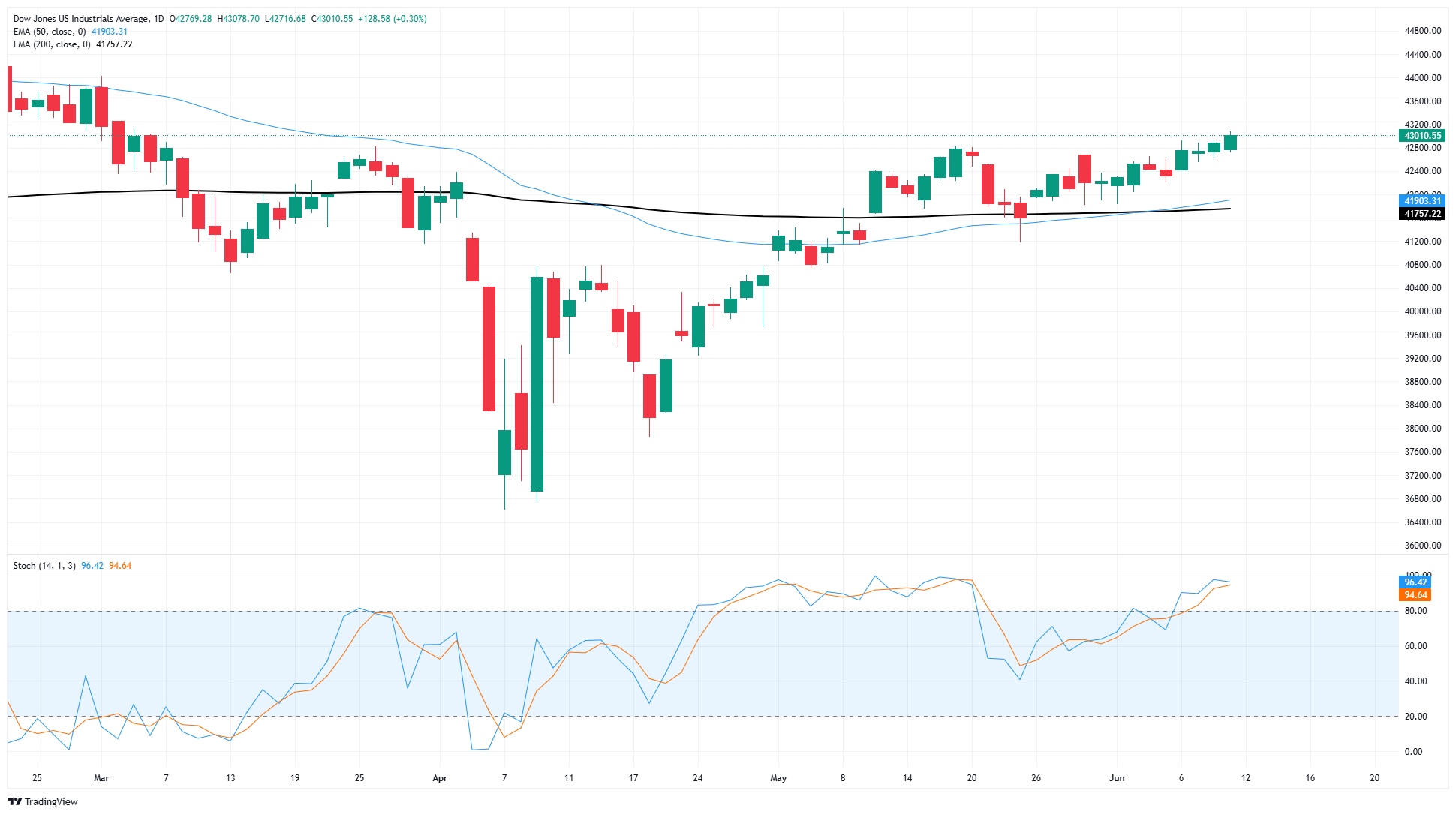
- The Dow Jones is testing above the 43,000 level for the first time since February.
- US CPI inflation came in cooler than expected, boosting investor hopes for Fed rate cuts.
- Trade tensions with China are easing after delegates from both sides reached a consensus.
The Dow Jones Industrial Average (DJIA) rose on Wednesday, bolstered by cooler-than-expected Consumer Price Index (CPI) inflation data for May, as well as a tentative trade policy framework following two days of trade talks in London. The framework still needs final approval from both President Donald Trump and Chinese President Xi Jinping; however, markets are hopeful that the progress will see both sides continuing to ease off from recent trade war rhetoric.
CPI inflation in May broadly came in below expectations, helping to bolster broad-market investor sentiment. Still, there are some glaring price volatility difficulties facing policymakers through the remainder of the year. Headline CPI inflation still rose on an annualized basis, ticking up to 2.4% YoY, and core CPI inflation excluding volatile food and energy prices held steady at 2.8% YoY. The figures are still well above the Federal Reserve’s (Fed) 2% annual inflation target, but investors are still banking on increased odds of a Fed rate cut in September. According to the CME’s FedWatch Tool, the odds of at least a quarter-point rate trim at the Fed’s September rate call have risen to nearly 70%.
After two days of private trade talks held in London, delegates from the Trump administration and the Chinese government have reached a preliminary trade policy framework, which now heads to the respective desks of Presidents Trump and Xi. According to social media posts by President Trump, tariffs on Chinese goods are being held at 55%, with China maintaining its 10% import tax on all American-made goods.
Dow Jones price forecast
The Dow Jones Industrial Average has finally broken back above the 43,000 major price handle after months of tariff doldrums. Bullish investor sentiment has boosted the Dow Jones into 14-week highs, and has put the DJIA back on track to taking a fresh run at record highs above 45,000.
Despite technical oscillators firmly pinned in overbought territory, the Dow Jones continues to drift higher, with the major equity index for all but four of the last 12 straight trading sessions. The DJIA is trading well north of the 200-day Exponential Moving Average (EMA) near 41,775, and bidders will be looking to price in a fresh technical floor at the old swing high point near 42,600.
Dow Jones daily chart
Dow Jones FAQs
The Dow Jones Industrial Average, one of the oldest stock market indices in the world, is compiled of the 30 most traded stocks in the US. The index is price-weighted rather than weighted by capitalization. It is calculated by summing the prices of the constituent stocks and dividing them by a factor, currently 0.152. The index was founded by Charles Dow, who also founded the Wall Street Journal. In later years it has been criticized for not being broadly representative enough because it only tracks 30 conglomerates, unlike broader indices such as the S&P 500.
Many different factors drive the Dow Jones Industrial Average (DJIA). The aggregate performance of the component companies revealed in quarterly company earnings reports is the main one. US and global macroeconomic data also contributes as it impacts on investor sentiment. The level of interest rates, set by the Federal Reserve (Fed), also influences the DJIA as it affects the cost of credit, on which many corporations are heavily reliant. Therefore, inflation can be a major driver as well as other metrics which impact the Fed decisions.
Dow Theory is a method for identifying the primary trend of the stock market developed by Charles Dow. A key step is to compare the direction of the Dow Jones Industrial Average (DJIA) and the Dow Jones Transportation Average (DJTA) and only follow trends where both are moving in the same direction. Volume is a confirmatory criteria. The theory uses elements of peak and trough analysis. Dow’s theory posits three trend phases: accumulation, when smart money starts buying or selling; public participation, when the wider public joins in; and distribution, when the smart money exits.
There are a number of ways to trade the DJIA. One is to use ETFs which allow investors to trade the DJIA as a single security, rather than having to buy shares in all 30 constituent companies. A leading example is the SPDR Dow Jones Industrial Average ETF (DIA). DJIA futures contracts enable traders to speculate on the future value of the index and Options provide the right, but not the obligation, to buy or sell the index at a predetermined price in the future. Mutual funds enable investors to buy a share of a diversified portfolio of DJIA stocks thus providing exposure to the overall index.
Recommended Articles


