




US Dollar is resilient on Fed caution, strong service sector data
- The US Dollar Index trades above 104.00 early Monday.
- Composite PMI shows accelerating growth in March.
- Fed’s Bostic warns of lingering economic uncertainty.
- Greenback is still recovering from recent multi-month lows.
The US Dollar Index (DXY), which measures the value of the US Dollar against a basket of currencies, held its upward momentum on Monday, tallying a four-day recovery. Strong S&P Services PMI as well as caution from Atlanta Federal Reserve President Raphael Bostic is benefiting the buck.
Daily digest market movers: US Dollar rises as economic signals clash with Fed caution
- S&P Global Composite PMI rose sharply, showing improved economic momentum in March, led by robust service sector growth.
- Manufacturing PMI disappointed, slipping into contraction territory below 50 and falling short of market expectations.
- Services PMI exceeded forecasts, offering optimism about consumer demand and economic resilience as it rose to 54.
- Atlanta Fed President Raphael Bostic emphasized ongoing uncertainty, stating that inflation progress may be slower than previously projected.
- Bostic trimmed his 2025 rate cut expectations, citing persistent price pressure and trade-related risks.
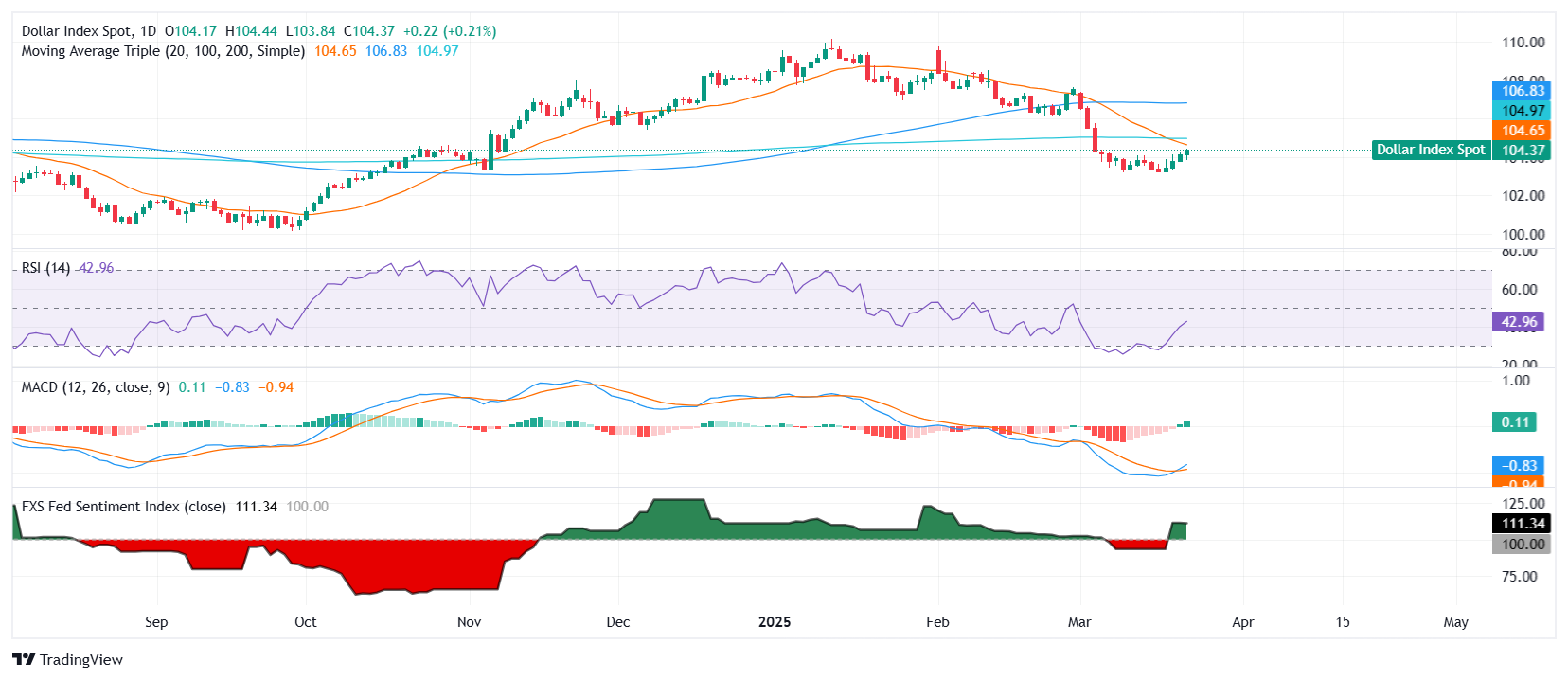
- On the DXY's daily chart the Fed's sentiment index has significantly rise above hawkish territory which also add momentum to the USD.
- US trade tensions were flagged as a concern with Bostic noting their potential drag on monetary policy decisions.
Technical analysis: DXY shows signs of base building
The US Dollar Index has marked a four-day winning streak, though the rally has stalled just below the 104.00 threshold. The Relative Strength Index (RSI) continues to climb gradually, while the Moving Average Convergence Divergence (MACD) histogram narrows, indicating reduced bearish momentum.
Key resistance lies at 104.20, with additional levels at 104.80 and 105.20, while support remains firm at 103.40, followed by 102.90.
A bearish crossover between the 20-day and 100-day Simple Moving Averages (SMA) near 105.00 adds to technical caution and may be interpreted as a sell signal. However, the DXY index appears poised to recover further from its March lows, supported by improving service sector strength.
Fed FAQs
Monetary policy in the US is shaped by the Federal Reserve (Fed). The Fed has two mandates: to achieve price stability and foster full employment. Its primary tool to achieve these goals is by adjusting interest rates. When prices are rising too quickly and inflation is above the Fed’s 2% target, it raises interest rates, increasing borrowing costs throughout the economy. This results in a stronger US Dollar (USD) as it makes the US a more attractive place for international investors to park their money. When inflation falls below 2% or the Unemployment Rate is too high, the Fed may lower interest rates to encourage borrowing, which weighs on the Greenback.
The Federal Reserve (Fed) holds eight policy meetings a year, where the Federal Open Market Committee (FOMC) assesses economic conditions and makes monetary policy decisions. The FOMC is attended by twelve Fed officials – the seven members of the Board of Governors, the president of the Federal Reserve Bank of New York, and four of the remaining eleven regional Reserve Bank presidents, who serve one-year terms on a rotating basis.
In extreme situations, the Federal Reserve may resort to a policy named Quantitative Easing (QE). QE is the process by which the Fed substantially increases the flow of credit in a stuck financial system. It is a non-standard policy measure used during crises or when inflation is extremely low. It was the Fed’s weapon of choice during the Great Financial Crisis in 2008. It involves the Fed printing more Dollars and using them to buy high grade bonds from financial institutions. QE usually weakens the US Dollar.
Quantitative tightening (QT) is the reverse process of QE, whereby the Federal Reserve stops buying bonds from financial institutions and does not reinvest the principal from the bonds it holds maturing, to purchase new bonds. It is usually positive for the value of the US Dollar.
Recommended Articles


