




Gold retreats slightly as US Dollar rebounds
- Gold trades with a mild positive bias but struggles to extend gains as the US Dollar rebounds.
- Fed easing expectations for 2026 remain in focus after softer US labour market signals
- On the technical front, XAU/USD remains in a bullish structure but is consolidating below the 4,350 resistance zone.
Gold (XAU/USD) trades with a mild positive bias on Wednesday but struggles to build on early gains, as a rebound in the US Dollar (USD) caps upside momentum. At the time of writing, XAU/USD is trading around $4,315, easing back after briefly touching $4,342 during the early European session.
Despite the range-bound price action seen so far this week, the broader bias for the yellow metal remains constructive, as a dovish Federal Reserve outlook and persistent geopolitical risks help limit downside attempts.
Market expectations continue to tilt toward further monetary easing by the Federal Reserve (Fed) in 2026 after Tuesday’s delayed US jobs data reinforced concerns about a cooling labour market, with attention now turning to Thursday’s Consumer Price Index (CPI) report.
The US economic calendar is relatively light on Wednesday, investors will parse comments from key FOMC members for additional clues on the Fed’s monetary policy path next year.
Market movers: US jobs data reinforce Fed easing expectations; geopolitical risks resurface
- The US Dollar Index (DXY), which tracks the Greenback against a basket of six major currencies, is trading around 98.50, extending its rebound after briefly slipping below 98.00 on Tuesday, its lowest level since October 3.
- Data from the US Bureau of Labor Statistics (BLS) showed that the US economy added 64,000 jobs in November, slightly above market expectations for a 50,000 increase, after payrolls fell by 105,000 in October due to the government shutdown. Meanwhile, the Unemployment Rate rose to 4.6%, above expectations of 4.4%, marking its highest level since September 2021.
- The report also showed that US payrolls were revised down by a combined 33,000 over August and September, echoing remarks from Fed Chair Jerome Powell, who warned at last week’s post-meeting press conference that job gains since April may have been overstated by around 60,000.
- Overall, the employment data suggest that the US labour market continues to cool. While November’s payroll gain came in slightly better than expected, the broader picture remains soft, with slower job creation, rising unemployment and easing wage growth. The data reinforce expectations that the Fed has room to ease policy, with markets currently pricing in two rate cuts next year.
- Geopolitical tensions are back in focus after earlier optimism around progress in US-led Russia-Ukraine peace talks was overshadowed by fresh developments, with reports that US President Donald Trump ordered a blockade of sanctioned Oil tankers entering and leaving Venezuela.
Technical analysis: XAU/USD consolidates below 4,350 resistance
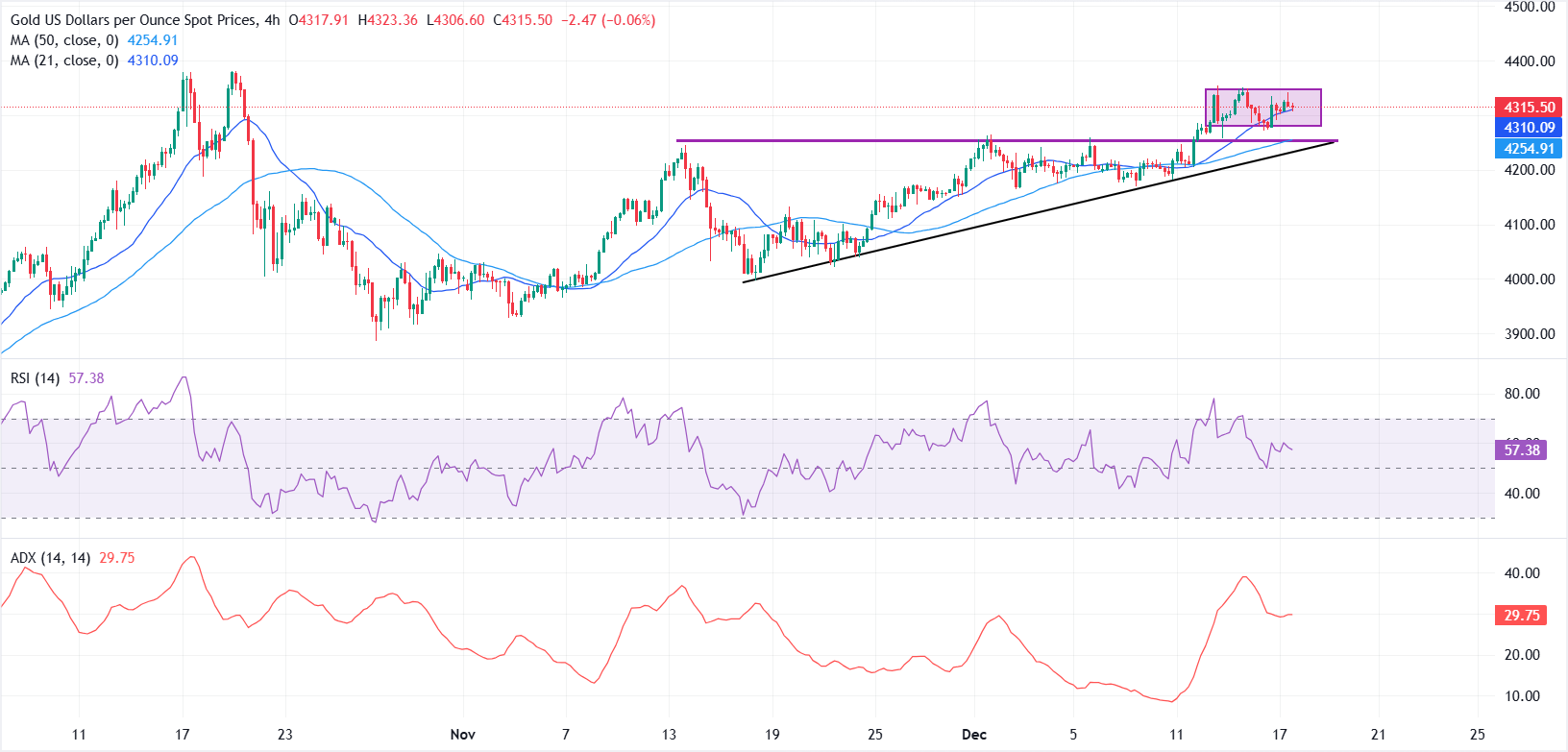
From a technical perspective, XAU/USD remains constructive after breaking above the $4,250 level, though near-term upside appears capped around $4,350, leaving prices vulnerable to a period of consolidation.
On the 4-hour chart, XAU/USD continues to trade within an ascending structure, supported by a rising trendline drawn from the mid-November lows near $4,000.
The 21-period SMA, currently around $4,310, offers immediate dynamic support, followed by a stronger support zone near $4,250, where the 50-period SMA converges.
On the upside, a decisive break above the $4,350 region would be needed to clear near-term resistance and open the door for a retest of record highs and potentially further gains.
The Relative Strength Index (RSI) is holding near 58, remaining in neutral-to-bullish territory above its midline. Meanwhile, the Average Directional Index (ADX) at around 29.75 suggests the broader trend remains intact, though some cooling in momentum implies consolidation could precede the next directional move.
Gold FAQs
Gold has played a key role in human’s history as it has been widely used as a store of value and medium of exchange. Currently, apart from its shine and usage for jewelry, the precious metal is widely seen as a safe-haven asset, meaning that it is considered a good investment during turbulent times. Gold is also widely seen as a hedge against inflation and against depreciating currencies as it doesn’t rely on any specific issuer or government.
Central banks are the biggest Gold holders. In their aim to support their currencies in turbulent times, central banks tend to diversify their reserves and buy Gold to improve the perceived strength of the economy and the currency. High Gold reserves can be a source of trust for a country’s solvency. Central banks added 1,136 tonnes of Gold worth around $70 billion to their reserves in 2022, according to data from the World Gold Council. This is the highest yearly purchase since records began. Central banks from emerging economies such as China, India and Turkey are quickly increasing their Gold reserves.
Gold has an inverse correlation with the US Dollar and US Treasuries, which are both major reserve and safe-haven assets. When the Dollar depreciates, Gold tends to rise, enabling investors and central banks to diversify their assets in turbulent times. Gold is also inversely correlated with risk assets. A rally in the stock market tends to weaken Gold price, while sell-offs in riskier markets tend to favor the precious metal.
The price can move due to a wide range of factors. Geopolitical instability or fears of a deep recession can quickly make Gold price escalate due to its safe-haven status. As a yield-less asset, Gold tends to rise with lower interest rates, while higher cost of money usually weighs down on the yellow metal. Still, most moves depend on how the US Dollar (USD) behaves as the asset is priced in dollars (XAU/USD). A strong Dollar tends to keep the price of Gold controlled, whereas a weaker Dollar is likely to push Gold prices up.
Recommended Articles


