




EUR/USD climbs above 1.1740 as risk appetite pressures Dollar, ECB in focus
- EUR/USD holds firm above 1.1704 SMA, hitting daily high at 1.1747.
- US delays EU trade progress; deal with Philippines offers limited Dollar support.
- ECB seen holding rates on July 24 as inflation nears target and trade risks persist.
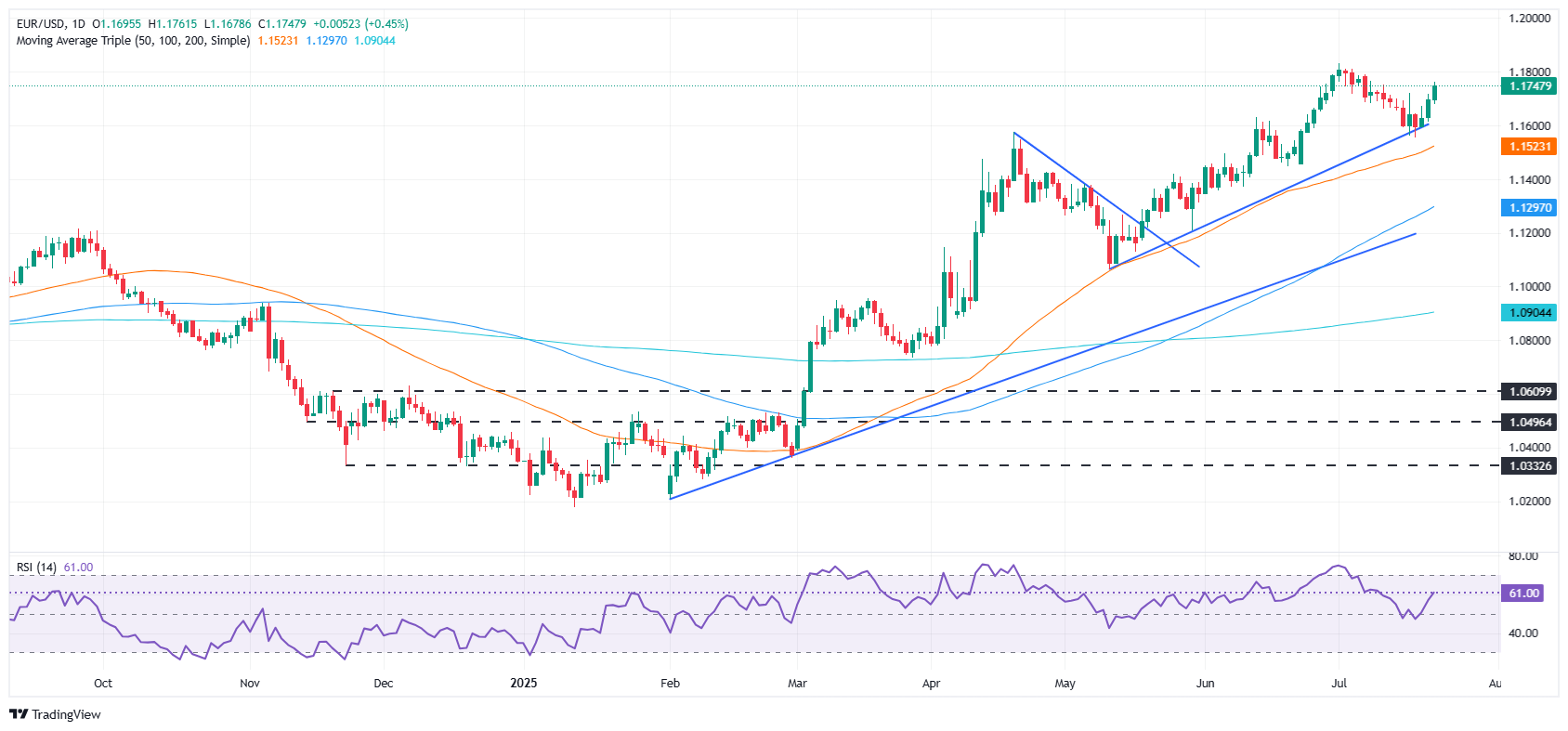
EUR/USD remains above the 20-day Simple Moving Average (SMA) of 1.1704, trading with gains of over 0.50% due to an improvement in risk appetite weighing on the US Dollar, even though fears that the European Union (EU) and the United States (US) might fail to reach a deal before the August 1 deadline. The pair trades at 1.1747 after hitting a daily low of 1.1678.
The financial markets narrative has remained unchanged for over 24 hours. US equities ended the session mixed. Trade news from the US continued to grab the headlines, with the US announcing a deal with the Philippines, but it has not revealed an advance with the EU.
US Treasury Secretary Scott Bessent said that the White House is more concerned with the quality of the deals than their timing. When asked about extending the deadline, he said it would be up to Donald Trump to decide.
Meanwhile, EU leaders will meet with their Japanese and Chinese counterparts this week, according to Bloomberg. Themes to discuss would focus on defense and trade cooperation with Japan, with limited hopes for discussions in Beijing.
Traders are eyeing the European Central Bank (ECB) monetary policy decision on July 24, in which the central bank is expected to hold rates unchanged as inflation is near target, and trade risks are still evolving.
This week, the EU’s economic docket will feature Consumer Confidence, Flash PMIs for July, and the European Central Bank (ECB) monetary policy decision. Across the pond, the US schedule will announce US housing data, S&P Global Flash PMIs, Initial Jobless Claims, and Durable Goods Orders.
Daily digest market movers: EUR/USD climbs on broad USD weakness
- The US Dollar Index (DXY), which tracks the buck's value against a basket of six currencies, drops 0.46% to 97.39, boosting the Euro’s advance against the former.
- Last week’s US economic data delivered a mixed picture. While consumer sentiment improved, inflation accelerated in June, with the Consumer Price Index (CPI) nearing the 3% mark. The Producer Price Index (PPI) showed some signs of easing, but a robust Retail Sales report highlighted the continued resilience of American consumers, despite the ongoing rise in prices.
- Some EU diplomats said the bloc is exploring a set of retaliatory measures against the US if an agreement fails to materialize. These measures include digital services, aerospace products, and bourbon. This wouldn’t offset the impact from the 30% tariff rate threatened by US President Donald Trump.
- The odds of the ECB keeping rates unchanged at the July 24 meeting are 57.5%, with a modest chance of a 0.25 percentage point cut at 42.5%. Compared to a day ago, the odds of a cut increased from 37.5%, which is worth noting.
Technical outlook: EUR/USD poised to test 1.1800 in the near term
The uptrend resumed after posting two straight days of gains, clearing the 20-day Simple Moving Average (SMA) at 1.1709. Momentum is favoring buyers, as depicted by the Relative Strength Index (RSI), which has jumped from around its neutral level towards the 60 mark.
If the EUR/USD climbs above 1.1750, expect a test of the 1.1800 figure ahead of the YTD high of 1.1829. Otherwise, if the pair tumbles below 1.1700, further downside is seen. The first support level would be 1.1600, followed by the 50-day SMA at 1.1532, ahead of 1.1500.
Euro FAQs
The Euro is the currency for the 19 European Union countries that belong to the Eurozone. It is the second most heavily traded currency in the world behind the US Dollar. In 2022, it accounted for 31% of all foreign exchange transactions, with an average daily turnover of over $2.2 trillion a day. EUR/USD is the most heavily traded currency pair in the world, accounting for an estimated 30% off all transactions, followed by EUR/JPY (4%), EUR/GBP (3%) and EUR/AUD (2%).
The European Central Bank (ECB) in Frankfurt, Germany, is the reserve bank for the Eurozone. The ECB sets interest rates and manages monetary policy. The ECB’s primary mandate is to maintain price stability, which means either controlling inflation or stimulating growth. Its primary tool is the raising or lowering of interest rates. Relatively high interest rates – or the expectation of higher rates – will usually benefit the Euro and vice versa. The ECB Governing Council makes monetary policy decisions at meetings held eight times a year. Decisions are made by heads of the Eurozone national banks and six permanent members, including the President of the ECB, Christine Lagarde.
Eurozone inflation data, measured by the Harmonized Index of Consumer Prices (HICP), is an important econometric for the Euro. If inflation rises more than expected, especially if above the ECB’s 2% target, it obliges the ECB to raise interest rates to bring it back under control. Relatively high interest rates compared to its counterparts will usually benefit the Euro, as it makes the region more attractive as a place for global investors to park their money.
Data releases gauge the health of the economy and can impact on the Euro. Indicators such as GDP, Manufacturing and Services PMIs, employment, and consumer sentiment surveys can all influence the direction of the single currency. A strong economy is good for the Euro. Not only does it attract more foreign investment but it may encourage the ECB to put up interest rates, which will directly strengthen the Euro. Otherwise, if economic data is weak, the Euro is likely to fall. Economic data for the four largest economies in the euro area (Germany, France, Italy and Spain) are especially significant, as they account for 75% of the Eurozone’s economy.
Another significant data release for the Euro is the Trade Balance. This indicator measures the difference between what a country earns from its exports and what it spends on imports over a given period. If a country produces highly sought after exports then its currency will gain in value purely from the extra demand created from foreign buyers seeking to purchase these goods. Therefore, a positive net Trade Balance strengthens a currency and vice versa for a negative balance.
Recommended Articles


