




Mexican Peso slips as US-China deal boosts USD, Banxico rate cut bets weigh
- Mexico’s Industrial Production was mixed; USMCA revision talks set to begin in H2 2025.
- US-China reach tariff rollback deal, lifting the Greenback and risk sentiment across markets.
- Banxico is expected to cut rates for the seventh time on Thursday, adding downside bias to MXN.
The Mexican Peso (MXN) is on the defensive against the US Dollar (USD) after developments over the weekend boosted the Greenback. A de-escalation of the US-China trade war, alongside expectations of a “large-sized” interest rate cut by the Banco de Mexico (Banxico), drove the USD/MXN pair higher. At the time of writing, it trades at 19.58, up by 0.79%.
Earlier on Monday, Washington and Beijing announced they’d reached an agreement to lower tariffs from 145% to 30% on China’s imports to the US, while the US reduced duties from 125% to 10% on its imports from China.
In the meantime, Mexico’s industrial production figures for March improved on an annual basis but declined on a monthly basis, according to the Instituto Nacional de Estadística, Geografía e Informática (INEGI). Traders are awaiting Banxico’s monetary policy decision on May 15, in which the Mexican institution is expected to reduce rates for the seventh consecutive meeting.
Recently, Mexico’s Finance Minister Edgar Amador Zamora said that he’s confident in meeting the fiscal goals despite trade risks. Meanwhile, Mexico’s Economy Minister, Marcelo Ebrard, announced that the USMCA revision will commence in the second half of 2025.
Daily digest market movers: Mexican Peso treads water as US-China deal boosts USD
- Mexico’s March Industrial Output dipped by 0.9% MoM, above estimates of -1.1%. On an annual basis, it rebounded from a 1.3% contraction and expanded by 1.9% YoY, exceeding forecasts of 1.5%.
- A Reuters poll revealed that most economists are expecting a 50-basis-point (bps) interest rate cut by Banxico. This would be the seventh consecutive meeting in which the central bank has lowered rates.
- Mexico’s inflation data for April, which expanded above expectations in both headline and core figures, would not prevent Banxico from prolonging its easing cycle.
- Worth noting that investors reduced their bets that the Federal Reserve (Fed) might only cut rates twice instead of thrice, as revealed by data from the Chicago Board of Trade (CBOT). The December 2025 fed funds rates futures contract shows that market players expect 57 basis points of easing.
- Therefore, monetary policy divergence between the Fed and Banxico might add pressure on the Peso and push USD/MXN exchange rate higher.
- Although Mexico’s economy narrowly avoided a technical recession, tariffs imposed on Mexican products, a reduced budget, and geopolitical uncertainties will continue to strain the country’s finances and impact the Peso.
USD/MXN technical outlook: Mexican Peso pressured as USD/MXN climbs towards 20-day SMA
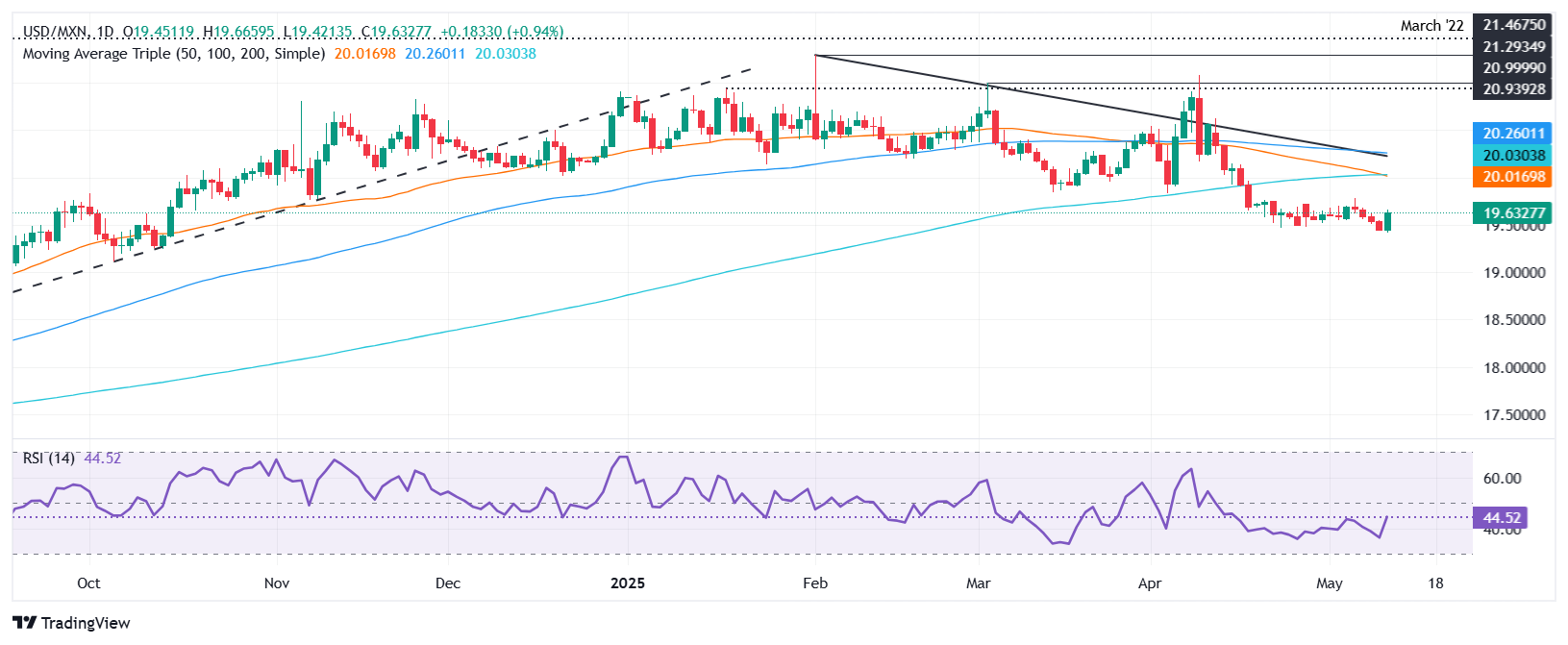
After hitting a new year-to-date (YTD) low of 19.41, USD/MXN climbed past the 19.50 area and reached a three-day high of 19.66, past the 20-day Simple Moving Average (SMA) of 19.63, before retreating somewhat. Nevertheless, the Relative Strength Index (RSI) surges sharply, indicating buyers are moving in.
That said, USD/MXN next resistance would be the 20-day SMA. A breach of the latter will expose the May 6 high at 19.77, followed by the confluence of the 200 and the 50-day SMAs around 19.99. Once surpassed, traders would eye the 100-day SMA at 20.23.
Conversely, if USD/MXN tumbles below 19.50, the first support would be the YTD low of 19.41, followed by the 19.00 mark.
Mexican Peso FAQs
The Mexican Peso (MXN) is the most traded currency among its Latin American peers. Its value is broadly determined by the performance of the Mexican economy, the country’s central bank’s policy, the amount of foreign investment in the country and even the levels of remittances sent by Mexicans who live abroad, particularly in the United States. Geopolitical trends can also move MXN: for example, the process of nearshoring – or the decision by some firms to relocate manufacturing capacity and supply chains closer to their home countries – is also seen as a catalyst for the Mexican currency as the country is considered a key manufacturing hub in the American continent. Another catalyst for MXN is Oil prices as Mexico is a key exporter of the commodity.
The main objective of Mexico’s central bank, also known as Banxico, is to maintain inflation at low and stable levels (at or close to its target of 3%, the midpoint in a tolerance band of between 2% and 4%). To this end, the bank sets an appropriate level of interest rates. When inflation is too high, Banxico will attempt to tame it by raising interest rates, making it more expensive for households and businesses to borrow money, thus cooling demand and the overall economy. Higher interest rates are generally positive for the Mexican Peso (MXN) as they lead to higher yields, making the country a more attractive place for investors. On the contrary, lower interest rates tend to weaken MXN.
Macroeconomic data releases are key to assess the state of the economy and can have an impact on the Mexican Peso (MXN) valuation. A strong Mexican economy, based on high economic growth, low unemployment and high confidence is good for MXN. Not only does it attract more foreign investment but it may encourage the Bank of Mexico (Banxico) to increase interest rates, particularly if this strength comes together with elevated inflation. However, if economic data is weak, MXN is likely to depreciate.
As an emerging-market currency, the Mexican Peso (MXN) tends to strive during risk-on periods, or when investors perceive that broader market risks are low and thus are eager to engage with investments that carry a higher risk. Conversely, MXN tends to weaken at times of market turbulence or economic uncertainty as investors tend to sell higher-risk assets and flee to the more-stable safe havens.
Recommended Articles


