




EUR/USD weakens ahead of US PCE Inflation, Trump’s tariff announcement
- EUR/USD faces pressure near 1.0800 as investors are cautious ahead of the US PCE inflation data for February.
- The European Commission prepares for retaliatory measures against US President Trump’s auto tariffs.
- Inflation in Spain and France grew at a moderate pace in March.
EUR/USD declines to near 1.0775 during European trading hours on Friday. The major currency pair faces pressure as United States (US) President Donald Trump is set to announce impending reciprocal tariffs on April 2.
The imposition of reciprocal tariffs by US President Trump is expected to weigh on economic growth and boost inflationary pressures across the globe, including the US. Trump also announced 25% tariffs on autos entering the US on Wednesday, which will become effective from April 2. Trump’s auto levy has resulted in global mayhem in automobile and auto-ancillary manufacturing companies' stocks.
Federal Reserve (Fed) officials have expressed concerns over a resurgence in price pressures in the near term due to Trump’s tariff agenda. "It looks inevitable that tariffs are going to increase inflation in the near term," Boston Fed Bank President Susan Collins said at an event on Thursday. Collins added that it seems more likely than not right now the increase in inflation will be “short-lived,” but warned of “potential risks” that higher price pressures could be persistent in nature. On the interest rate outlook, Collins said that holding them at their current levels for longer “is likely to be appropriate”. However, the Fed should show "active patience" and stand ready to be “flexible”.
In Friday’s session, investors will focus on the US Personal Consumption Expenditures Price (PCE) Index for February, which will be published at 12:30 GMT. Economists expect the US core PCE inflation, which is the Fed’s preferred inflation gauge, to have grown at a faster pace of 2.7% year-on-year, compared to the 2.6% increase seen in January.
The impact of the underlying inflation data is expected to be limited over the market speculation for the Fed’s monetary policy outlook as the central bank’s fate relies largely upon the consequences of Donald Trump’s economic policies.
Daily digest market movers: EUR/USD declines on potential US-EU trade war
- EUR/USD weakens amid deepening uncertainty over the Euro (EUR) due to potential risks of a trade war between the Eurozone and the US. The European Commission (EC) plans to announce retaliatory tariffs on the US for imposing a 25% blanket levy on autos. German carmakers dispatch 13% of their total auto exports to the US, and a 25% tariff on autos could make their cars less competitive in the global market.
- “We regret 25% auto tariffs and a new suite of measures coming on April 2, but we are preparing for all of these,” EC spokesman Olof Gill said on Thursday. When asked about the degree and timing of retaliatory measures, Gill refrained from guiding exact timings but assured that it will be “timely, robust, well calibrated and will achieve the intended impact".
- Financial market participants and German leaders warned that auto tariffs would be a lose-lose situation for both countries. “Trump’s decision is wrong," German Chancellor Olaf Scholz said on Thursday and added that the US has chosen a path at whose end “lie only losers” since tariffs and isolation hurt prosperity “for everyone”.
- Meanwhile, European Central Bank (ECB) officials expect Trump’s tariff agenda will hurt the Eurozone economic growth and boost inflationary pressures in the near term. ECB Vice President Luis de Guindos said that the impact of tariffs on inflation will be temporary, but it will be persistent on growth. "For growth, trade is extremely detrimental," de Guindos said and added, the "worst outcome is a vicious circle of tariffs/retaliation." On the monetary policy guidance, de Guindos said, "it is very difficult to say what ECB will do in April."
- On the economic front, France and Spain's March preliminary inflation data has shown that price pressures rose at a slower-than-expected pace. In 12 months to March, France’s Consumer Price Index (CPI) (EU Norm) rose steadily by 0.9%, slower than estimates of 1.1%. In the same period, Spain’s Harmonized Index of Consumer Prices (HICP) grew at a slower pace of 2.2%, compared to the prior release of 2.9%.
Technical Analysis: EUR/USD holds key 20-day EMA
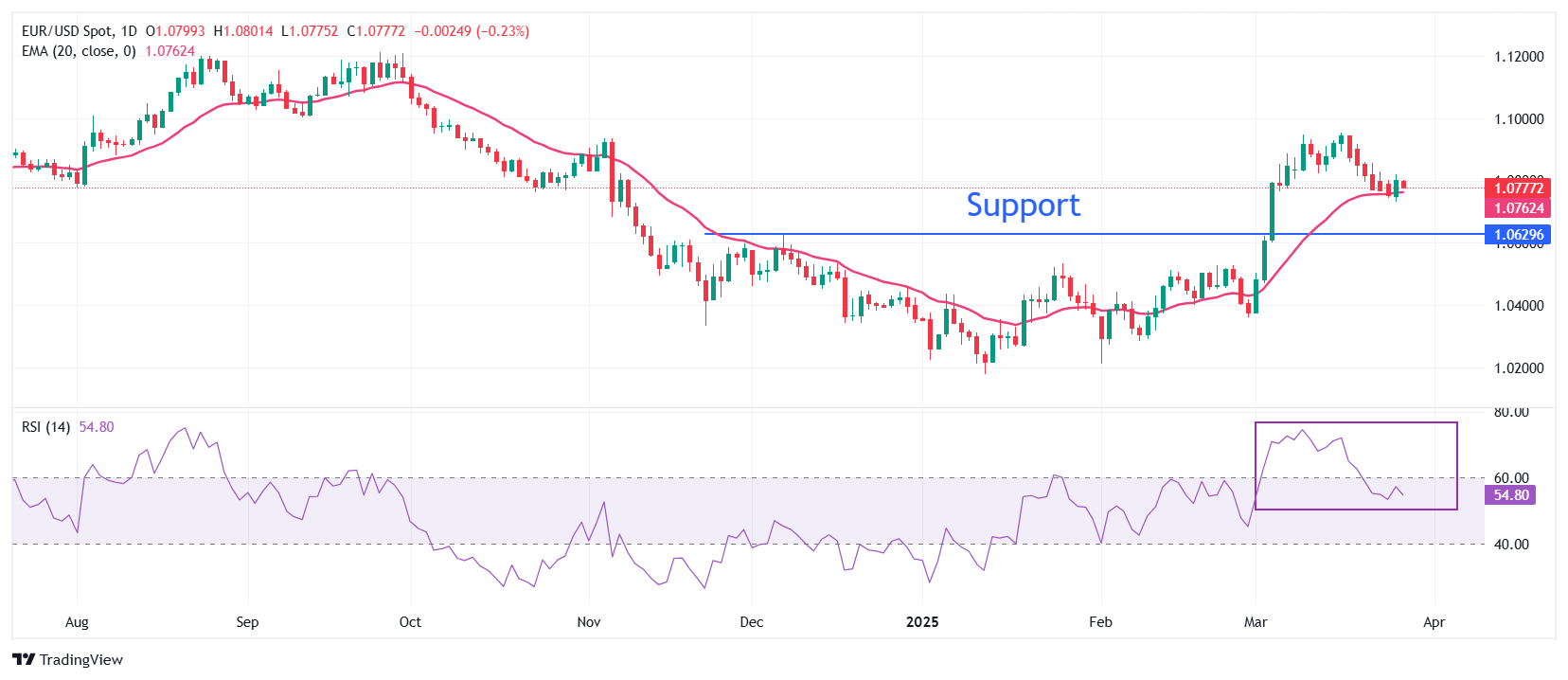
EUR/USD drops to near 1.0775 on Friday but continues to hold the 20-day Exponential Moving Average (EMA), which trades around 1.0760.
The 14-day Relative Strength Index (RSI) cools down below 60.00, suggesting that the bullish momentum is over, but the upside bias is intact.
Looking down, the December 6 high of 1.0630 will act as the major support zone for the pair. Conversely, the psychological level of 1.1000 will be the key barrier for the Euro bulls.
Euro FAQs
The Euro is the currency for the 19 European Union countries that belong to the Eurozone. It is the second most heavily traded currency in the world behind the US Dollar. In 2022, it accounted for 31% of all foreign exchange transactions, with an average daily turnover of over $2.2 trillion a day. EUR/USD is the most heavily traded currency pair in the world, accounting for an estimated 30% off all transactions, followed by EUR/JPY (4%), EUR/GBP (3%) and EUR/AUD (2%).
The European Central Bank (ECB) in Frankfurt, Germany, is the reserve bank for the Eurozone. The ECB sets interest rates and manages monetary policy. The ECB’s primary mandate is to maintain price stability, which means either controlling inflation or stimulating growth. Its primary tool is the raising or lowering of interest rates. Relatively high interest rates – or the expectation of higher rates – will usually benefit the Euro and vice versa. The ECB Governing Council makes monetary policy decisions at meetings held eight times a year. Decisions are made by heads of the Eurozone national banks and six permanent members, including the President of the ECB, Christine Lagarde.
Eurozone inflation data, measured by the Harmonized Index of Consumer Prices (HICP), is an important econometric for the Euro. If inflation rises more than expected, especially if above the ECB’s 2% target, it obliges the ECB to raise interest rates to bring it back under control. Relatively high interest rates compared to its counterparts will usually benefit the Euro, as it makes the region more attractive as a place for global investors to park their money.
Data releases gauge the health of the economy and can impact on the Euro. Indicators such as GDP, Manufacturing and Services PMIs, employment, and consumer sentiment surveys can all influence the direction of the single currency. A strong economy is good for the Euro. Not only does it attract more foreign investment but it may encourage the ECB to put up interest rates, which will directly strengthen the Euro. Otherwise, if economic data is weak, the Euro is likely to fall. Economic data for the four largest economies in the euro area (Germany, France, Italy and Spain) are especially significant, as they account for 75% of the Eurozone’s economy.
Another significant data release for the Euro is the Trade Balance. This indicator measures the difference between what a country earns from its exports and what it spends on imports over a given period. If a country produces highly sought after exports then its currency will gain in value purely from the extra demand created from foreign buyers seeking to purchase these goods. Therefore, a positive net Trade Balance strengthens a currency and vice versa for a negative balance.
Recommended Articles


