




Indian Rupee opens positively at the start of the week
- The Indian Rupee opens on a positive note against the US Dollar.
- Market experts warn INR’s rally due to strong FCNR(B) deposits could be capped.
- Investors shift their focus to the US CPI data for August.
The Indian Rupee (INR) opens higher against the US Dollar (USD) at the start of the week. The USD/INR pair drops to near 94.38 as the significant increase in forex reserves due to overwhelming response by Non-Residents to Reserve Bank of India’s (RBI) special foreign deposits window has strengthened the Indian currency.
INR outperformance underpinned by RBI Dollar inflows and reduced left-tail risks
Analysts at MUFG highlight that the Indian Rupee has been a notable outperformer, pointing to “strong outperformance in the Indian Rupee, driven by much higher-than-expected Dollar inflows from RBI’s FCNR(B) FX measures, reaching above US$130bn in total as of 31 Aug.”
The bank advised that investors should not be gung-ho about the Indian currency, as it still thinks USD/INR should trend higher over time. But it ruled out the possibility of a sharp INR depreciation, clarifying that RBI’s FX measures have given authorities meaningful firepower and ammunition.
Higher oil prices could weigh on INR
Rising oil prices due to restricted energy supply through the Strait of Hormuz on the back of US-Iran conflicts could dent the rally in the Indian Rupee.
The continued exchange of attacks between the US and Iran regarding the control of Hormuz is keeping oil prices higher.
On Sunday, the Iranian government said that it targeted three oil tankers using an unauthorized route through the Strait of Hormuz, as well as a number of US-linked ships, in retaliation for US attacks on Iranian tankers over the weekend.
In the opening session on Monday, the MCX Crude Oil contract expiring on September 21 is up 1.75% to near Rs. 8,730, closer to its over three-month high of Rs. 8,791.
US Inflation data in focus
This week, the major event for global markets is expected to be the US Consumer Price Index (CPI) data for August, which will be published on Friday.
Investors will closely track the data as Fed Chairman Kevin Warsh has warned of upside inflation risks several times and has stated that the central bank is committed to bringing price pressures down.
However, recent comments from board members: New York Fed Bank President John Williams and Governor Christopher Waller have signaled that recent data on inflation has been “encouraging”.
Meanwhile, traders are expected to reassess the Fed’s interest rate expectations due to stronger-than-expected Nonfarm Payrolls data for August released on Friday. The data showed that employers hired 162K fresh workers, significantly higher than 56K estimate. July’s NFP data was also revised higher to 21K from -23K.
Currently, the CME FedWatch tool shows a 58% chance that the Fed will hike interest rates at the policy meeting next week.
USD/INR Technical Analysis
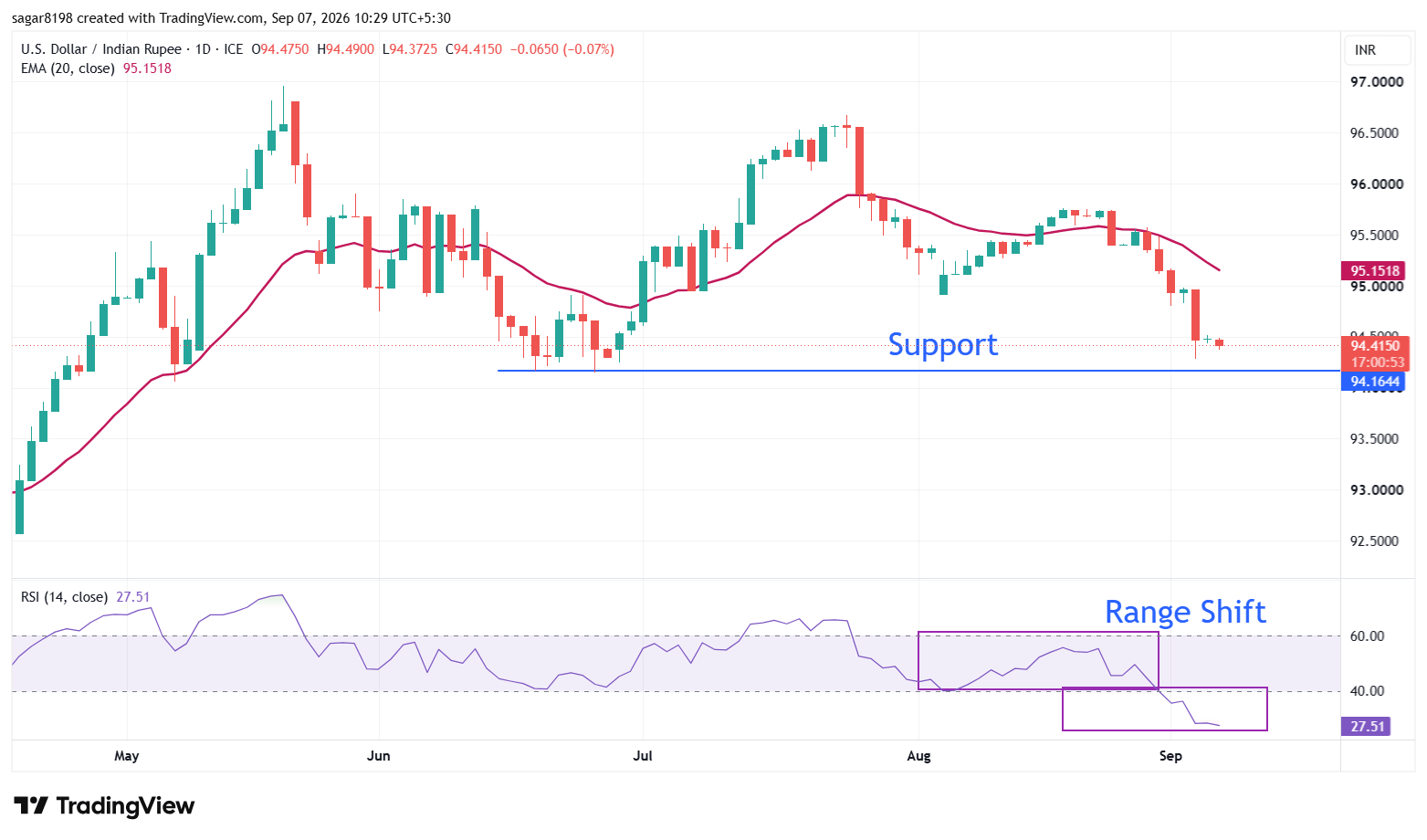
In the daily chart, USD/INR trades at 94.49. The pair maintains a bearish near-term bias as price holds below the 20-day Exponential Moving Average (EMA) at 95.15.
The shift in the Relative Strength Index (14) range from the 40.00-60.00 zone to below 40.00 suggests downside momentum remains dominant but also warns that selling pressure could be stretched.
On the downside, the June low at 94.15 will be the key support level for the USD/INR pair. On the topside, the 20-day EMA at 95.15 stands as the first meaningful resistance that the pair would need to reclaim to ease the current bearish tone and open the door to a corrective rebound.
(The technical analysis of this story was written with the help of an AI tool. Know more.)
Indian Rupee FAQs
The Indian Rupee (INR) is one of the most sensitive currencies to external factors. The price of Crude Oil (the country is highly dependent on imported Oil), the value of the US Dollar – most trade is conducted in USD – and the level of foreign investment, are all influential. Direct intervention by the Reserve Bank of India (RBI) in FX markets to keep the exchange rate stable, as well as the level of interest rates set by the RBI, are further major influencing factors on the Rupee.
The Reserve Bank of India (RBI) actively intervenes in forex markets to maintain a stable exchange rate, to help facilitate trade. In addition, the RBI tries to maintain the inflation rate at its 4% target by adjusting interest rates. Higher interest rates usually strengthen the Rupee. This is due to the role of the ‘carry trade’ in which investors borrow in countries with lower interest rates so as to place their money in countries’ offering relatively higher interest rates and profit from the difference.
Macroeconomic factors that influence the value of the Rupee include inflation, interest rates, the economic growth rate (GDP), the balance of trade, and inflows from foreign investment. A higher growth rate can lead to more overseas investment, pushing up demand for the Rupee. A less negative balance of trade will eventually lead to a stronger Rupee. Higher interest rates, especially real rates (interest rates less inflation) are also positive for the Rupee. A risk-on environment can lead to greater inflows of Foreign Direct and Indirect Investment (FDI and FII), which also benefit the Rupee.
Higher inflation, particularly, if it is comparatively higher than India’s peers, is generally negative for the currency as it reflects devaluation through oversupply. Inflation also increases the cost of exports, leading to more Rupees being sold to purchase foreign imports, which is Rupee-negative. At the same time, higher inflation usually leads to the Reserve Bank of India (RBI) raising interest rates and this can be positive for the Rupee, due to increased demand from international investors. The opposite effect is true of lower inflation.
Recommended Articles


