




Pound Sterling trades cautiously to start a data-light week
- The Pound Sterling struggles to extend Friday’s gains, which came after strong UK Retail Sales and PMI data.
- Investors expect the White House to reveal the Fed’s new Chairman this week.
- The Fed is expected to keep interest rates unchanged on Wednesday.
The Pound Sterling (GBP) trades mixed against its major currency peers, edging higher to near 1.3665 against the US Dollar (USD) on Monday. The British currency steadies after a sharp rally on Friday, which was prompted by strong United Kingdom (UK) S&P Global Purchasing Managers’ Index (PMI) preliminary data for January and upbeat Retail Sales data for December.
The data released on Friday showed that UK private business activity expanded at a faster pace due to strong manufacturing and services PMI. The UK Composite PMI came in at 53.9 in January, higher than estimates of 51.7 and the prior release of 51.4.
Meanwhile, the UK Office for National Statistics (ONS) reported that Retail Sales returned to growth in December after declining in the previous two months. Retail Sales rose by 0.4%, while it was expected to have declined 0.1% again.
This week, the UK economic calendar will be light; therefore, market sentiment and speculation ahead of the Bank of England’s (BoE) monetary policy meeting in February will be key drivers for the Pound Sterling.
In the December policy meeting, the BoE guided that monetary policy will remain on a “gradual downward path”. Meanwhile, BoE Monetary Policy Committee (MPC) member Megan Greene stated on Friday that the UK central bank should avoid reducing interest rates, like the Federal Reserve, citing upside wage growth expectations.
"I will be watching household and business inflation expectations over the next few months to see if they come down in line with lower inflation outturns. Even more concerning, in my view, are the forward indicators for wage growth," Greene said, Reuters reported.
Daily Digest Market Movers: US Dollar weakens on hopes Fed’s new Chair announcement this week
- The Pound Sterling ticks marginally higher against the US Dollar during the European trading hours on Monday. The GBP/USD pair edges up as the US Dollar underperforms across the board, with the US Dollar Index (DXY) trading 0.3% lower near 97.15 as of writing. A slight uptick in the GBP/USD pair at times when the US Dollar is sharply lower signifies that the Pound Sterling is also weak.
- The US Dollar faces severe selling pressure on hopes that the White House could announce the name of the Fed’s next Chairman this week. United States (US) President Donald Trump said in December that he would announce the name of Fed Chair Jerome Powell’s successor sometime in January.
- According to recent comments from White House officials, National Economic Council Director Kevin Hassett, BlackRock executive Rick Rieder, current Fed Governors Christopher Waller and Michelle Bowman, and former Fed Governor Kevin Warsh are top contenders to replace Powell.
- Investors worry that the Fed would lose its independence after the appointment of a Trump candidate as Fed Chairman. In the past, Trump has criticized Powell for not lowering interest rates and has also imposed criminal charges for renovation cost overruns. Therefore, it is highly anticipated that decisions taken by the new Chairman will be biased towards Trump’s economic agenda.
- This week, investors will also focus on the Fed’s monetary policy announcement on Wednesday. According to the CME FedWatch tool, the Fed is expected to announce a pause after three consecutive interest rate cuts. In the last three policy meetings of 2025, the Fed reduced borrowing rates by 75 basis points (bps) to the 3.50%-3.75% range, citing labor market risks.
- In Monday’s session, investors will focus on US Durable Goods Orders data for November, which will be published at 13:30 GMT.
Technical Analysis: GBP/USD approaches four-year high at 1.3790
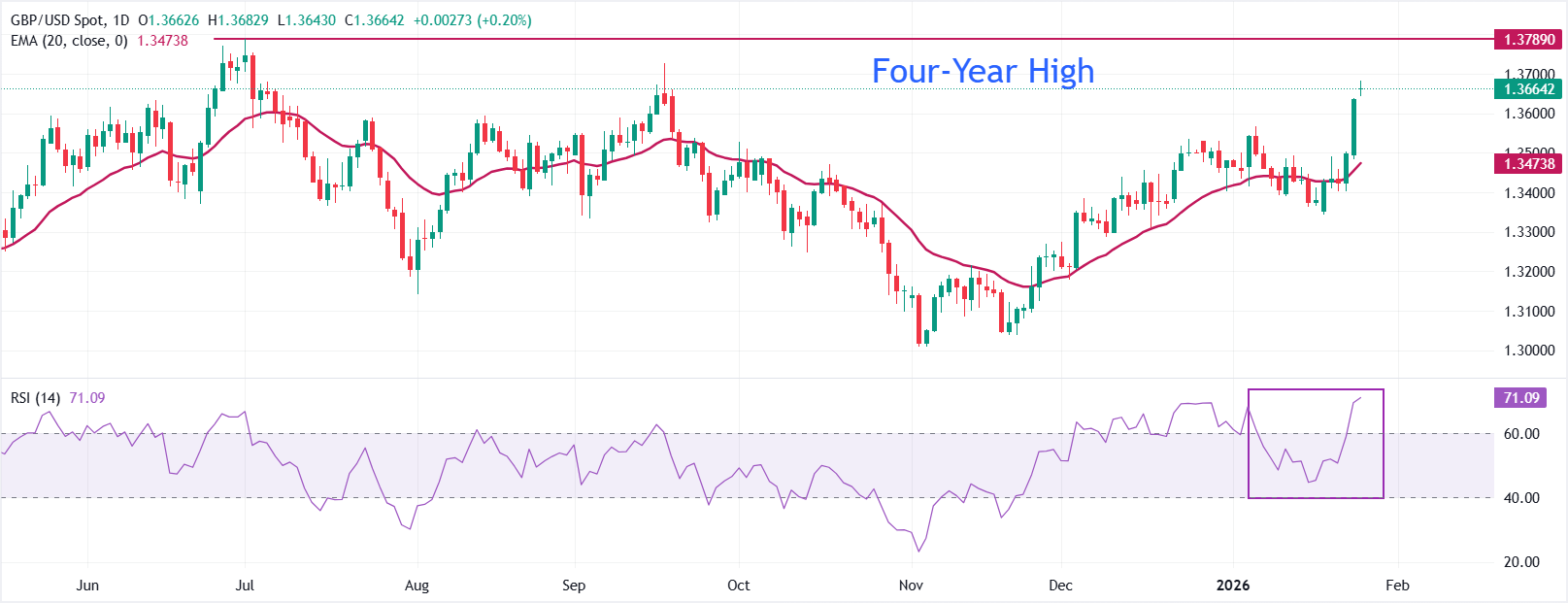
GBP/USD trades higher at around 1.3664 as of writing. Price action holds well above the rising 20-day Exponential Moving Average (EMA), which has advanced to 1.3474 and underpins the bullish structure. The average has turned higher in recent sessions, reinforcing a positive trend bias. The Relative Strength Index (RSI) at 71.11 (overbought) signals stretched momentum and warns of scope for consolidation.
While above the 20-day EMA, pullbacks could remain contained and the uptrend could extend. A dip in RSI back below 70 would indicate momentum cooling and increase the risk of a pause.
(The technical analysis of this story was written with the help of an AI tool.)
Pound Sterling FAQs
The Pound Sterling (GBP) is the oldest currency in the world (886 AD) and the official currency of the United Kingdom. It is the fourth most traded unit for foreign exchange (FX) in the world, accounting for 12% of all transactions, averaging $630 billion a day, according to 2022 data. Its key trading pairs are GBP/USD, also known as ‘Cable’, which accounts for 11% of FX, GBP/JPY, or the ‘Dragon’ as it is known by traders (3%), and EUR/GBP (2%). The Pound Sterling is issued by the Bank of England (BoE).
The single most important factor influencing the value of the Pound Sterling is monetary policy decided by the Bank of England. The BoE bases its decisions on whether it has achieved its primary goal of “price stability” – a steady inflation rate of around 2%. Its primary tool for achieving this is the adjustment of interest rates. When inflation is too high, the BoE will try to rein it in by raising interest rates, making it more expensive for people and businesses to access credit. This is generally positive for GBP, as higher interest rates make the UK a more attractive place for global investors to park their money. When inflation falls too low it is a sign economic growth is slowing. In this scenario, the BoE will consider lowering interest rates to cheapen credit so businesses will borrow more to invest in growth-generating projects.
Data releases gauge the health of the economy and can impact the value of the Pound Sterling. Indicators such as GDP, Manufacturing and Services PMIs, and employment can all influence the direction of the GBP. A strong economy is good for Sterling. Not only does it attract more foreign investment but it may encourage the BoE to put up interest rates, which will directly strengthen GBP. Otherwise, if economic data is weak, the Pound Sterling is likely to fall.
Another significant data release for the Pound Sterling is the Trade Balance. This indicator measures the difference between what a country earns from its exports and what it spends on imports over a given period. If a country produces highly sought-after exports, its currency will benefit purely from the extra demand created from foreign buyers seeking to purchase these goods. Therefore, a positive net Trade Balance strengthens a currency and vice versa for a negative balance.
Recommended Articles


