




USD/INR clings to gains as Greenback steadies on easing US-EU disputes
- The Indian Rupee remains on the back foot against the US Dollar due to multiple headwinds.
- The US Dollar gains on receding geopolitical and trade tensions between the US and the EU.
- FIIs continue to offload their stakes in the Indian stock market.
The Indian Rupee (INR) holds onto losses near its all-time low against the US Dollar (USD) in the opening session on Thursday. The USD/INR pair trades marginally below the lifetime high of 92.00 posted on Wednesday as continuous selling pressure in the Indian stock market from overseas investors keeps battering the Indian currency.
Foreign Institutional Investors (FIIs) continue to pare their stakes in the Indian equity market due to the United States (US)- India trade deal stalemate.
So far in January, FIIs have remained net sellers in 13 of 14 trading days, offloading stakes worth Rs. 34,041.21 crore.
On the domestic front, investors await the preliminary HSBC Composite Purchasing Managers’ Index (PMI) data for January, which will be released on Friday. Investors will closely monitor the data to get fresh cues about the economy’s overall demand ahead of the Financial Year (FY) 2026-2027 fiscal budget announcement on February 1.
Daily Digest Market Movers: Trump drops plans of military action and tariff threats to acquire Greenland
- A strong recovery move in the US Dollar due to easing geopolitical and trade tensions between the US and the European Union (EU) is also strengthening USD/INR. As of writing, the US Dollar Index (DXY), which tracks the Greenback’s value against six major currencies, clings to gains near Wednesday’s high around 98.80.
- The US Dollar attracted significant bids on Wednesday after US President Donald Trump dropped his plans of military action and tariff threats on EU members for Greenland’s acquisition.
- Speaking at the World Economic Forum (WEF) in Davos on Wednesday, Trump said that “I won't use force” to purchase Greenland, but is “seeking immediate negotiations” to discuss its acquisition.
- US President Trump also confirmed his plans of dropping Greenland’s forceful acquisition through a post on Truth.Social, after meeting with the Secretary General of NATO, Mark Rutte. Trump added that Washington and NATO have formed the framework of a “future deal with respect to Greenland, and in fact, the entire Arctic Region”.
- Last weekend, US President Trump announced 10% tariffs on several EU nations and the United Kingdom (UK) for opposing Washington’s plans to possess Greenland, and warned that import duties could be increased further unless a deal is reached. The event led to a sharp decline in the demand for riskier assets and the US Dollar, while heightening concerns of a trade war between the world’s largest economies.
- Meanwhile, investors await the US Personal Consumption Expenditure Prices Index (PCE) data for October and November, which will be published at 15:00 GMT. The impact of the Federal Reserve’s (Fed) preferred inflation gauge on expectations for the monetary policy outlook will be limited, as it doesn't cover price changes of latest months.
Technical Analysis: USD/INR trades firmly near all-time highs of 92.00
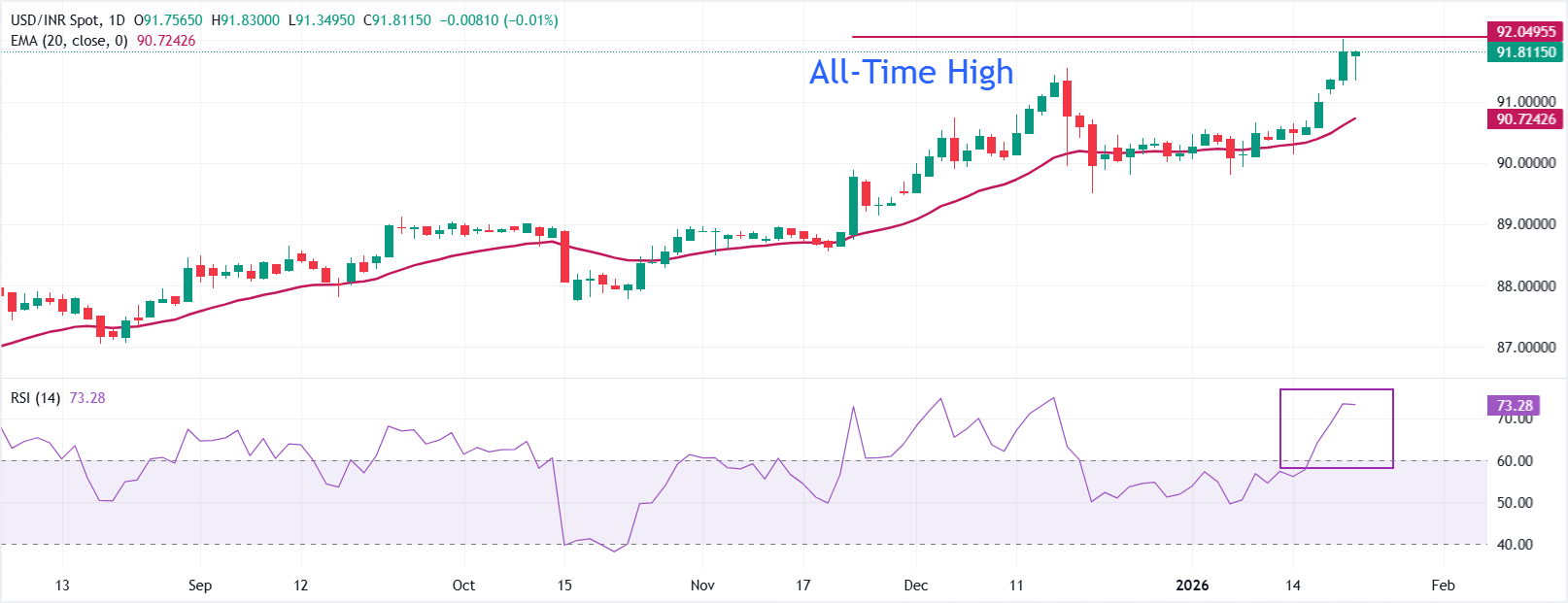
USD/INR trades firmly near 91.81 as of writing. The pair holds above a rising 20-day Exponential Moving Average (EMA), preserving a firm bullish bias. The 20-day EMA continues to slope higher, confirming trend strength.
The 14-day Relative Strength Index (RSI) at 73.28 (overbought) highlights stretched momentum after the latest advance. Initial support sits at the 20-day EMA at 90.72, and while above this gauge, the path of least resistance would remain higher.
Should buyers defend the 20-day EMA at 90.72, the advance would extend, though the overbought oscillator could cap momentum until it cools. A daily close below that average would warn of a loss of trend control, with RSI slipping under 70, flagging a broader pullback.
(The technical analysis of this story was written with the help of an AI tool.)
Indian Rupee FAQs
The Indian Rupee (INR) is one of the most sensitive currencies to external factors. The price of Crude Oil (the country is highly dependent on imported Oil), the value of the US Dollar – most trade is conducted in USD – and the level of foreign investment, are all influential. Direct intervention by the Reserve Bank of India (RBI) in FX markets to keep the exchange rate stable, as well as the level of interest rates set by the RBI, are further major influencing factors on the Rupee.
The Reserve Bank of India (RBI) actively intervenes in forex markets to maintain a stable exchange rate, to help facilitate trade. In addition, the RBI tries to maintain the inflation rate at its 4% target by adjusting interest rates. Higher interest rates usually strengthen the Rupee. This is due to the role of the ‘carry trade’ in which investors borrow in countries with lower interest rates so as to place their money in countries’ offering relatively higher interest rates and profit from the difference.
Macroeconomic factors that influence the value of the Rupee include inflation, interest rates, the economic growth rate (GDP), the balance of trade, and inflows from foreign investment. A higher growth rate can lead to more overseas investment, pushing up demand for the Rupee. A less negative balance of trade will eventually lead to a stronger Rupee. Higher interest rates, especially real rates (interest rates less inflation) are also positive for the Rupee. A risk-on environment can lead to greater inflows of Foreign Direct and Indirect Investment (FDI and FII), which also benefit the Rupee.
Higher inflation, particularly, if it is comparatively higher than India’s peers, is generally negative for the currency as it reflects devaluation through oversupply. Inflation also increases the cost of exports, leading to more Rupees being sold to purchase foreign imports, which is Rupee-negative. At the same time, higher inflation usually leads to the Reserve Bank of India (RBI) raising interest rates and this can be positive for the Rupee, due to increased demand from international investors. The opposite effect is true of lower inflation.
Recommended Articles


