




EUR/USD bounces up from lows as market sentiment improves
- EUR/USD returns to levels near 1.1740 on Tuesday after hitting four-week lows at 1.1660 the previous day.
- Weak US economic data, dovish Fed speak, and risk appetite have curbed demand for the US Dollar.
- Eurozone Services PMI and German inflation data will test the strength of the Euro rally on Tuesday.
EUR/USD is trading with moderate gains on Tuesday, changing hands at 1.1735 at the time of writing after hitting four-week lows near 1.1650 the previous day. Weak US manufacturing activity data and dovish comments from Federal Reserve (Fed) speakers have curbed demand for the US Dollar (USD), as concerns about the US intervention in Venezuela fade.
US ISM Manufacturing Purchasing Managers' Index (PMI) figures revealed that the sector's business activity fell at its fastest pace in the last 14 months, with new orders contracting while prices keep rising. This, coupled with some dovish comments by Minneapolis Fed President Neel Kashkari, renewed hopes of further monetary easing by the US central bank and sent the US Dollar lower.
On Tuesday's economic calendar, the German preliminary Harmonized Index of Consumer Prices (HICP) reading for December and the final Eurozone HCOB Services PMI will grab the attention during the European session.
In the US, Richmond Fed President Thomas Barkin's speech and the final S&P Global Services PMI might have some impact on the US Dollar, although the main focus is on a string of US labour data, due later this week, especially Friday's Nonfarm Payrolls (NFP) report.
Euro Price Today
The table below shows the percentage change of Euro (EUR) against listed major currencies today. Euro was the strongest against the US Dollar.
| USD | EUR | GBP | JPY | CAD | AUD | NZD | CHF | |
|---|---|---|---|---|---|---|---|---|
| USD | -0.11% | -0.15% | -0.03% | -0.06% | -0.31% | -0.29% | -0.05% | |
| EUR | 0.11% | -0.02% | 0.07% | 0.05% | -0.20% | -0.19% | 0.07% | |
| GBP | 0.15% | 0.02% | 0.11% | 0.08% | -0.16% | -0.15% | 0.10% | |
| JPY | 0.03% | -0.07% | -0.11% | -0.02% | -0.27% | -0.27% | -0.01% | |
| CAD | 0.06% | -0.05% | -0.08% | 0.02% | -0.25% | -0.24% | 0.01% | |
| AUD | 0.31% | 0.20% | 0.16% | 0.27% | 0.25% | 0.02% | 0.27% | |
| NZD | 0.29% | 0.19% | 0.15% | 0.27% | 0.24% | -0.02% | 0.25% | |
| CHF | 0.05% | -0.07% | -0.10% | 0.00% | -0.01% | -0.27% | -0.25% |
The heat map shows percentage changes of major currencies against each other. The base currency is picked from the left column, while the quote currency is picked from the top row. For example, if you pick the Euro from the left column and move along the horizontal line to the US Dollar, the percentage change displayed in the box will represent EUR (base)/USD (quote).
Daily Digest Market Movers: US Dollar loses ground as market sentiment improves
- The combination of weak US manufacturing data seen on Monday, dovish comments from Fed's Kashkari, and easing concerns about the consequences of the intervention in Venezuela brought appetite for risk back to the table on Monday's US session, and sent the US Dollar retreating across the board.
- US ISM Manufacturing PMI dropped to 47.9 in December from 48.2 in November, compared to expectations of a mild improvement to 48.3. New orders edged up to 47.7 from 47.4 in the previous month but remain in contraction territory, while the Prices Paid subindex remained unchanged at 58.5, levels reflecting significant inflationary pressures.
- Later on, Minneapolis Fed President Neel Kashkari said that inflationary pressures are slowly trending down, but warned that the jobless rate could "pop" higher, which supported market hopes of further Fed monetary easing.
- Geopolitical concerns triggered by the US military intervention in Venezuela have mostly remained subdued. Nicolás Maduro pleaded not guilty in a New York Federal Court, and investors have taken in stride China's warnings about "hegemonic acts" that violate international law.
- On the Eurozone calendar, the main attraction will be Germany's preliminary HICP figures for December, which are expected to show that inflation bounced up 0.4% in the month, from -0.5% in November. The yearly rate, however, is seen easing to 2.2% from 2.6% in the previous month.
- Previously, the Eurozone final HCOB Services PMI is expected to show that the sector's activity slowed down to a level of 52.6 in December, from 53.6 last month.
- In the US, the final US S&P Global Services PMI is the only macroeconomic release worth mentioning today. Preliminary estimations showed a slowdown to 52.9 in December, from 54.1 in November.
Technical Analysis: EUR/USD bounces from 1.1670 support
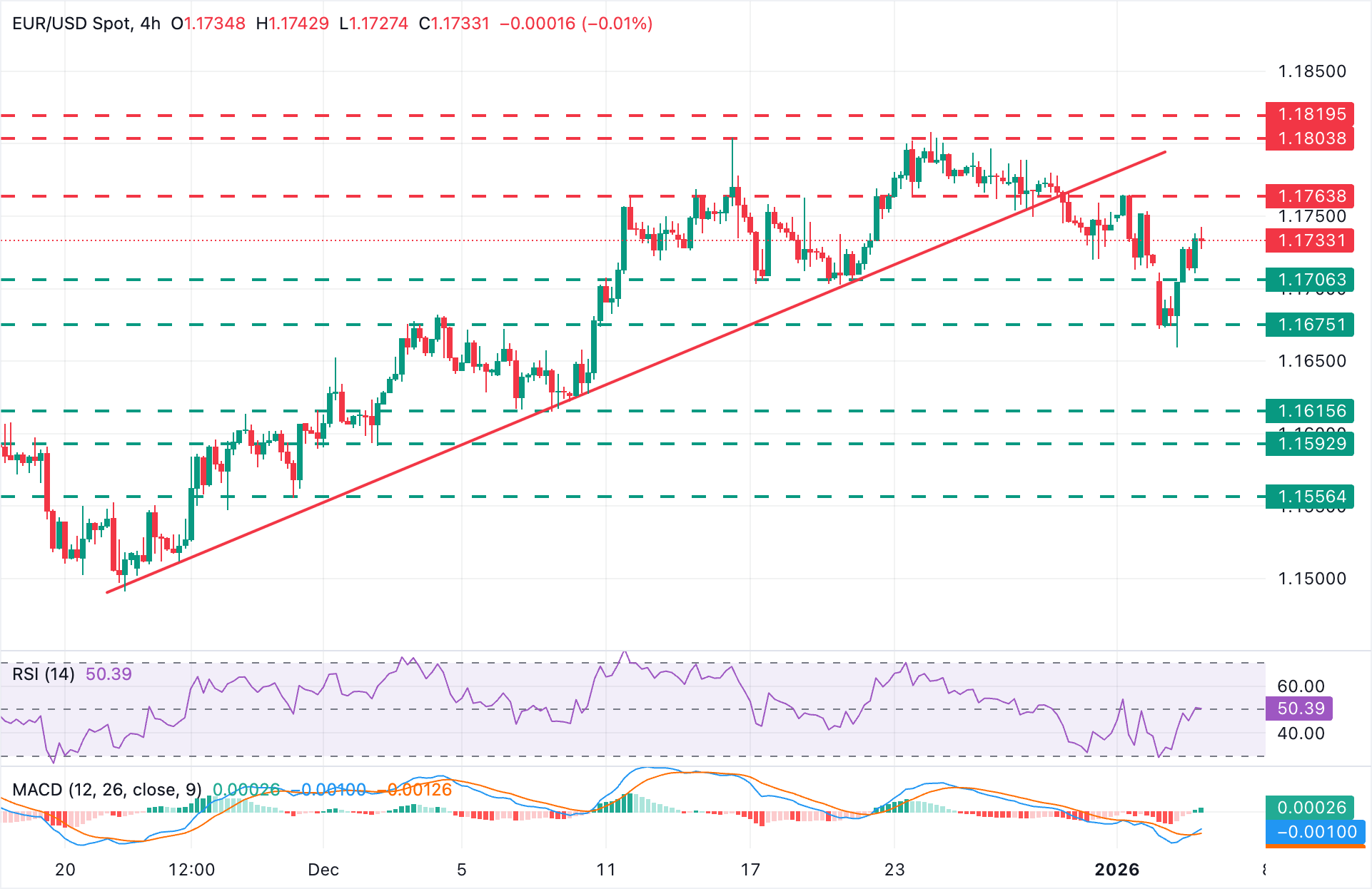
The EUR/USD found support at the 1.1670 area on Monday and is looking stronger on Tuesday. The 4-hour Relative Strength Index (RSI) has returned above 50, and the Moving Average Convergence Divergence (MACD) histogram bars are popping up above zero as the MACD line crosses over the Signal line, which highlights an improving momentum.
Immediate resistance is at the January 2 high, at 1.1765. Further up the confluence of a reverse trendline with December's peak, at 1.1808, is likely to pose a significant resistance.
On the downside, session lows are at 1.1710, ahead of Monday's low of 1.1660. Further down, the next target is at the December 8 and 9 lows, in the area of 1.1615.
Euro FAQs
The Euro is the currency for the 20 European Union countries that belong to the Eurozone. It is the second most heavily traded currency in the world behind the US Dollar. In 2022, it accounted for 31% of all foreign exchange transactions, with an average daily turnover of over $2.2 trillion a day. EUR/USD is the most heavily traded currency pair in the world, accounting for an estimated 30% off all transactions, followed by EUR/JPY (4%), EUR/GBP (3%) and EUR/AUD (2%).
The European Central Bank (ECB) in Frankfurt, Germany, is the reserve bank for the Eurozone. The ECB sets interest rates and manages monetary policy. The ECB’s primary mandate is to maintain price stability, which means either controlling inflation or stimulating growth. Its primary tool is the raising or lowering of interest rates. Relatively high interest rates – or the expectation of higher rates – will usually benefit the Euro and vice versa. The ECB Governing Council makes monetary policy decisions at meetings held eight times a year. Decisions are made by heads of the Eurozone national banks and six permanent members, including the President of the ECB, Christine Lagarde.
Eurozone inflation data, measured by the Harmonized Index of Consumer Prices (HICP), is an important econometric for the Euro. If inflation rises more than expected, especially if above the ECB’s 2% target, it obliges the ECB to raise interest rates to bring it back under control. Relatively high interest rates compared to its counterparts will usually benefit the Euro, as it makes the region more attractive as a place for global investors to park their money.
Data releases gauge the health of the economy and can impact on the Euro. Indicators such as GDP, Manufacturing and Services PMIs, employment, and consumer sentiment surveys can all influence the direction of the single currency. A strong economy is good for the Euro. Not only does it attract more foreign investment but it may encourage the ECB to put up interest rates, which will directly strengthen the Euro. Otherwise, if economic data is weak, the Euro is likely to fall. Economic data for the four largest economies in the euro area (Germany, France, Italy and Spain) are especially significant, as they account for 75% of the Eurozone’s economy.
Another significant data release for the Euro is the Trade Balance. This indicator measures the difference between what a country earns from its exports and what it spends on imports over a given period. If a country produces highly sought after exports then its currency will gain in value purely from the extra demand created from foreign buyers seeking to purchase these goods. Therefore, a positive net Trade Balance strengthens a currency and vice versa for a negative balance.
Recommended Articles


