




AUD/USD runs out of gas near 0.67 as holiday slowdown grinds on
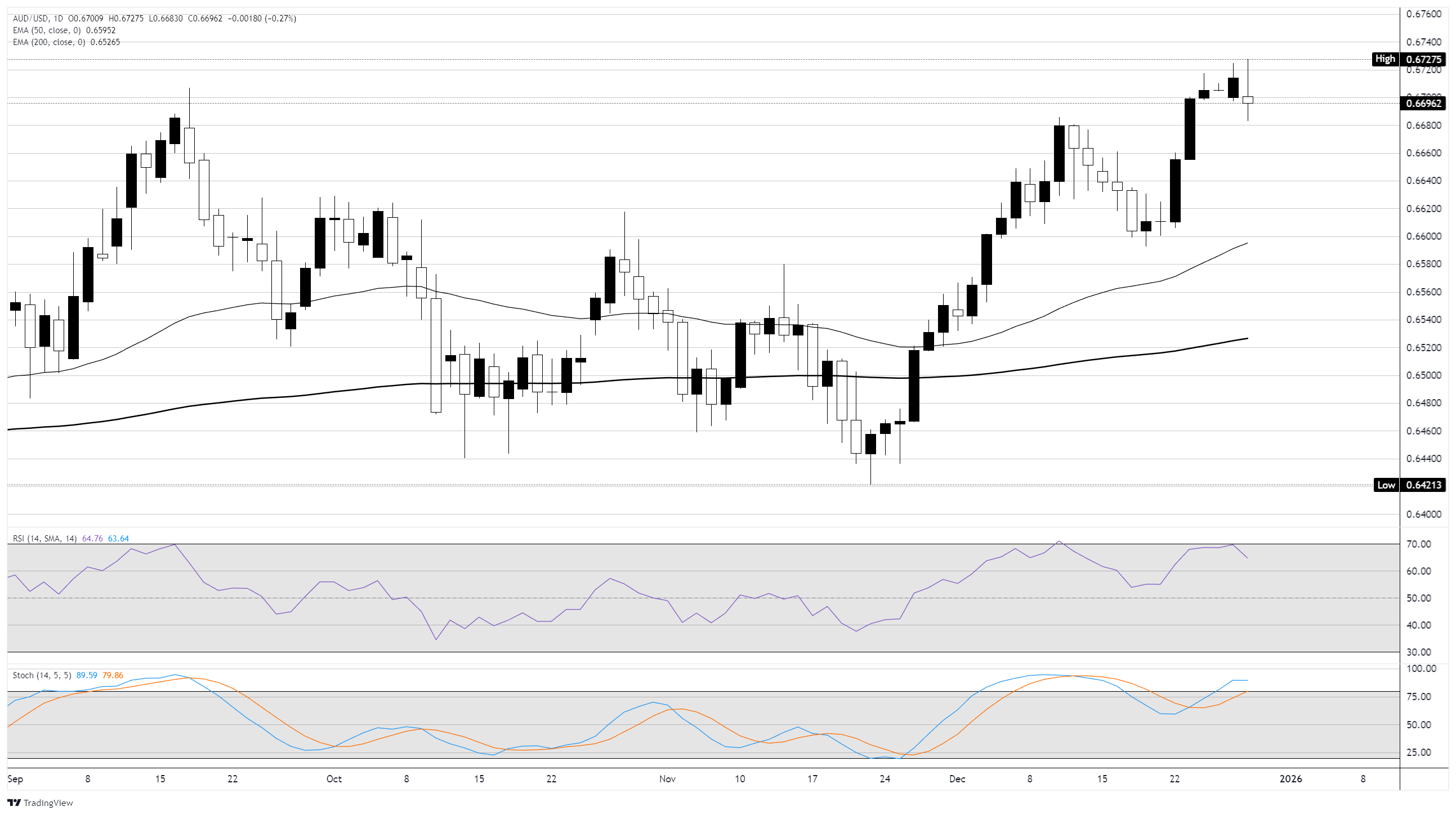
- AUD/USD snapped a near-term bull run on Monday, slipping back below 0.6700.
- Year-end volume dry-up has left Aussie market flows stumbling near key levels.
- The latest Fed Meeting Minutes serve as the sole focal point for datawatchers.
AUD/USD fizzled to open the final trading week of 2025, pumping the brakes on a recent bullish swing and backsliding below 0.6700 as traders step back into defensive positioning during the year-end slowdown.
Despite tepid market flows during thin final week trading, underlying drivers are unlikely to shift significantly heading into 2026. The Reserve Bank of Australia (RBA) is on a path toward accelerating interest rate hikes, bolstering the Australian Dollar (AUD) heading into the first quarter. The Federal Reserve (Fed), by comparison, is trapped in a downward spiral, with global markets broadly expecting a further dovish tilt from Fed officials.
RBA and Fed trajectories harden, show widening rate spread
Shifting policy stances on both sides of the Pacific and widening interest rate differentials are expected to bolster the Aussie and sewer the Greenback, barring any significant changes in economic modelling. Bleary-eyed traders will be keeping an eye on the Fed’s latest Meeting Minutes, slated to be released on Tuesday.
Major sea changes in policy discussions are not expected from the Fed’s most recent interest rate call, which saw the US central bank trim interest rates for a third straight meeting. According to the Fed’s own dot plot, policymakers expect a moderate easing pace in rates, with median dot plot clusters calling for two interest rate cuts over the next two years.
According to the CME’s FedWatch Tool, rate markets are pricing in an accelerating interest rate-cutting schedule. Rate traders are pricing in at least two interest rate cuts from the Fed before the end of September, with further easing expected in the future.
AUD/USD daily chart
Australian Dollar FAQs
One of the most significant factors for the Australian Dollar (AUD) is the level of interest rates set by the Reserve Bank of Australia (RBA). Because Australia is a resource-rich country another key driver is the price of its biggest export, Iron Ore. The health of the Chinese economy, its largest trading partner, is a factor, as well as inflation in Australia, its growth rate and Trade Balance. Market sentiment – whether investors are taking on more risky assets (risk-on) or seeking safe-havens (risk-off) – is also a factor, with risk-on positive for AUD.
The Reserve Bank of Australia (RBA) influences the Australian Dollar (AUD) by setting the level of interest rates that Australian banks can lend to each other. This influences the level of interest rates in the economy as a whole. The main goal of the RBA is to maintain a stable inflation rate of 2-3% by adjusting interest rates up or down. Relatively high interest rates compared to other major central banks support the AUD, and the opposite for relatively low. The RBA can also use quantitative easing and tightening to influence credit conditions, with the former AUD-negative and the latter AUD-positive.
China is Australia’s largest trading partner so the health of the Chinese economy is a major influence on the value of the Australian Dollar (AUD). When the Chinese economy is doing well it purchases more raw materials, goods and services from Australia, lifting demand for the AUD, and pushing up its value. The opposite is the case when the Chinese economy is not growing as fast as expected. Positive or negative surprises in Chinese growth data, therefore, often have a direct impact on the Australian Dollar and its pairs.
Iron Ore is Australia’s largest export, accounting for $118 billion a year according to data from 2021, with China as its primary destination. The price of Iron Ore, therefore, can be a driver of the Australian Dollar. Generally, if the price of Iron Ore rises, AUD also goes up, as aggregate demand for the currency increases. The opposite is the case if the price of Iron Ore falls. Higher Iron Ore prices also tend to result in a greater likelihood of a positive Trade Balance for Australia, which is also positive of the AUD.
The Trade Balance, which is the difference between what a country earns from its exports versus what it pays for its imports, is another factor that can influence the value of the Australian Dollar. If Australia produces highly sought after exports, then its currency will gain in value purely from the surplus demand created from foreign buyers seeking to purchase its exports versus what it spends to purchase imports. Therefore, a positive net Trade Balance strengthens the AUD, with the opposite effect if the Trade Balance is negative.
Recommended Articles


