




Pound Sterling turns subdued on BoE dovish expectations
- The Pound Sterling ticks lower against its major currency peers at the start of the week.
- UK Chancellor Reeves announces tax hike of up to 26 billion pounds by 2029-30.
- The Fed is expected to cut interest rates in its monetary policy meeting next week.
The Pound Sterling (GBP) trades subduedly against its major currency peers at the start of the week. The British currency is expected to remain under pressure as traders are increasingly confident that the Bank of England (BoE) will cut interest rates in its last monetary policy announcement of this year on December 18.
Investors expect the BoE to cut interest rates by 25 basis points (bps) to 3.75% as the latest United Kingdom (UK) data showed signs of further weakness in job growth and slowing inflation growth.
In addition to dovish BoE expectations, cooling gilt yields, following the announcement of fresh tax hikes by Chancellor of the Exchequer Rachel Reeves in the Autumn budget report, released last Wednesday, are also expected to cap the Pound Sterling’s upside. 10-year UK gilt yields are down almost 4% to near 4.44% from the November high of 4.62%.
In the budget report, Reeves announced that the government will raise taxes by 26 billion pounds by 2029-30 to fill the fiscal gap. Moody’s rating agency has acknowledged the Labour Party’s efforts to reduce the debt, while warning that “execution risks” remain intact.
"While the government’s willingness to bring public finances back in line with its targets is positive, execution risks remain high," Moody’s said.
Daily digest market movers: Pound Sterling flattens against US Dollar
- The Pound Sterling trades flat around 1.3230 against the US Dollar (USD) during the European trading session on Monday. The GBP/USD pair consolidates while the US Dollar falls further amid firm expectations that the Federal Reserve (Fed) will cut interest rates in its monetary policy announcement next week.
- During European trading hours, the US Dollar Index (DXY), which tracks the Greenback’s value against six major currencies, posts a fresh two-week low near 99.30.
- The CME FedWatch tool shows that the probability of the Fed cutting interest rates by 25 basis points (bps) to 3.50%-3.75% in December is 87.5%.
- Fed dovish speculation has remained intensified due to weakness in the US labour market, and expectations that the impact of tariffs on inflation remains limited.
- This week, the US Dollar is expected to trade cautiously as a slew of United States (US) data is scheduled to be published this week, notably the ADP Employment Change for November, which will be released on Wednesday.
- The ADP Employment Change data will indicate the current status of labour demand in the private sector. Economists expect the private sector to have added fresh 20K workers in November, lower than the 42K hired in October.
- In Monday’s session, investors will pay attention to the US ISM Manufacturing Purchasing Managers’ Index (PMI) figure for November, which will be published at 15:00 GMT. The agency is expected to report that the Manufacturing PMI contracted at a faster pace to 48.6 from 48.7 in October.
Technical Analysis: GBP/USD struggles to break above 200-day EMA
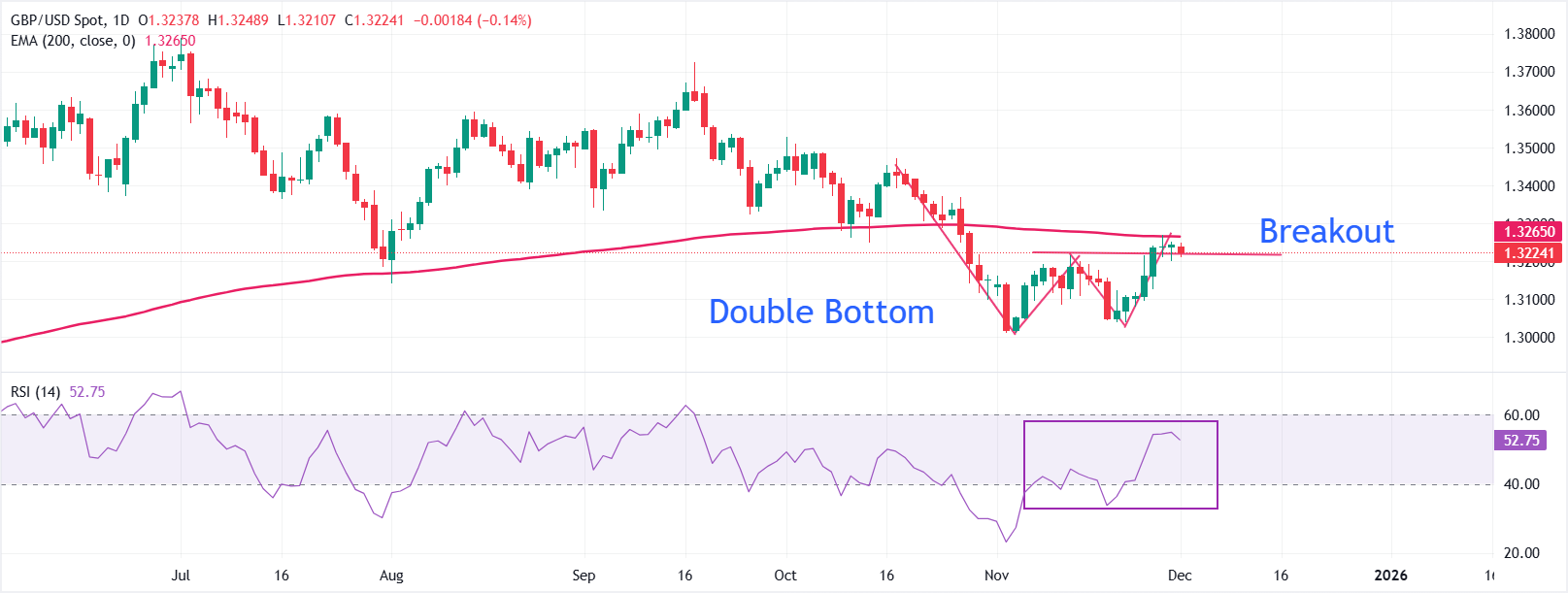
On the daily chart, GBP/USD trades flat at 1.3224 and is expected to attract significant bids as a breakout of a Double Bottom formation has set a bullish reversal. However, the 200-day Exponential Moving Average (EMA) near 1.3265 continues to act as a key barrier for the Pound Sterling bulls.
The Relative Strength Index (RSI) at 52.75 is neutral-to-bullish, reflecting a steady recovery in momentum.
Looking up, the Cable could strengthen if it decisively breaks above the 200-day EMA. Such a scenario could lead the pair towards the October 28 high around 1.3370. On the downside, the November 21 low around 1.3040 will remain a key support level for the pair.
(The technical analysis of this story was written with the help of an AI tool.)
Pound Sterling FAQs
The Pound Sterling (GBP) is the oldest currency in the world (886 AD) and the official currency of the United Kingdom. It is the fourth most traded unit for foreign exchange (FX) in the world, accounting for 12% of all transactions, averaging $630 billion a day, according to 2022 data. Its key trading pairs are GBP/USD, also known as ‘Cable’, which accounts for 11% of FX, GBP/JPY, or the ‘Dragon’ as it is known by traders (3%), and EUR/GBP (2%). The Pound Sterling is issued by the Bank of England (BoE).
The single most important factor influencing the value of the Pound Sterling is monetary policy decided by the Bank of England. The BoE bases its decisions on whether it has achieved its primary goal of “price stability” – a steady inflation rate of around 2%. Its primary tool for achieving this is the adjustment of interest rates. When inflation is too high, the BoE will try to rein it in by raising interest rates, making it more expensive for people and businesses to access credit. This is generally positive for GBP, as higher interest rates make the UK a more attractive place for global investors to park their money. When inflation falls too low it is a sign economic growth is slowing. In this scenario, the BoE will consider lowering interest rates to cheapen credit so businesses will borrow more to invest in growth-generating projects.
Data releases gauge the health of the economy and can impact the value of the Pound Sterling. Indicators such as GDP, Manufacturing and Services PMIs, and employment can all influence the direction of the GBP. A strong economy is good for Sterling. Not only does it attract more foreign investment but it may encourage the BoE to put up interest rates, which will directly strengthen GBP. Otherwise, if economic data is weak, the Pound Sterling is likely to fall.
Another significant data release for the Pound Sterling is the Trade Balance. This indicator measures the difference between what a country earns from its exports and what it spends on imports over a given period. If a country produces highly sought-after exports, its currency will benefit purely from the extra demand created from foreign buyers seeking to purchase these goods. Therefore, a positive net Trade Balance strengthens a currency and vice versa for a negative balance.
Recommended Articles


