


VOOG: Is This Vanguard ETF a Better Way to Buy the Nasdaq-100?
Key Points
The Vanguard S&P 500 Growth ETF has delivered annualized returns of 16.7% for more than 15 years.
The Invesco QQQ Trust has still outperformed it.
Buying the Qs is tough to beat if you want to invest in a low-cost portfolio of major tech names.
- 10 stocks we like better than Vanguard Admiral Funds - Vanguard S&P 500 Growth ETF ›
If you want to buy America's most prominent tech stocks, one of the easiest ways to do that is to buy the Invesco QQQ Trust (NASDAQ: QQQ). This fund tracks the tech-heavy Nasdaq-100 index, so it gives you exposure to all the major tech names driving the artificial intelligence (AI) boom. And this tech ETF is so well-regarded and popular that it's known by its nickname: "The Qs."
In the past 10 years, the ETF has delivered average annual returns of 21.1%. This fund has outperformed the S&P 500 index 88% of the time during the past 10 years. Why would anyone buy anything else?
Will AI create the world's first trillionaire? Our team just released a report on the one little-known company, called an "Indispensable Monopoly" providing the critical technology Nvidia and Intel both need. Continue »
Some investors might not want to buy the Qs but still want exposure to major tech stocks. Some investors might not have access to the Qs through their retirement plan or brokerage account platform. If you want an alternative to buying the Invesco QQQ Trust, Vanguard offers a low-cost index fund called the Vanguard S&P 500 Growth ETF (NYSEMKT: VOOG), which could be a good choice.

Image source: Getty Images.
Let's look at the Vanguard S&P 500 Growth ETF and see if it could take the place of the Qs in your portfolio.
Vanguard S&P 500 Growth ETF: 145 stocks, 16.7% annualized returns for 15 years
When you buy the Vanguard S&P 500 Growth ETF, you're not exactly buying the Nasdaq-100 index. This fund holds 145 stocks, instead of 102 in the Qs. And the Vanguard ETF is not as tech-heavy as the Invesco QQQ Trust.
The Vanguard S&P 500 Growth ETF is also not a typical S&P 500 ETF. Instead of tracking the entire S&P 500, it only invests in the Standard & Poor's 500 Growth Index, made up of stocks that are expected to offer high potential for investment growth.
As of April 30, this fund has delivered average annual returns (by net asset value) of 26.9% over the past three years, 14.15% over the past five years, and 17.6% over the past 10 years. Since the fund's inception in September 2010, it has delivered annualized returns of 16.7%.
For most of the past year, the Vanguard S&P 500 Growth ETF's performance has tracked fairly closely to the Qs. But in late April, with the recent tech rally, the Invesco ETF started to outpace the Vanguard fund. The Qs have gained 42% in the past year, while the Vanguard S&P 500 Growth ETF is up 35.2%.
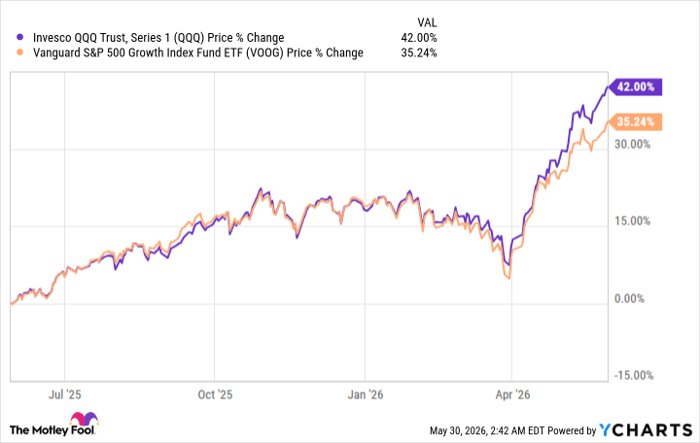
QQQ data by YCharts
The Qs have outperformed even more strongly over a longer five-year time frame. The Invesco QQQ Trust has delivered a five-year cumulative return of 103.8% (by net asset value), compared with 93.8% for the Vanguard S&P 500 Growth ETF.
This shows how hard it is to outperform the Qs. The Vanguard S&P 500 Growth ETF has almost doubled in value in the past five years -- and investors would still have earned a better return from the Invesco QQQ Trust.
VOOG vs. QQQ: Head-to-head comparison
While 63.6% of the Invesco QQQ Trust ETF's assets are in technology sector stocks, only 49.2% of the Vanguard ETF's holdings are in tech. Here are the top five sector holdings in the Vanguard S&P 500 Growth ETF, and how they compare to the Qs:
|
Vanguard S&P Growth ETF |
Invesco QQQ Trust |
|---|---|
|
Technology (49.2% of the fund) |
Technology (63.6% of the fund) |
|
Communication services (17.6%) |
Consumer discretionary (19.7%) |
|
Consumer discretionary (9.3%) |
Healthcare (4.2%) |
|
Financials (8.9%) |
Telecommunications (3.4%) |
|
Industrials (6.7%) |
Industrials (3.3%) |
Data sources: Vanguard, Invesco.
Both funds offer exposure to most of the same major tech names, but at slightly different levels of concentration. The top five stock holdings in each fund are:
|
Vanguard S&P Growth ETF (as of April 30) |
Invesco QQQ Trust (as of May 27) |
|---|---|
|
Nvidia (14.6% of the fund) |
Nvidia (8.3% of the fund) |
|
Alphabet (12.1%) |
Apple (7.3%) |
|
Microsoft (9.1%) |
Alphabet (6.97%) |
|
Apple (5.98%) |
Microsoft (5.1%) |
|
Broadcom (5.9%) |
Amazon (4.7%) |
Data sources: Vanguard, Invesco
What about dividends, price to earnings (P/E) ratios, and expenses? Here's a quick breakdown of those key metrics:
|
Metric |
Vanguard S&P Growth ETF |
Invesco QQQ Trust |
|---|---|---|
|
Trailing 12-month dividend yield |
0.47% |
0.42% |
|
P/E ratio |
33.51 |
36.02 |
|
Expense ratio |
0.07% |
0.18% |
Data source: Yahoo! Finance.
The Vanguard S&P Growth ETF is a slightly lower-cost index fund, but the Invesco QQQ Trust has achieved such strong outperformance that it could be worth paying an extra 11 basis points. Neither of these funds pays huge dividends, but that's typical for growth stocks. And the Vanguard fund might look slightly cheaper based on the earnings multiple, but probably not enough to outweigh the upside of the Qs.
Why buy the Qs instead of VOOG?
I'm usually a big fan of Vanguard ETFs, but in this case, I would recommend buying the non-Vanguard fund. If you want to buy tech stocks, the Invesco QQQ Trust might be too hard to beat.
If you want to get away from tech stocks by buying a more diversified, low-cost index fund to invest in different parts of the market, other Vanguard ETFs can be good for that purpose. But if you really just want the top 100 largest non-financial companies on the Nasdaq, buy the Qs.
Should you buy stock in Vanguard Admiral Funds - Vanguard S&P 500 Growth ETF right now?
Before you buy stock in Vanguard Admiral Funds - Vanguard S&P 500 Growth ETF, consider this:
The Motley Fool Stock Advisor analyst team just identified what they believe are the 10 best stocks for investors to buy now… and Vanguard Admiral Funds - Vanguard S&P 500 Growth ETF wasn’t one of them. The 10 stocks that made the cut could produce monster returns in the coming years.
Consider when Netflix made this list on December 17, 2004... if you invested $1,000 at the time of our recommendation, you’d have $462,983!* Or when Nvidia made this list on April 15, 2005... if you invested $1,000 at the time of our recommendation, you’d have $1,375,447!*
Now, it’s worth noting Stock Advisor’s total average return is 995% — a market-crushing outperformance compared to 212% for the S&P 500. Don't miss the latest top 10 list, available with Stock Advisor, and join an investing community built by individual investors for individual investors.
See the 10 stocks »
*Stock Advisor returns as of June 2, 2026.
Ben Gran has no position in any of the stocks mentioned. The Motley Fool has positions in and recommends Alphabet, Apple, Broadcom, Microsoft, and Nvidia. The Motley Fool has a disclosure policy.
Recommended Articles


