


Zillow Just Painted a Grim Outlook for the Housing Market. Here Are 3 Beaten-Down Stocks to Buy Anyway.
Key Points
Housing demand is weighed down by both high interest rates and home prices relative to household income.
Housing supply is low because new construction isn’t making up for the shortfall in sales of existing homes.
Companies with exposure to the housing market offer an alternative way to benefit from an eventual recovery.
- 10 stocks we like better than Zillow Group ›
Zillow (NASDAQ: ZG) (NASDAQ: Z) stock is hovering around a three-year low. This follows the company's delivery of weak guidance with a forecast for a flat housing market in the second half of the year, even when factoring in a slower-than-expected start to the year.
Here's a look at why the housing market is under pressure, and at three stocks that can reward patient investors.
Will AI create the world's first trillionaire? Our team just released a report on the one little-known company, called an "Indispensable Monopoly" providing the critical technology Nvidia and Intel both need. Continue »

Image source: Getty Images.
The housing-market glut
The housing market is a textbook example of supply and demand. Supply is influenced by housing availability, from existing homes and new builds, which are impacted by zoning and tax laws. Demand fluctuates based on interest rates, lending options, employment, and housing prices relative to the median household income.
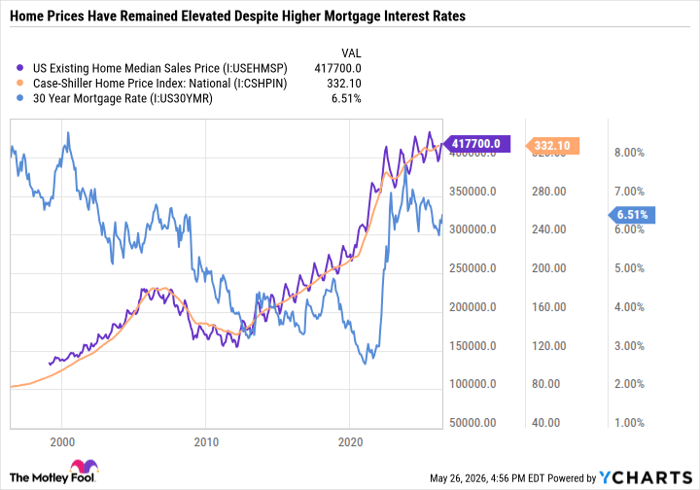
Housing prices surged early in the pandemic as 30-year mortgage interest rates fell to multi-decade lows. But those prices have stayed high even as mortgage rates have climbed far above pre-pandemic levels:
US Existing Home Median Sales Price data by YCharts.
The Case-Shiller U.S. National Home Price Index tracks changes in the value of single-family U.S. homes, similar to how stock market indexes like the S&P 500 and the Dow Jones Industrial Average measure changes in a basket of stocks. As you can see in the above chart, the Case-Shiller index and the median sales price of an existing U.S. home surged in the early 2000s, then pulled back during the Great Recession, but both have rapidly recovered over the last 15 years.
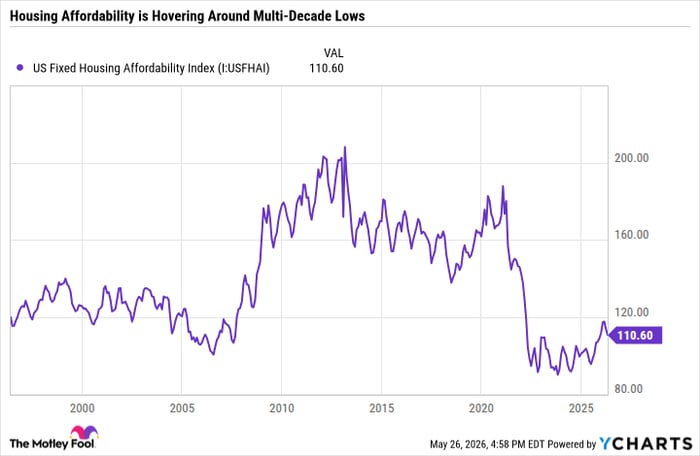
However, housing affordability is now at multi-decade lows, because housing prices have risen significantly faster than household incomes. A value of 100 on the Fixed Housing Affordability Index means that a family with a median household income can qualify for a mortgage on a median home price with a 20% down payment. Historically, the vast majority of households could qualify, but the value fell below 100 in recent years:
US Fixed Housing Affordability Index data by YCharts.
The index would likely be even lower if it focused only on potential first-time homebuyers, as it's somewhat inflated by including existing homeowners, who tend to have higher down payments.
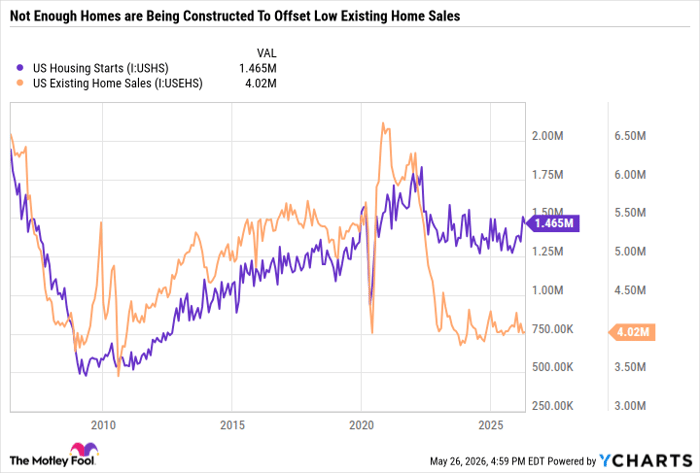
Aside from lowering mortgage interest rates and raising household incomes, another way to make housing more affordable is to increase supply. But as you can see in the following chart, U.S housing starts have flatlined while U.S. existing home sales are near multi-decade lows:
US Housing Starts data by YCharts.
This means that developers aren't building new units fast enough, and existing homeowners aren't rushing to sell their homes, which reduces supply. Throw in the inflationary pressure of higher oil prices, and it's understandable that housing demand remains constrained.
The growth play
Zillow thrives when homes are rapidly changing hands in a hot housing market. But it's proving that it can still generate strong results even during a slowdown.
The company has a highly valuable database that connects real estate professionals, buyers, sellers, and renters. It sells software, tools, and advertising options to industry professionals, agents, and property management companies looking to reach potential customers. Zillow Home Loans offers financing for home purchases.
However, traffic to Zillow's mobile apps and site was down 3% year over year in its latest quarter. Since the platform is free, Zillow still has a massive user base, with 220 million average monthly unique users. Despite the slower traffic, revenue jumped 18%, and the company is now consistently profitable.
For long-term investors looking for a growth stock poised to recover in lockstep with the housing market, Zillow looks like a great buy.
The income and value play
Home Depot (NYSE: HD) is the largest home-improvement retailer in the world. But because it operates exclusively in the U.S., Canada, and Mexico (with the vast majority of its business in the U.S.), the company is extremely sensitive to consumer spending and the U.S. housing market.
When interest rates are low and household incomes are rising, folks may be more inclined to improve their existing home or to buy a home that needs improvements. Home Depot has been in a multiyear slowdown because its customers are putting off big-ticket home improvement projects.
In the latest quarter, the average ticket rose 2.2% while overall transaction volume fell 1.3%. Home Depot's operating margins have been ticking down, and revenue is growing at a relatively low rate.
However, Home Depot is a coiled spring for a recovery in the housing market, because the company continues to build new stores, reinnovate existing stores, and expand its contractor business to diversify its revenue stream.
Home Depot also has a history of 18 consecutive years of dividend raises, and currently yields a sizable 3%. That makes it a top choice for dividend stock investors.
The balanced play
You may be familiar with Sherwin-Williams (NYSE: SHW) through either its own stores or its channel partners like Lowe's Companies that sell Sherwin-Williams-branded products. You might also know its other company-owned brands, such as Valspar paints and coatings, Cabot wood care and stain products, or Krylon spray paint. Sherwin-Williams also has a sizable performance coatings division, which made up 29% of 2025 sales.
A good chunk of its retail business is commercial and industrial -- not residential. It also has a significant international segment, making it less dependent on U.S consumers.
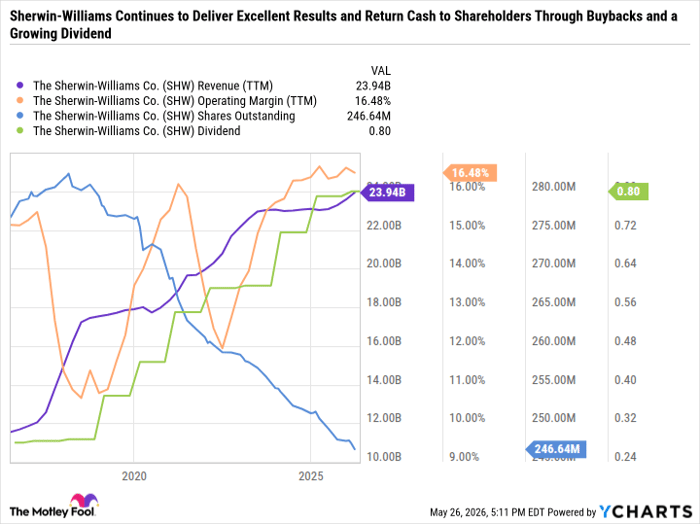
As a result, Sherwin-Williams has been less affected by the housing-market slowdown than Zillow and Home Depot, with strong margins and all-time-high sales. Its growth has allowed it to steadily repurchase a ton of stock and boost its dividend for 47 consecutive years, including some massive raises that have nearly tripled the dividend over the last decade:
SHW Revenue (TTM) data by YCharts.
Sherwin-Williams does have a premium valuation compared to Home Depot, and a far lower yield at just 1%. But for investors looking for a stock that benefits from a strong housing market, it's a solid buy, and it's less of a pure play than Zillow and Home Depot.
Should you buy stock in Zillow Group right now?
Before you buy stock in Zillow Group, consider this:
The Motley Fool Stock Advisor analyst team just identified what they believe are the 10 best stocks for investors to buy now… and Zillow Group wasn’t one of them. The 10 stocks that made the cut could produce monster returns in the coming years.
Consider when Netflix made this list on December 17, 2004... if you invested $1,000 at the time of our recommendation, you’d have $465,733!* Or when Nvidia made this list on April 15, 2005... if you invested $1,000 at the time of our recommendation, you’d have $1,313,467!*
Now, it’s worth noting Stock Advisor’s total average return is 985% — a market-crushing outperformance compared to 211% for the S&P 500. Don't miss the latest top 10 list, available with Stock Advisor, and join an investing community built by individual investors for individual investors.
See the 10 stocks »
*Stock Advisor returns as of May 29, 2026.
Daniel Foelber has positions in Home Depot. The Motley Fool has positions in and recommends Home Depot and Zillow Group. The Motley Fool recommends Lowe's Companies and Sherwin-Williams. The Motley Fool has a disclosure policy.
Recommended Articles


