


Think Inflation Is Fed Chair Kevin Warsh's Biggest Challenge? Guess Again...
Key Points
Jerome Powell's second term as Fed chair ended on May 15, with President Donald Trump's nominee, Kevin Warsh, succeeding him.
Although Kevin Warsh is inheriting two price shocks and a rapid rise in inflation, higher prices aren't his biggest dilemma as Fed chair.
There's nothing more important to sustaining the Trump bull market than getting all FOMC members on the same page and maintaining Federal Reserve credibility in the eyes of investors.
- 10 stocks we like better than S&P 500 Index ›
The well-telegraphed change at America's foremost financial institution that Wall Street has been waiting for has occurred. May 15 marked the final day of Jerome Powell's second term as Fed chair, paving the way for President Donald Trump's nominee, Kevin Warsh, to begin his term as head of the central bank.
It also marks the start of a period of heightened uncertainty for the Dow Jones Industrial Average (DJINDICES: ^DJI), S&P 500 (SNPINDEX: ^GSPC), and Nasdaq Composite (NASDAQINDEX: ^IXIC), which all reached record highs this year.
Will AI create the world's first trillionaire? Our team just released a report on the one little-known company, called an "Indispensable Monopoly" providing the critical technology Nvidia and Intel both need. Continue »
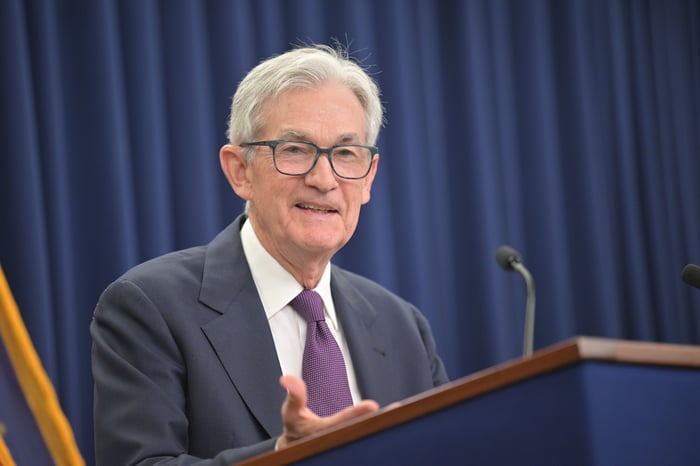
Jerome Powell's term as Fed chair came to a close on May 15. Image source: Official Federal Reserve Photo.
Warsh can expect to be challenged immediately. But while most of Wall Street anticipates his biggest stumbling block will be a rapid increase in inflation, something far more sinister looms large.
Two price shocks have U.S. inflation at a three-year high
There's little question that the Federal Open Market Committee (FOMC) -- the 12-person body, including the Fed chair, responsible for setting the nation's monetary policy -- is in a tough position with regard to inflation.
Warsh is beginning his term at the tail-end of one price shock, President Trump's tariffs, and in the potential early stages of another, the Iran war.
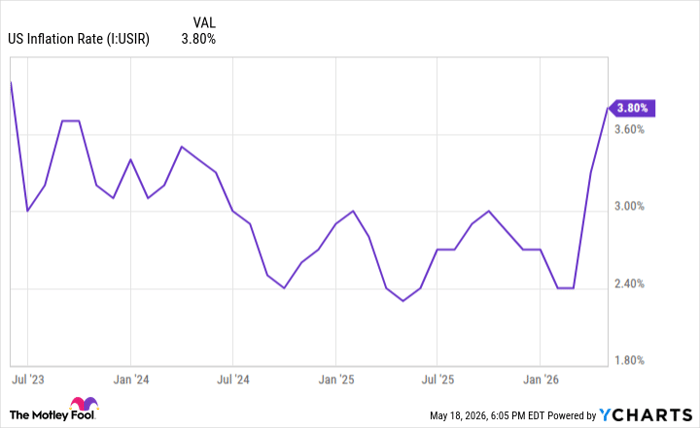
US Inflation Rate data by YCharts.
Trailing 12-month (TTM) inflation clocked in at 2.4% in February, before the effects of the Iran war began showing up in economic data. In April, TTM inflation surged to 3.8%, with energy prices leading the way higher. Iran's closure of the Strait of Hormuz to most commercial vessels has halted the transport of roughly 20 million barrels of petroleum liquids per day.
Inflation isn't showing any signs of slowing down, either. Given that inflationary impacts often lag by a few months for businesses, the Cleveland Fed's Inflation Nowcasting tool predicts the TTM inflation rate ending in May will rise another 38 basis points to 4.18%.
Navigating rapidly rising inflation without upending the Trump bull market will be a challenge -- but not Warsh's biggest challenge.

Image source: Getty Images.
Maintaining central bank credibility is Kevin Warsh's most important task
The toughest task at hand for Trump's handpicked Fed chair is getting FOMC members on the same page on monetary policy.
Although Jerome Powell had the lowest dissent rate of any Fed chair since 1978, his last FOMC meeting was marred by a record four dissents, which hadn't happened since 1992. Stephen Miran favored a quarter-point cut to the federal funds target rate, while three other FOMC members were opposed to the easing bias statement.
NEW: There were *four* dissents on the Fed's rate pause.
-- Nick Timiraos (@NickTimiraos) April 29, 2026
Three bank presidents wanted to ditch the easing bias, and a governor dissented for a rate cut.
The last meeting with four dissents was in 1992. pic.twitter.com/JM88jOXIAg
For several decades, Wall Street has become accustomed to the idea of the Federal Reserve serving as a foundational pillar for the stock market. Even though the FOMC is often behind the curve with its monetary policy moves -- a function of basing these moves on backward-looking economic data -- investors are forgiving as long as all members share the same vision.
If Warsh is unsuccessful in bridging the ideological gap that's led to seven consecutive FOMC meetings with at least one dissent, there's the real risk of the Federal Reserve losing credibility in the eyes of investors. A fractured FOMC may be virtually impossible for a historically expensive stock market to tolerate, and it can send the Dow Jones Industrial Average, S&P 500, and Nasdaq Composite tumbling from their respective pedestals.
Should you buy stock in S&P 500 Index right now?
Before you buy stock in S&P 500 Index, consider this:
The Motley Fool Stock Advisor analyst team just identified what they believe are the 10 best stocks for investors to buy now… and S&P 500 Index wasn’t one of them. The 10 stocks that made the cut could produce monster returns in the coming years.
Consider when Netflix made this list on December 17, 2004... if you invested $1,000 at the time of our recommendation, you’d have $481,750!* Or when Nvidia made this list on April 15, 2005... if you invested $1,000 at the time of our recommendation, you’d have $1,352,457!*
Now, it’s worth noting Stock Advisor’s total average return is 990% — a market-crushing outperformance compared to 206% for the S&P 500. Don't miss the latest top 10 list, available with Stock Advisor, and join an investing community built by individual investors for individual investors.
See the 10 stocks »
*Stock Advisor returns as of May 21, 2026.
Sean Williams has no position in any of the stocks mentioned. The Motley Fool has no position in any of the stocks mentioned. The Motley Fool has a disclosure policy.
Recommended Articles


