


Indian Rupee ticks up against US Dollar on RBI’s likely intervention
- The Indian Rupee edges higher against the US Dollar on Tuesday amid possible RBI intervention.
- Higher oil prices to restrict upside in the Indian currency.
- The US aims to isolate Iran from the global financial system.
The Indian Rupee (INR) trades marginally higher against the US Dollar (USD) in the opening session on Tuesday. The USD/INR pair ticks lower to near 95.70 as the Indian Rupee edges up amid possible Reserve Bank of India’s (RBI) intervention in the spot and Non-Deliverable Forwards (NDFs) market to counter one-sided excessive moves against the domestic currency.
USD/INR pegged in the 95.50-96 range in near term, with RBI interventions curbing gains, traders say, Reuters reported.
Tactical support from the Indian central bank could prove to be short-lived as global energy prices remain broadly higher due to the prolonged closure of the Strait of Hormuz, a critical chokepoint for almost 20% of global energy supply.
In the opening trade, the MCX Crude Oil contract expiring on September 21 trades 0.25% higher to near Rs. 8,160, closer to its four-week high of Rs. 8,404 posted last week.
Currencies from economies, such as India, which rely heavily on oil imports to meet their energy needs, tend to underperform in a high-oil-price environment.
US warns to tighten sanctions on Iran
On Monday, United States (US) Treasury Secretary Scott Bessent warned of extending economic pressure to isolate Iran from the global financial system. Bessent said that the US is launching "an economic onslaught against Iran's financial connections around the globe". At a press conference, Bessent outlined plans to launch an "economic D-Day" on Iran and stated the US would pursue a "zero leakage" approach to enforcing its sanctions.
US Treasury Secretary Bessent added that every country has been given a defined timeline to shut down activities the Treasury has identified, including closing Iran's bank branches abroad. Where governments fail to act, he said, the US would move unilaterally through Treasury authorities. He made clear the pressure extends to the largest economies, stating that no one, including China, is above the reach of US sanctions.
In response, Iran said that it is fully prepared to counter US economic sanctions, while remaining confident that “Neither China nor Russia had accepted the US measures," predicting “other countries would resist them.”
Financial markets worry that US economic sanctions could fuel oil prices further, which would strengthen the US Dollar and US Treasury Yields, a scenario that could raise fiscal concerns for Washington itself.
MUFG warns of D-Day shock risk
Analysts at MUFG highlight that Iran has warned “not a single drop of oil” will pass through the Strait of Hormuz if the US proceeds with its so‑called Economic D-Day plan, yet they note that “the oil markets does not seem to believe Iran with Brent crude oil down 1.4% so far today.” MUFG cautions that the risk lies less in the immediate price action and more in the potential escalation path: “if China was to by hit hard possibly via its refiners or banks that would signal an escalation that would likely prompt a response from China.” In such a scenario, they argue, “if the action is seen a credible and severe we would certainly see crude oil bouncing back and the Dollar would initially at least strengthen.” MUFG also links this to the rates backdrop, warning that “if crude oil prices have also risen due to a severe D-Day plan, we may see the 30-year yield break above the 5.34% high set last week.”
USD/INR Technical Analysis
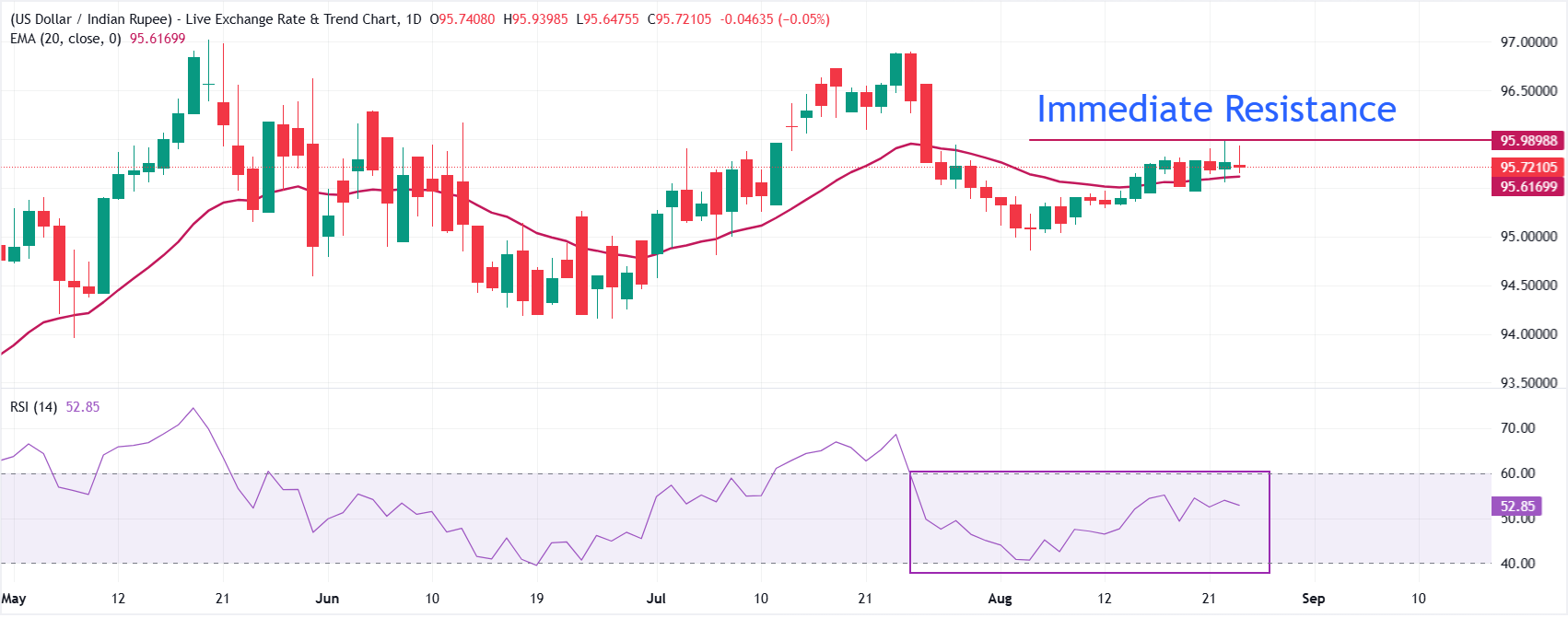
USD/INR trades at 95.72. The pair holds a mild bullish bias as it trades above the 20-day Exponential Moving Average (EMA) at 95.61, suggesting underlying demand on dips, while momentum remains constructive with the Relative Strength Index (RSI) hovering just above the neutral 50 line.
On the downside, initial support is seen at the 20-day EMA near 95.62, followed by the August 12 low at 95.29. Looking up, the August 24 high at 95.98 is the immediate resistance; a decisive break above that would improve the chances for the pair to revisit the all-time high near 97.10.
(The technical analysis of this story was written with the help of an AI tool. Know more.)
Indian Rupee FAQs
The Indian Rupee (INR) is one of the most sensitive currencies to external factors. The price of Crude Oil (the country is highly dependent on imported Oil), the value of the US Dollar – most trade is conducted in USD – and the level of foreign investment, are all influential. Direct intervention by the Reserve Bank of India (RBI) in FX markets to keep the exchange rate stable, as well as the level of interest rates set by the RBI, are further major influencing factors on the Rupee.
The Reserve Bank of India (RBI) actively intervenes in forex markets to maintain a stable exchange rate, to help facilitate trade. In addition, the RBI tries to maintain the inflation rate at its 4% target by adjusting interest rates. Higher interest rates usually strengthen the Rupee. This is due to the role of the ‘carry trade’ in which investors borrow in countries with lower interest rates so as to place their money in countries’ offering relatively higher interest rates and profit from the difference.
Macroeconomic factors that influence the value of the Rupee include inflation, interest rates, the economic growth rate (GDP), the balance of trade, and inflows from foreign investment. A higher growth rate can lead to more overseas investment, pushing up demand for the Rupee. A less negative balance of trade will eventually lead to a stronger Rupee. Higher interest rates, especially real rates (interest rates less inflation) are also positive for the Rupee. A risk-on environment can lead to greater inflows of Foreign Direct and Indirect Investment (FDI and FII), which also benefit the Rupee.
Higher inflation, particularly, if it is comparatively higher than India’s peers, is generally negative for the currency as it reflects devaluation through oversupply. Inflation also increases the cost of exports, leading to more Rupees being sold to purchase foreign imports, which is Rupee-negative. At the same time, higher inflation usually leads to the Reserve Bank of India (RBI) raising interest rates and this can be positive for the Rupee, due to increased demand from international investors. The opposite effect is true of lower inflation.
Artigos Recomendados


