


Pound Sterling drops as UK Retail Sales decline sharply in October
- The Pound Sterling faces selling pressure as UK Retail Sales declined by 1.1% in October compared with the previous month.
- Investors await UK-US flash S&P Global PMI data for November.
- Fed’s Hammack said that high inflation is the real issue of the economy.
The Pound Sterling (GBP) falls sharply against its major currency peers on Friday and trades broadly stable against the US Dollar (USD) after the release of poor United Kingdom (UK) Retail Sales data for October.
The Office for National Statistics (ONS) reported that Retail Sales, a measure of consumer spending, declined by 1.1% month-on-month, a worse-than-expected outcome as analysts forecasted sales to remain flat. In September, the indicator rose by 0.7%, revised higher from the 0.5% initially estimated.
On an annual basis, Retail Sales grew by 0.2% against estimates of 1.5% and the prior release of 1%, which was downwardly revised from 1.5%.
The report showed that sales receipts at Textile clothing and footwear stores fell 3.3% on month, which remained a major drag on overall retail sales.
A sharp decline in Retail Sales is expected to further intensify Bank of England (BoE) dovish expectations, which have already accelerated significantly this month due to cooling inflationary pressures and weakening job market conditions.
Going forward, the major trigger for the Pound Sterling will be the UK Autumn Budget announcement on November 26, in which Chancellor of the Exchequer Rachel Reeves is expected to raise income taxes on households to fill the £22 billion shortfall in the government's finances.
Daily digest market movers: Pound Sterling holds immediate lows against US Dollar
- The Pound Sterling strives to hold its immediate low of 1.3050 against the US Dollar (USD) during the European trading session on Friday. The GBP/USD pair remains broadly under pressure also due to a stronger US Dollar, which are supported by increasing speculation that the Federal Reserve (Fed) could refrain from cutting interest rates again in the December policy meeting.
- At the press time, the US Dollar Index (DXY), which tracks the Greenback’s value against six major currencies, ticks slightly down to near 100.10. Still, the index is close to its over five-month high of 100.36.
- According to the CME FedWatch tool, the probability of the Fed cutting interest rates by 25 basis points (bps) to 3.50%-3.75% in the December meeting is at 33.1%, down from 44.4%a week ago.
- Traders have pared Fed dovish bets as officials have been stressing the need to bring inflation down, which has remained well above the central bank’s 2% target. On Thursday, Cleveland Fed Bank President Beth Hammack stated that high inflation is the “real issue” of the economy, adding that “inflation is still too high and trending in the wrong direction”, which calls for the need to keep the monetary policy “somewhat restrictive”.
- The Federal Open Market Committee (FOMC) minutes of the October policy meeting, released on Wednesday, also showed that many officials expressed the need to hold interest rates steady in December to control inflation.
- In Friday’s session, investors will focus on the preliminary UK and US S&P Global Purchasing Managers’ Index (PMI) data for November. Private-sector activity growth in both countries is expected to have slowed down.
Technical Analysis: Pound Sterling faces pressure from 20-day EMA
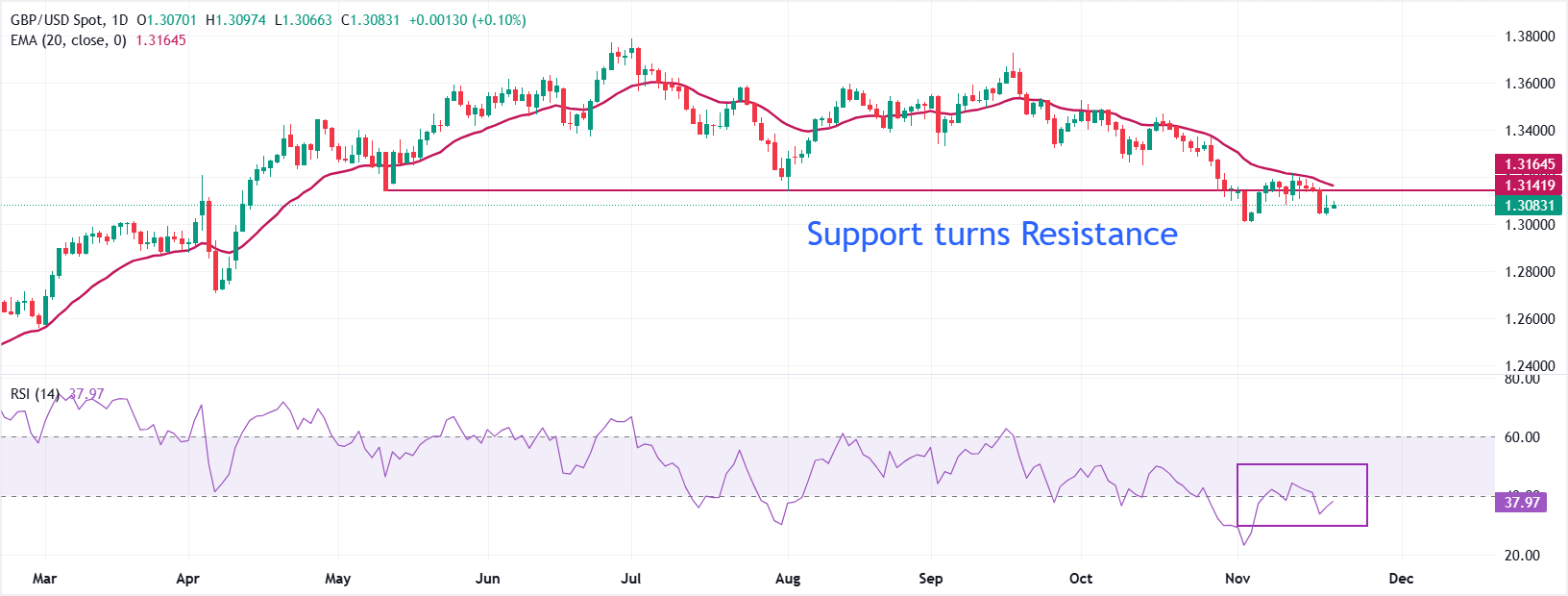
The Pound Sterling continues to struggle near a two-week low around 1.3030 against the US Dollar. The overall trend of the GBP/USD pair remains bearish as the 20-day Exponential Moving Average (EMA), which trades around 1.3165, slopes downwards. The Cable resumed its downside journey after falling below the August low of around 1.3140, which had been a key support zone.
The 14-day Relative Strength Index (RSI) remains below 40.00, indicating a fresh bearish momentum ahead.
Looking down, the April low near 1.2700 will act as a key support zone. On the upside, the October 28 high around 1.3370 will act as a key barrier.
Pound Sterling FAQs
The Pound Sterling (GBP) is the oldest currency in the world (886 AD) and the official currency of the United Kingdom. It is the fourth most traded unit for foreign exchange (FX) in the world, accounting for 12% of all transactions, averaging $630 billion a day, according to 2022 data. Its key trading pairs are GBP/USD, also known as ‘Cable’, which accounts for 11% of FX, GBP/JPY, or the ‘Dragon’ as it is known by traders (3%), and EUR/GBP (2%). The Pound Sterling is issued by the Bank of England (BoE).
The single most important factor influencing the value of the Pound Sterling is monetary policy decided by the Bank of England. The BoE bases its decisions on whether it has achieved its primary goal of “price stability” – a steady inflation rate of around 2%. Its primary tool for achieving this is the adjustment of interest rates. When inflation is too high, the BoE will try to rein it in by raising interest rates, making it more expensive for people and businesses to access credit. This is generally positive for GBP, as higher interest rates make the UK a more attractive place for global investors to park their money. When inflation falls too low it is a sign economic growth is slowing. In this scenario, the BoE will consider lowering interest rates to cheapen credit so businesses will borrow more to invest in growth-generating projects.
Data releases gauge the health of the economy and can impact the value of the Pound Sterling. Indicators such as GDP, Manufacturing and Services PMIs, and employment can all influence the direction of the GBP. A strong economy is good for Sterling. Not only does it attract more foreign investment but it may encourage the BoE to put up interest rates, which will directly strengthen GBP. Otherwise, if economic data is weak, the Pound Sterling is likely to fall.
Another significant data release for the Pound Sterling is the Trade Balance. This indicator measures the difference between what a country earns from its exports and what it spends on imports over a given period. If a country produces highly sought-after exports, its currency will benefit purely from the extra demand created from foreign buyers seeking to purchase these goods. Therefore, a positive net Trade Balance strengthens a currency and vice versa for a negative balance.
Artigos Recomendados


