


Who Can Challenge TSMC? Q1 Net Profit Jumps 58% Year-on-Year, AI Demand Becomes Biggest Driver

 Trending Articles
- US President Donald Trump says trade will be priority in summit with Xi, not Iran
- Gold drifts higher to near $4,750 ahead of US CPI inflation release
- Gold slumps below $4,700 on Trump rejection of Iran peace proposal
- WTI falls to near $93.50 after Israel, Iran signal an end to hostilities
- Inflation 'High Fever' Fails to Stop Rally? BTC Temporarily Loses 80,000 Mark, But Arthur Hayes Sees Peak of $126,000
- When Will the Gold Dilemma Be Resolved? Breakdown of US-Iran Negotiations Puts Gold Prices Under Pressure Again, Can It Return to $5,000?
TradingKey - On April 16, TSMC ( TSM) reported its first-quarter 2026 financial results, with core financial metrics exceeding market expectations across the board and profitability achieving a breakthrough improvement, further solidifying its leading position in the global semiconductor foundry industry.
Financial data showed that TSMC's first-quarter revenue reached NT$1.134 trillion, up 35% year-on-year and slightly higher than the market estimate of NT$1.12 trillion; net profit surged 58% year-on-year to NT$572.5 billion, nearly 6% above analysts' estimates of NT$542.4 billion; and operating profit reached NT$659 billion, also exceeding the estimate of NT$623.8 billion.
Meanwhile, profitability metrics also performed brilliantly, with TSMC's gross margin soaring to 66.2%, up nearly 4 percentage points from the previous quarter's 62.3% and significantly exceeding the market estimate of 64.5%; the operating margin also rose to 58.1%, higher than the estimated 55.6% and the previous quarter's 54.0%.
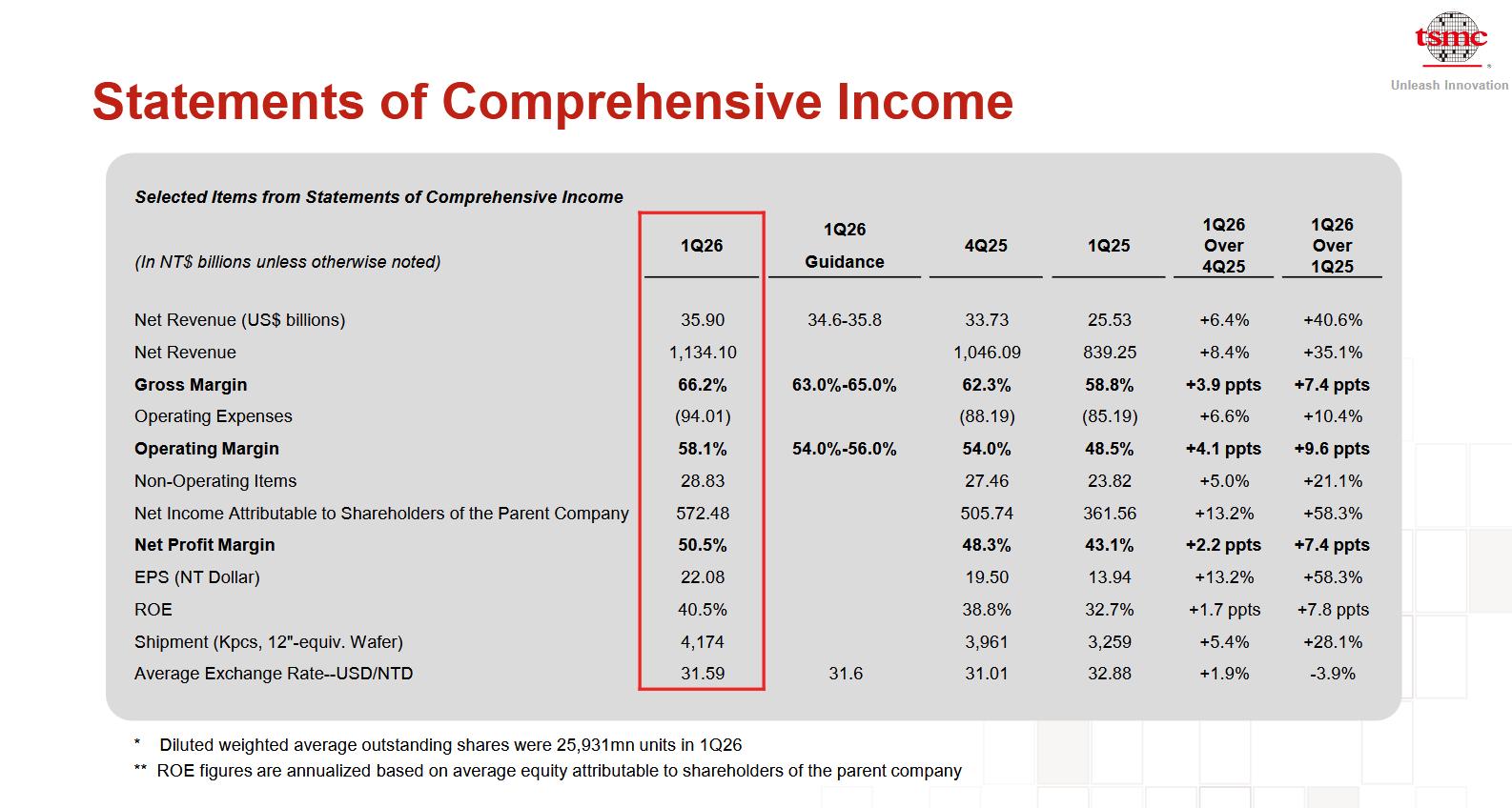
TSMC has set performance records for four consecutive quarters, primarily driven by robust demand for artificial intelligence chips.
Currently, Nvidia ( NVDA) is its largest customer, and the company also manufactures advanced processors for firms such as AMD ( AMD ), Apple ( AAPL ), and others. The revenue share from advanced process nodes continues to rise, as smaller process nodes deliver higher processing power and efficiency, aligning with the AI chip requirement for extreme computing power.
Boosted by the earnings news, TSMC's U.S. shares rose nearly 2% in overnight trading.
Led by Advanced Nodes
Advanced processes remain the core pillar of TSMC's revenue, with the 5nm process leading at a 36% share and the 3nm process reaching 25%. Together, they contribute over 60% of total revenue, with growth momentum accelerating quarter-over-quarter.
From Q1 2024 to Q1 2026, quarterly revenue from 7nm and below processes has nearly doubled, with these advanced nodes accounting for 74% of total wafer sales this quarter. The transition of advanced processes toward 3nm and below nodes continues to outpace market expectations, aligning perfectly with the urgent global demand for extreme computing power in AI chips.
By application platform, High-Performance Computing (HPC) has become TSMC's largest revenue source, accounting for 61% of revenue this quarter and showing a trend of accelerating concentration.
Additionally, the smartphone platform ranked second with a 26% share, remaining relatively stable driven by the stocking cycle for flagship models. The Internet of Things (IoT) platform accounted for 6%, automotive electronics for 4%, and DCE and other businesses combined for just 3%.
TSMC Sets Clear Full-Year Growth Target
In the subsequent earnings conference call, TSMC executives further disclosed full-year development plans, noting that capital expenditure for 2026 will lean toward the upper end of the $52 billion to $56 billion range. Full-year sales growth in U.S. dollar terms is expected to exceed 30%, while second-quarter revenue is projected to fall between $39 billion and $40.2 billion, representing significant growth from the $30.07 billion recorded in the same period of 2025. Meanwhile, gross margin is expected to remain between 65.5% and 67.5%, and operating margin between 56.5% and 58.5%, with both profitability indicators exceeding previous market consensus expectations.
Regarding market concerns over the impact of geopolitical tensions in the Middle East, TSMC stated clearly that demand in the artificial intelligence sector remains "extremely strong," with demand signals from customers being clear and urgent; currently, the company's overall capacity remains tight.
In the face of external uncertainties, TSMC is prudently planning its business layout and closely tracking the impact of rising component prices on production costs. The company also emphasized that procurement channels for key raw materials such as helium and hydrogen are diversified, ensuring that supply will not be affected in the short term, and global energy fluctuations will not have an immediate impact on operations.
Regarding capacity and technology layout, TSMC's 2-nanometer (N2) process has entered the mass production stage. To meet the robust demand in the AI field, the company is increasing capital expenditures to expand 3-nanometer (N3) process capacity. In terms of overseas layout, mature process capacity in Japan and Germany continues to rise, while the company plans to gradually shut down 6-inch wafer fabs to dynamically optimize global capacity allocation.
When asked about the competition from Intel ( INTC) and Tesla ( TSLA) teaming up to build their own 2-nanometer wafer fab, Terafab, TSMC Chairman C.C. Wei responded that it takes three to five years for a new chip factory to move from construction to capacity ramp-up. He expressed full confidence in TSMC's technological position, noting that Intel is both a competitor and a customer.
As Asia's most valuable technology company, TSMC still holds stable orders from core customers like Apple, and demand for its advanced semiconductor products has not been significantly impacted by geopolitical situations.
The release of the Q1 2026 financial report further solidified TSMC's leading position in the global semiconductor market, particularly in advanced chip technology—with 3nm chip revenue accounting for 25% of total wafer revenue. This data directly confirms TSMC's leading edge in cutting-edge manufacturing technology, which is crucial for developments in high-performance computing, mobile devices, and other sectors.
Read more
* The content presented above, whether from a third party or not, is considered as general advice only. This article should not be construed as containing investment advice, investment recommendations, an offer of or solicitation for any transactions in financial instruments.


