


Is Bloom Energy Really Worth $200 Right Now? Here's the Math.
Key Points
Bloom Energy's third-quarter revenue surged 138%, and it raised its full-year financial guidance again.
At roughly $200 per share, the stock trades for more than 60x the midpoint of its projected 2026 adjusted EPS.
The stock's future returns will depend on both rapid earnings growth and how much investors are willing to pay for those earnings five years from now.
- Motley Fool Issues Rare "Total Conviction" Buy Alert ›
Bloom Energy (NYSE:BE) has emerged as one of the biggest beneficiaries of surging demand for power to support artificial intelligence (AI) data centers. The company's revenue has skyrocketed, and its stock has delivered enormous gains over the past year despite a sharp pullback from its peak.
However, even after that sell-off, shares recently traded around $200. Is Bloom Energy really worth that much?
Missed AI’s "Act 1"? Act 2 Could Be 15x Bigger. Most investors think they missed the AI boat because they didn't buy Nvidia in 2005. But according to our analysts, we’re only at the end of "Act 1"—the R&D phase. "Act 2" is the global rollout. Continue »
To answer that question, investors need to look beyond its impressive growth and consider how much the company's earnings must increase to justify its current valuation.
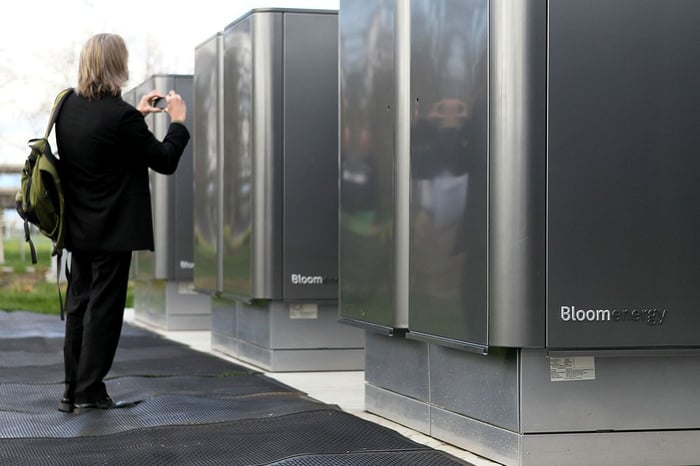
Image source: Getty Images.
Why Bloom's growth is so exciting
Bloom Energy's stock has rallied more than 125% this year and recently traded around $200 per share (though that's well below its peak of over $350). Fueling that rally has been the robust demand for the company's fuel cells, which are becoming essential to powering the AI boom. Bloom's revenue rocketed 138% during the third quarter to $1.2 billion, while its adjusted earnings per share surged more than 500% to $0.94 per share.
The energy company now expects its revenue to grow 122% this year to around $4.5 billion. Meanwhile, it expects to report adjusted earnings of $3.10 to $3.40 per share. That's a more than 300% increase from last year's level of $0.76 per share.
The driving force is surging demand for distributed power (on-site), particularly from data centers. They need reliable electricity and can't afford to wait years for traditional grid connections. As a result, the company's momentum has accelerated throughout 2026, with guidance rising each quarter.
However, extraordinary business growth doesn't automatically make a stock an attractive investment at any price.
The valuation math
With Bloom Energy's stock recently around $200 a share, the fuel cell maker trades at about 61.5x adjusted earnings at the midpoint of its guidance range. That's a high starting valuation, even for a rapidly growing company. The S&P 500 currently trades at 22.4x earnings while the Nasdaq-100 Index fetches 27x earnings.
Here's the issue. Even if Bloom Energy continues to rapidly grow its earnings, it will likely do so into the headwind of a contraction in its valuation multiple. I modeled several different scenarios. Each assumes the company will continue to grow rapidly, though all also anticipate that investors won't be willing to pay as high a price for its future earnings:

Image source: The author.
I want to focus on the optimistic base case. Under that scenario, Bloom Energy delivers 25% annual adjusted earnings-per-share growth over the next five years. However, its valuation multiple is steadily contracting toward a market-average of 25x earnings. That would only deliver a meager 5% annualized total return from the current price of around $200 per share. So, while Bloom would deliver robust growth, investors' returns would underwhelm. To earn a 10% annualized return in the optimistic base case, investors would need to buy Bloom Energy stock at closer to $150 per share.
To achieve higher returns from the current price, Bloom would need to deliver faster growth and maintain a higher valuation multiple. That's demanding, but not impossible for a company expanding as quickly as Bloom.
Are those assumptions realistic?
Bloom is delivering tremendous earnings growth. That should continue for the next several years. It has secured multiple partnerships with leading data center developers, including Oracle and Brookfield. Its Brookfield partnership alone is worth up to $25 billion. Bloom is also expanding internationally and recently signed its biggest international deal.
However, there are a few things that I think warrant some caution. While Bloom Energy is growing its revenue and adjusted earnings rapidly, that growth hasn't yet translated into reliable free cash flow. Bloom used $181 million in cash during the third quarter due to working capital requirements and capital spending. While that's not an issue for a company that currently has $2.5 billion in cash on its balance sheet, it's something to keep watching.
An even bigger potential headwind is dilution. Its shares outstanding have risen 38% over the past year due to stock-based compensation and the issuance of additional shares to fund its growth. Even if its total earnings continue to rise rapidly, additional share issuances could slow the growth rate attributable to each existing share.
Finally, there's growing pushback against new data center developments. A pipeline delay has already pushed back the start date of one of its data center developments with Oracle. Meanwhile, the recent election results could lead to new regulations that slow data center development.
Bullish on the company, not necessarily the stock
Bloom Energy could have an exceptionally bright future as demand for reliable power continues to expand. However, its stock already reflects considerable optimism about that opportunity.
Even assuming 25% annual earnings growth over the next five years, investors buying near $200 could earn disappointing returns if the valuation multiple contracts. And that projection doesn't fully capture the risks associated with Bloom's capital spending, cash flow, and potential dilution.
I think Bloom is an exciting company with considerable growth potential. But the math suggests that $200 is still too high a price to pay for Bloom Energy right now.
Should you buy stock in Bloom Energy right now?
Before you buy stock in Bloom Energy, consider this:
The Motley Fool Stock Advisor analyst team just identified what they believe are the 10 best stocks for investors to buy now… and Bloom Energy wasn’t one of them. The 10 stocks that made the cut could produce monster returns in the coming years.
Consider when Netflix made this list on December 17, 2004... if you invested $1,000 at the time of our recommendation, you’d have $341,966!* Or when Nvidia made this list on April 15, 2005... if you invested $1,000 at the time of our recommendation, you’d have $1,146,819!*
Now, it’s worth noting Stock Advisor’s total average return is 852% — a market-crushing outperformance compared to 203% for the S&P 500. Don't miss the latest top 10 list, available with Stock Advisor, and join an investing community built by individual investors for individual investors.
See the 10 stocks »
*Stock Advisor returns as of November 9, 2026.
Matt DiLallo has positions in Bloom Energy and Brookfield Asset Management. The Motley Fool has positions in and recommends Bloom Energy, Brookfield Asset Management, and Oracle. The Motley Fool has a disclosure policy.
Recommended Articles


