


SpaceX Stock Price Forecast: Deutsche Bank Says Market Overestimates Political Risk, Sees Pullback as Buying Opportunity With Stock Poised to Rebound to $149
TradingKey - Following the U.S. midterm elections, political risks surrounding SpaceX (SPCX) have become a market focus. On November 5, the company's shares fell by about 9%, touching $120.39 intraday, their lowest level since August 7. Investors are concerned that with Democrats taking control of Congress, scrutiny of businesses owned by Republican backer Elon Musk could intensify, potentially affecting government contracts and business expansion.
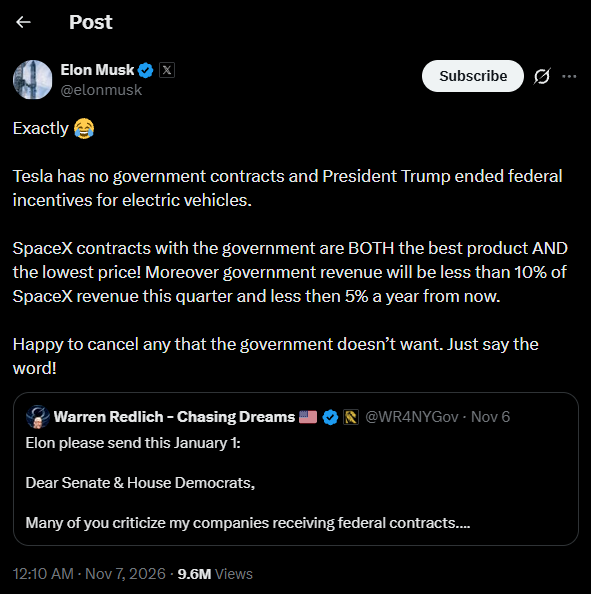
In response to these concerns, Musk stated on the social media platform X that government business accounts for less than 10% of SpaceX's revenue this quarter, and is expected to fall below 5% in a year. He emphasized that the products the company provides to the government offer both performance and cost advantages, and that he is willing to cancel the relevant transactions if the government no longer needs them.
Musk's response points to changes in SpaceX's revenue structure: as its commercial business expands, SpaceX's reliance on government orders is decreasing, and the impact of potential contract adjustments on overall revenue is also expected to diminish.
[Musk's Social Media Post, Source: X]
Deutsche Bank, looking at contractual relationships, argued that market concerns over political retaliation have been overstated and that the recent pullback presents a buying opportunity. The bank noted that SpaceX's launch and satellite communications contracts are primarily signed with federal executive agencies such as NASA and the Space Force, and because the executive branch remains under Republican control, shifts in congressional control will not directly alter existing contracts. Furthermore, viable alternative suppliers are lacking for certain operations, meaning that cutting related budgets could harm U.S. interests and raise the actual costs of intervention.
Compared to federal contracts, Deutsche Bank views Texas policy as a more direct risk. Democratic Governor-elect Gina Hinojosa advocates pausing data center expansion until protective measures are implemented, which could impact project approvals and construction timelines.
However, Deutsche Bank expects policy is more likely to shift toward stringent scrutiny rather than a blanket ban on construction. According to the bank's estimates, most of the 8 to 10 gigawatts of computing capacity SpaceX plans to deploy by 2027 are located outside Texas, meaning the impact on near-term earnings forecasts should be limited; expansion plans beyond 2028, however, are more susceptible to regulatory changes.
This also underpins Deutsche Bank's rationale for seeing opportunity in the pullback: the share of government orders is falling, and the existing computing capacity footprint partially diversifies Texas policy risk. However, as AI operations expand, SpaceX's future growth will rely more heavily on the delivery of new computing capacity. If stricter approvals lengthen construction cycles and drive up capital expenditures, they could still affect subsequent revenue realization and investment returns.
[SpaceX Daily Stock Chart, Source: TradingView]
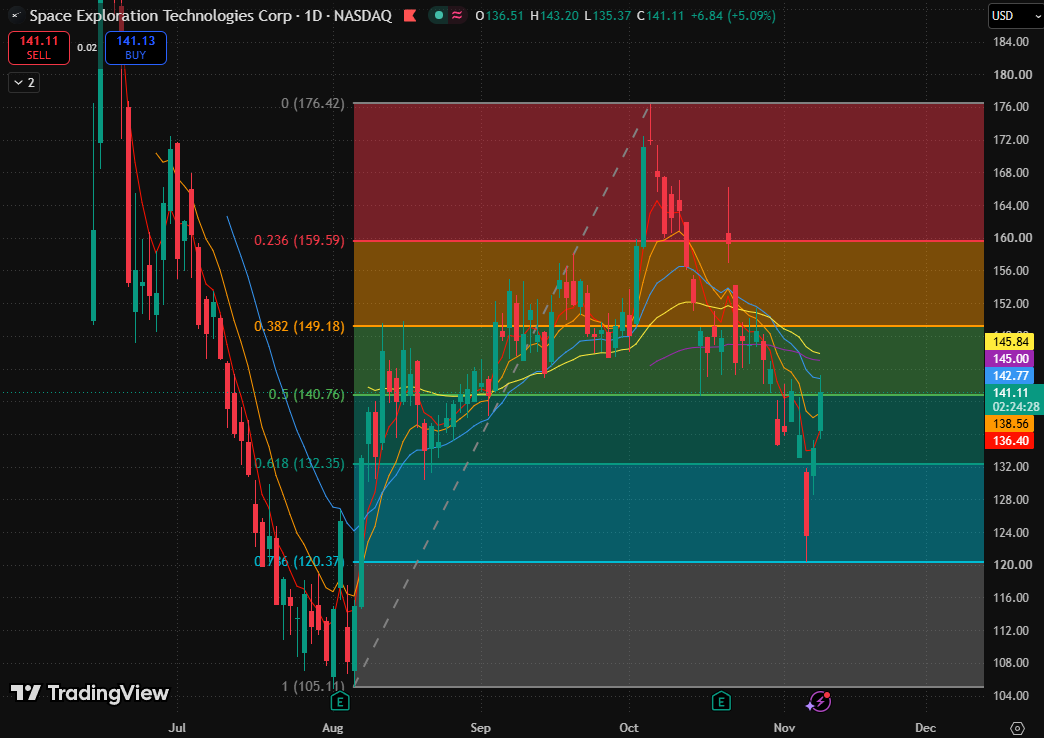
Following the midterm elections, SpaceX's stock found support at the 0.786 Fibonacci retracement level ($120.37). The rebound has now pushed near the 0.5 Fibonacci retracement level ($140.76), with short-term technical recovery noticeably improving; the key focus now is whether $140.76 can turn into pullback support.
If the stock price holds firmly above $140.76 on the daily chart and finds support on a pullback, the next target will be to test the $145.00–$149.18 zone, where two medium-term moving averages and the 0.382 Fibonacci retracement level converge. If it breaks below the short-term moving average band of $136.37–$138.54 and fails to reclaim it on a rebound, the short-term technical recovery will weaken.
Recommended Articles


