


Is Credo Technology Stock a Buy Right Now?
Key Points
Credo Technology has flashed explosive growth, but depends on a handful of large AI hyperscalers.
The stock's valuation has plunged, but it might not be cheap given the new risks of an eroding AI trade.
Strong financials and healthy fundamentals make Credo an intriguing stock, though the risks are real.
- 10 stocks we like better than Credo Technology Group ›
Credo Technology (NASDAQ: CRDO) has been a huge winner over the past several years. Artificial intelligence (AI) hyperscalers are using its connectivity hardware products in their data centers. Shares have risen by more than 880% since its IPO in early 2022.
But investors are grappling with a rapidly changing market climate. Suddenly, AI stocks have come under pressure following the monumental political shift in the wake of America's recent midterm elections. Credo Technology has plunged over 60% from its former high.
Missed AI’s "Act 1"? Act 2 Could Be 15x Bigger. Most investors think they missed the AI boat because they didn't buy Nvidia in 2005. But according to our analysts, we’re only at the end of "Act 1"—the R&D phase. "Act 2" is the global rollout. Continue »
Despite the company's strong performance in recent history, investors may not want to rush into buying shares until the dust settles on the current political landscape. Here's what you need to know.
Future concerns put a damper on some excellent growth numbers
AI data centers need a ton of bandwidth to move data quickly between chips and servers so they can analyze and respond to a prompt quickly. Credo Technology's products help make that happen. Its Active Electrical Cables (AEC) have been primarily responsible for driving Credo Technology's growth.
Image source: The Motley Fool
Revenue increased by 114.7% year over year to $479 million in Q1 of its fiscal 2027. It is hard to fault investors for looking at buying such a steep dip in a stock when the underlying business is thriving like this.
But changes could be coming to the AI industry
On one hand, someone could look at the Q1 2027 results, see the stock is down over 60% from its high, and rush to scoop up shares. But it's not that simple, not anymore.
Data centers are broadly unpopular among consumers, and the recent midterm elections have shifted the balance of political power toward Democrats, who seem to favor a slower pace and more regulations on AI companies.
Any threat to data centers is likely problematic for Credo Technology, which has come to depend on the AI hyperscalers. Two companies, widely believed to be AI hyperscalers, accounted for 71% of total sales in Q1 2027.
A tricky valuation to nail down
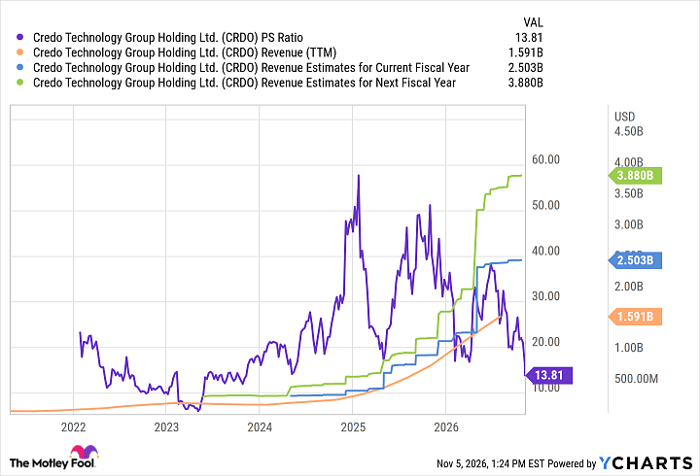
Unfortunately, it's no longer as simple as valuing Credo Technology based on forward-looking revenue estimates. The more uncertainty there is around data center momentum, the more the company's business results might vary over the next 48 months. Sales estimates could easily change if, say, a major customer slashes their data center spending.
CRDO PS Ratio data by YCharts
Although the stock's valuation has come way down from nearly 60 times sales to about 14 times sales, it could be smart to remain patient for a while. The shares could easily continue sliding as the market compensates for the risk of declining data center spending.
Nobody wants to catch a "falling knife," as investors often say. The good news? Credo Technology can still be a long-term winner. It's in solid shape to endure a downturn in AI infrastructure spending. The company has almost zero debt, over $760 million in cash, and is generating tons of free cash flow.
That said, approach with caution. The future is suddenly less certain than it was even a month ago.
Should you buy stock in Credo Technology Group right now?
Before you buy stock in Credo Technology Group, consider this:
The Motley Fool Stock Advisor analyst team just identified what they believe are the 10 best stocks for investors to buy now… and Credo Technology Group wasn’t one of them. The 10 stocks that made the cut could produce monster returns in the coming years.
Consider when Netflix made this list on December 17, 2004... if you invested $1,000 at the time of our recommendation, you’d have $341,966!* Or when Nvidia made this list on April 15, 2005... if you invested $1,000 at the time of our recommendation, you’d have $1,146,819!*
Now, it’s worth noting Stock Advisor’s total average return is 852% — a market-crushing outperformance compared to 203% for the S&P 500. Don't miss the latest top 10 list, available with Stock Advisor, and join an investing community built by individual investors for individual investors.
See the 10 stocks »
*Stock Advisor returns as of November 9, 2026.
Justin Pope has no position in any of the stocks mentioned. The Motley Fool has no position in any of the stocks mentioned. The Motley Fool has a disclosure policy.
Recommended Articles


