


These 6 Telecom Stocks Collect Monthly Bills No Matter What the Market Does
Key Points
A handful of familiar telecommunication companies have loyal customer bases that pay their monthly bills like clockwork.
Thriving in this saturated industry isn’t quite as easy as it used to be, however.
Interested investors should carefully compare and contrast what makes these seemingly-similar outfits different from one another…particularly right now.
- 10 stocks we like better than AT&T ›
Most investors are willing to take the occasional swing on a risky growth stock. The fact is, however, companies like AT&T (NYSE: T), Verizon Communications (NYSE: VZ), T-Mobile US (NASDAQ: TMUS), Comcast (NASDAQ: CMCSA), Charter Communications (NASDAQ: CHTR), and Lumen Technologies (NASDAQ: LUMN) are the kinds of companies that provide the reliable results that investors need.
Their common thread? They're all telecom names with businesses that generate regular revenue from customers paying monthly bills to maintain these connections...at least for the time being. In some of these cases, that could be changing soon.
Missed Nvidia in 2009? This Rare Signal Is Flashing Again. In 2009, a "Double Down" signal flashed for a little-known chipmaker called Nvidia. For the first time in years, that same "Total Conviction" signal is flashing for a company 1/100th the size of Nvidia. Continue »
Here's a closer look at each one and what the foreseeable future holds.
1. AT&T
There was a time when AT&T was not only the biggest and best-known name in the telecom business, but also its best investment. That's not the case anymore, though. With 110.2 million total subscribers (91.7 million of which are phone subscribers), AT&T is now technically behind Verizon and T-Mobile in terms of total wireless market share.
It didn't necessarily have to be this way. AT&T arguably just tried too hard to expand into arenas it thought would be more natural fits. It acquired satellite cable brand DirecTV in 2015, for instance, and then scooped up entertainment powerhouse Time Warner in 2018. Both businesses have since been shed, but at a loss that's still echoing. The company stopped raising its dividend in 2022, aiming to shore up a relatively ugly balance sheet. Although its customers still pay their bills like clockwork, AT&T still has a great deal of work to do to become a top-tier investment again.
2. T-Mobile
Some investors are surprised to learn that T-Mobile, rather than Verizon, is the nation's single-biggest wireless service provider in terms of customer headcount, with 142 million paying customers. Just remember this figure also includes all of the customers that came over from Sprint when the two companies were combined in 2020.
It's been a pretty solid performer too, although not unlike AT&T, its foray into the cable television business with what ended up being launched as TVision in 2019 was probably ill-advised. Meanwhile, it remains to be seen if its at-home wireless internet endeavor will pay off in the long run, although, as of the latest disclosure, there are over 8 million of these broadband customers. Not bad.
3. Verizon
Finally, quietly nestled in between T-Mobile and AT&T is Verizon, which has remained more focused on its core telecom business, investing money where it matters the most, like its fiberoptic network that supports its home-broadband business as well as its wireless operation. It has 11 million traditional fiber-broadband customers, and more than 6 million wireless home-broadband subscribers in addition to its massive mobile phone customer base.
This focus -- paired with capital spending with the biggest ROI -- has been well worth it too. During its recently ended fiscal Q3, the company experienced its strongest third-quarter of postpaid phone customer growth since 2021, and its highest net growth in total accounts in over a decade, prompting Verizon to raise its full-year revenue guidance for a third straight quarter.

Image source: Getty Images.
Shareholders are benefiting from this resiliency in an immediate way as well, with this stock's dividend. It's now been raised for 20 consecutive years, reflecting the company's ongoing growth. You can plug into this ticker while its forward-looking yield stands at 6.2%, which is the highest among the three mobile telecom names in focus here.
4. Comcast
Technically speaking, Comcast's Xfinity brand is in the wireless telecom business too, with 10.6 million subscribers as of the end of September. It's also parent to television broadcast network NBC and film studio Universal. Its breadwinning businesses are still cable TV and broadband service, though, which account for roughly two-thirds of its quarterly revenue of just under $20 billion.
And that's a problem. For a long while, the growth of its broadband business could offset the slow attrition of cable customers due to cord-cutting. Now that's not even happening. That's why Comcast's overall revenue hasn't grown in years.
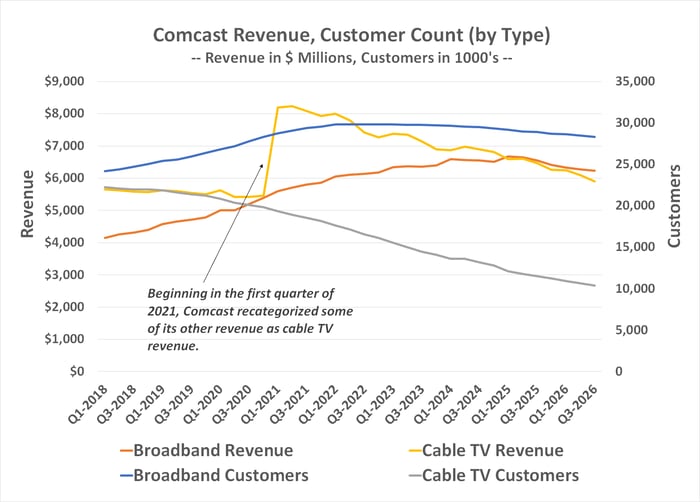
Data source: Comcast Corp. Chart by author.
It's not necessarily the end of the world just yet. Total revenue isn't shrinking either. Customers still need to keep their connections active, and the company is still turning more than enough of their monthly payments into profits, which in turn supports its dividend payment.
For the first time in a long time, though, Comcast didn't raise its per-share payout at the beginning of this year. It may be a hint that the long-term sustainability of its business has reached a tipping point.
5. Charter Communications
You may know Charter Communications better by its operating brand name Spectrum, which offers cable television and broadband internet service, although, like Comcast, it's also easing into the wireless telecom arena. It was serving 13.5 million mobile customers as of the end of September, which is roughly one-third of its total 36.7 million customer relationships.
Like Comcast, this pure(r) telecommunications name had been able to offset the impact of the cord-cutting movement with the addition of broadband subscribers. That's not working anymore, however. Revenue has stagnated, even if it continues to flow. Ditto for earnings.
But does it offer a solid dividend until then? Nope, Charter has never paid a dividend, and isn't apt to start now. Instead, it has used its earnings to fund stock buybacks, which does add shareholder value. There's no particularly beneficial endgame in sight for shareholders, however. The company is just mitigating how its business is fading away.
6. Lumen Technologies
Last but not least, Lumen Technologies is one of a handful of telecom outfits with reliable revenue from its customers' monthly bill payments. Just not in the way you might imagine.
It's not a household name. That's because it doesn't serve consumer households. Rather, Lumen offers networking solutions specifically built for artificial intelligence platforms.
The company's near future isn't entirely clear. Although its third-quarter total revenue fell to $2.7 billion, its strategic revenue improved 10% year over year to $1.28 billion thanks to a 24% quarter-to-quarter increase in active customers. It's per-share loss was pared back from $0.20 to a loss of only $0.14 per share this time around, but Lumen shrank its way to that progress.
A bet on Lumen Technologies is still ultimately a bet on the continued proliferation of AI data centers, though, and the subsequent need to make them safer, faster, and more efficient. Just be patient as it makes this transition. It's expected to report slightly lower revenue again next year, as it continues to chip away at its losses.
Should you buy stock in AT&T right now?
Before you buy stock in AT&T, consider this:
The Motley Fool Stock Advisor analyst team just identified what they believe are the 10 best stocks for investors to buy now… and AT&T wasn’t one of them. The 10 stocks that made the cut could produce monster returns in the coming years.
Consider when Netflix made this list on December 17, 2004... if you invested $1,000 at the time of our recommendation, you’d have $341,966!* Or when Nvidia made this list on April 15, 2005... if you invested $1,000 at the time of our recommendation, you’d have $1,146,819!*
Now, it’s worth noting Stock Advisor’s total average return is 852% — a market-crushing outperformance compared to 203% for the S&P 500. Don't miss the latest top 10 list, available with Stock Advisor, and join an investing community built by individual investors for individual investors.
See the 10 stocks »
*Stock Advisor returns as of November 9, 2026.
James Brumley has positions in AT&T. The Motley Fool recommends Comcast, T-Mobile US, and Verizon Communications. The Motley Fool has a disclosure policy.
Recommended Articles


