


If a Recession Hits in 2027, This Is the Dividend Stock I Want to Own
Key Points
Although far from certain, the possibility of prolonged economic weakness taking hold in the near future is growing.
If and when it does, reliable cash income becomes a primary means of continuing to extract value from the stock market.
While past performance is no guarantee of future results, it is a pretty good indication of what’s likely.
- 10 stocks we like better than PepsiCo ›
As of the beginning of this year, the economy looked fine. Lingering inflation was annoying, but manageable. AI technology stocks were performing because they held so much promise, boding well for the rest of the market and the overall economy.
Now the risk of a recession is all too real. Inflation hasn't abated, and the Federal Reserve is seemingly uncertain if an interest rate increase will help or do more harm. The prospect of prolonged economic weakness can't be ruled out.
Missed Nvidia in 2009? This Rare Signal Is Flashing Again. In 2009, a "Double Down" signal flashed for a little-known chipmaker called Nvidia. For the first time in years, that same "Total Conviction" signal is flashing for a company 1/100th the size of Nvidia. Continue »
I've got one dividend-paying consumer-goods name in mind to defend my portfolio against this possibility, though. That's beverage and snack outfit PepsiCo (NASDAQ: PEP).

Image source: Getty Images.
An exception worth making right now
It's not the go-to beverage stock most investors usually select when seeking safety. That honor still broadly belongs to bigger rival Coca-Cola (NYSE: KO).
However, there's a not-so-minor nuance with these two tickers right now that matters. That's their yields. Thanks to Coca-Cola's 50% share-price run-up over the past two years, Coke's forward-looking dividend yield has been dialed back to only 2.2%, or nearly half of the 4.2% yield PepsiCo currently offers.
Investors keeping their finger on the pulse of these two stocks know the reason why. That is, PepsiCo has struggled with inflation far more than Coca-Cola has, pulling PepsiCo shares down 36% from their 2023 high to last month's multiyear low.
As the old adage goes, nothing lasts forever. We're seeing glimmers of hope that the company's turned the corner, in fact. Its third-quarter organic revenue improved 3.1% year over year, a trend PepsiCo expects to more or less repeat in the quarter currently underway. That's not impressive by technology stock standards, but it's solid for a consumer goods name. It's also better than we've seen from the company for the past couple of years.
History says
PepsiCo's stock has a pretty strong record of performance during recessions, too.
While it struggled in the wake of 2008's subprime mortgage meltdown and during the short-lived recession linked to the onset of the COVID-19 pandemic, those were unusual circumstances. During the more ordinary cyclical weakness seen beginning with the implosion of dot-com names in the early 2000s as well as back during the 1990s recession, PepsiCo shares actually logged gains, reflecting the resilient nature of the beverage business even when consumer spending on other fronts dries up.
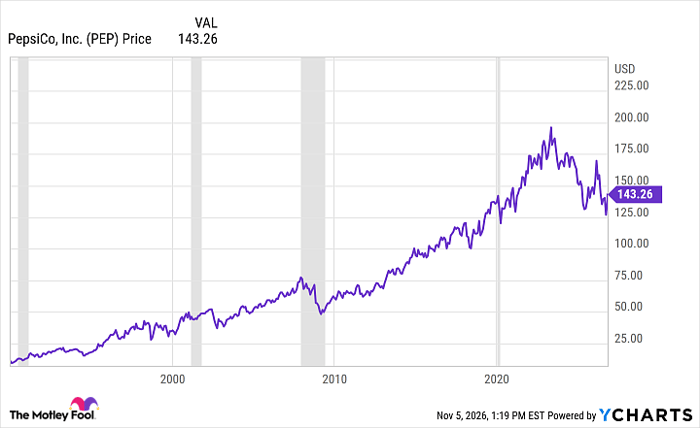
Data by YCharts.
Obviously there's no guarantee this ticker will perform as well again during the next recession whenever it might take shape. There's a reason it was able to do so in the past, however.
Perhaps more than anything, though, PepsiCo's dividend is almost sure to continue being paid even if we do run into an economic headwind. Even with all the inflationary pressure of the past couple of years, the company has earned more than enough profits to continue fully funding its dividend payments. This isn't likely to change going forward either. The company's track record of 54 years of uninterrupted annual dividend growth confirms this resilience.
Besides, when little else about the stock market is working in your favor, a little cash flow is a pretty big deal.
Should you buy stock in PepsiCo right now?
Before you buy stock in PepsiCo, consider this:
The Motley Fool Stock Advisor analyst team just identified what they believe are the 10 best stocks for investors to buy now… and PepsiCo wasn’t one of them. The 10 stocks that made the cut could produce monster returns in the coming years.
Consider when Netflix made this list on December 17, 2004... if you invested $1,000 at the time of our recommendation, you’d have $341,966!* Or when Nvidia made this list on April 15, 2005... if you invested $1,000 at the time of our recommendation, you’d have $1,146,819!*
Now, it’s worth noting Stock Advisor’s total average return is 852% — a market-crushing outperformance compared to 203% for the S&P 500. Don't miss the latest top 10 list, available with Stock Advisor, and join an investing community built by individual investors for individual investors.
See the 10 stocks »
*Stock Advisor returns as of November 9, 2026.
James Brumley has positions in Coca-Cola. The Motley Fool has no position in any of the stocks mentioned. The Motley Fool has a disclosure policy.
Recommended Articles


