


Eli Lilly Is Now Worth Nearly 9 Novo Nordisks. Here's How the Gap Got So Wide.
Key Points
Novo entered the GLP-1 space ahead of Lilly, but has since lost its lead.
Both of these players launched new GLP-1 drugs, the first in pill form, this year.
- 10 stocks we like better than Eli Lilly ›
Eli Lilly (NYSE: LLY) and Novo Nordisk (NYSE: NVO) both participate in one of the biggest pharma growth markets today, and that's the weight loss drug market. These companies are leaders in the space, with Novo entering first and Lilly joining soon afterward.
Lilly makes tirzepatide, sold as Mounjaro for type 2 diabetes and Zepbound for weight loss; Novo makes semaglutide under the names Ozempic for the former and Wegovy for the latter. These drugs have helped revenue soar in recent years as patients rushed to get in on this safe and effective weight loss opportunity.
Missed Nvidia in 2009? This Rare Signal Is Flashing Again. In 2009, a "Double Down" signal flashed for a little-known chipmaker called Nvidia. For the first time in years, that same "Total Conviction" signal is flashing for a company 1/100th the size of Nvidia. Continue »
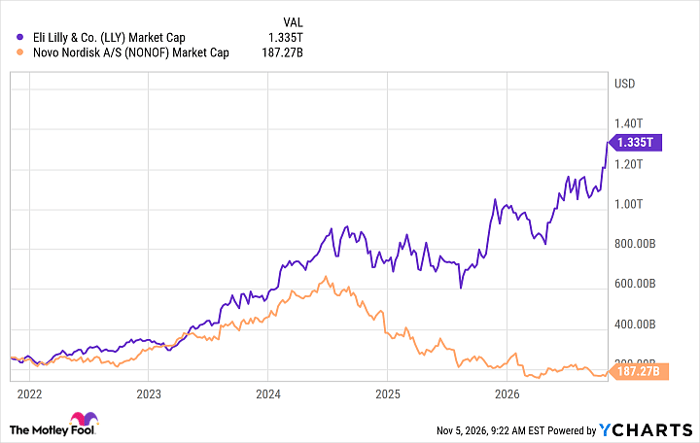
As a result, the companies' stock prices have also benefited from their work in the GLP-1 space. But one of these players has emerged as the biggest winner, at least so far, and that's Lilly. In fact, Lilly is now worth almost nine Novo Nordisks in terms of market capitalization. Let's check out how the gap got so wide.

Image source: Getty Images.
The key growth driver for Lilly and Novo
Novo and Lilly are major pharma companies offering drugs across treatment areas, so they don't depend uniquely on weight loss drugs for revenue. But in recent years, this type of product has become the key growth driver. And this is due to the high level of demand for such products, so high that at some points the Novo and Lilly drugs even landed on the U.S. Food and Drug Administration's shortage list. They've since come off the list as both companies have ramped up production.
These treatments, known as GLP-1 drugs, work by targeting hormonal pathways involved in digestion, and this helps control the individual's blood sugar levels and appetite. Novo won approval of Ozempic back in 2017, and Lilly followed in 2022 with Mounjaro. Doctors often prescribed these drugs off-label for weight loss -- until the companies won approval for their products, under the Zepbound and Wegovy brand names, specifically for weight loss, too.
The four drugs are all injectables, and these pharma giants further strengthened their portfolios recently by winning approval of oral weight loss drugs. Novo launched oral Wegovy early this year, and Lilly released Foundayo a few months later.
Lilly takes GLP-1 leadership
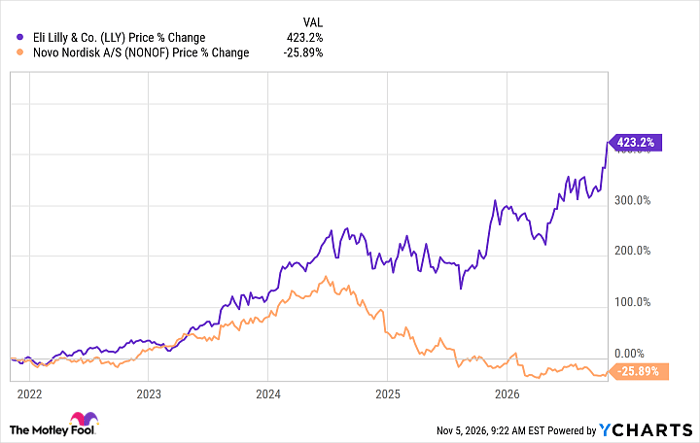
Novo, as the earliest to market, originally dominated, but a clear shift began in late 2024, and in early 2025 something big happened: Lilly took the lead in the market and today holds a 63% share in the U.S. Novo holds about a 36% share.
As this unfolded, Lilly's price soared, while Novo's sank.
LLY data by YCharts
And as a result, market cap took the same path.
LLY Market Cap data by YCharts
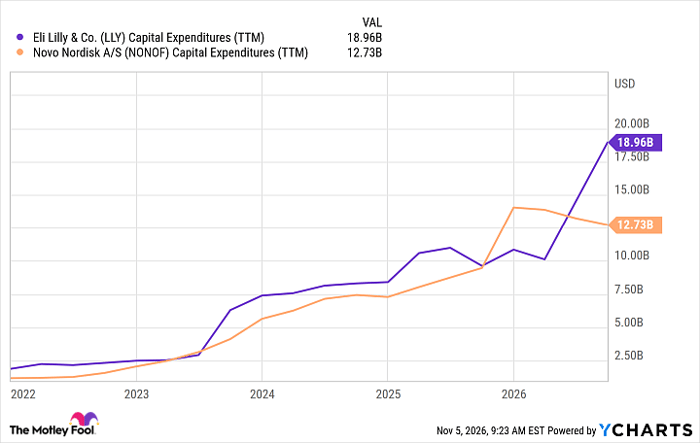
How did the gap get so wide? A few factors likely played a role. When faced with supply shortages in relation to demand, Lilly spent more aggressively to build out manufacturing infrastructure. This helped the company more easily address current demand and plan for the future.
LLY Capital Expenditures (TTM) data by YCharts
Meanwhile, Lilly's tirzepatide may have won over more doctors and patients due to its ability to generate greater weight loss. In a head-to-head study, Lilly's tirzepatide delivered an average weight loss of just over 20%, while Novo's semaglutide delivered a little under 14%.
Today, Novo's Wegovy pill remains ahead of Lilly's Foundayo in prescriptions, but with Foundayo steadily on the rise and given Novo's earlier launch, the leader is yet to be determined. Foundayo offers a significant advantage as it may be taken at any time of day with or without food, while the Wegovy pill comes with food and beverage restrictions.
On top of this strength from Lilly, Novo has faced certain challenges in recent months, from mixed data on weight loss drug candidate CagriSema to the failure of a heart drug candidate in a late-stage trial.
All of these elements have prompted investors to opt for Lilly as they aim to benefit from growth in the weight loss space -- and widened the Lilly/Novo market cap gap. And here's some good news if you haven't yet picked up Lilly shares. The stock still is a great buy, given potential growth ahead for Foundayo and Lilly's strong weight loss pipeline.
Should you buy stock in Eli Lilly right now?
Before you buy stock in Eli Lilly, consider this:
The Motley Fool Stock Advisor analyst team just identified what they believe are the 10 best stocks for investors to buy now… and Eli Lilly wasn’t one of them. The 10 stocks that made the cut could produce monster returns in the coming years.
Consider when Netflix made this list on December 17, 2004... if you invested $1,000 at the time of our recommendation, you’d have $341,966!* Or when Nvidia made this list on April 15, 2005... if you invested $1,000 at the time of our recommendation, you’d have $1,146,819!*
Now, it’s worth noting Stock Advisor’s total average return is 852% — a market-crushing outperformance compared to 203% for the S&P 500. Don't miss the latest top 10 list, available with Stock Advisor, and join an investing community built by individual investors for individual investors.
See the 10 stocks »
*Stock Advisor returns as of November 9, 2026.
Adria Cimino has no position in any of the stocks mentioned. The Motley Fool has positions in and recommends Eli Lilly and Novo Nordisk. The Motley Fool has a disclosure policy.
Recommended Articles


