


Nvidia Falls Over 5% Pre-Market to Near-7-Month Low: Jensen Huang Admits Extramarital Affair, Board Launches Investigation, CEO Succession Risk Draws Scrutiny
TradingKey - On November 9, Eastern Time, Nvidia (NVDA) traded lower in pre-market trading. As of press time, Nvidia shares were down 5.32% at $176.72, breaking below the intraday low of $180.62 set on April 9 and retreating to their lowest range since April.
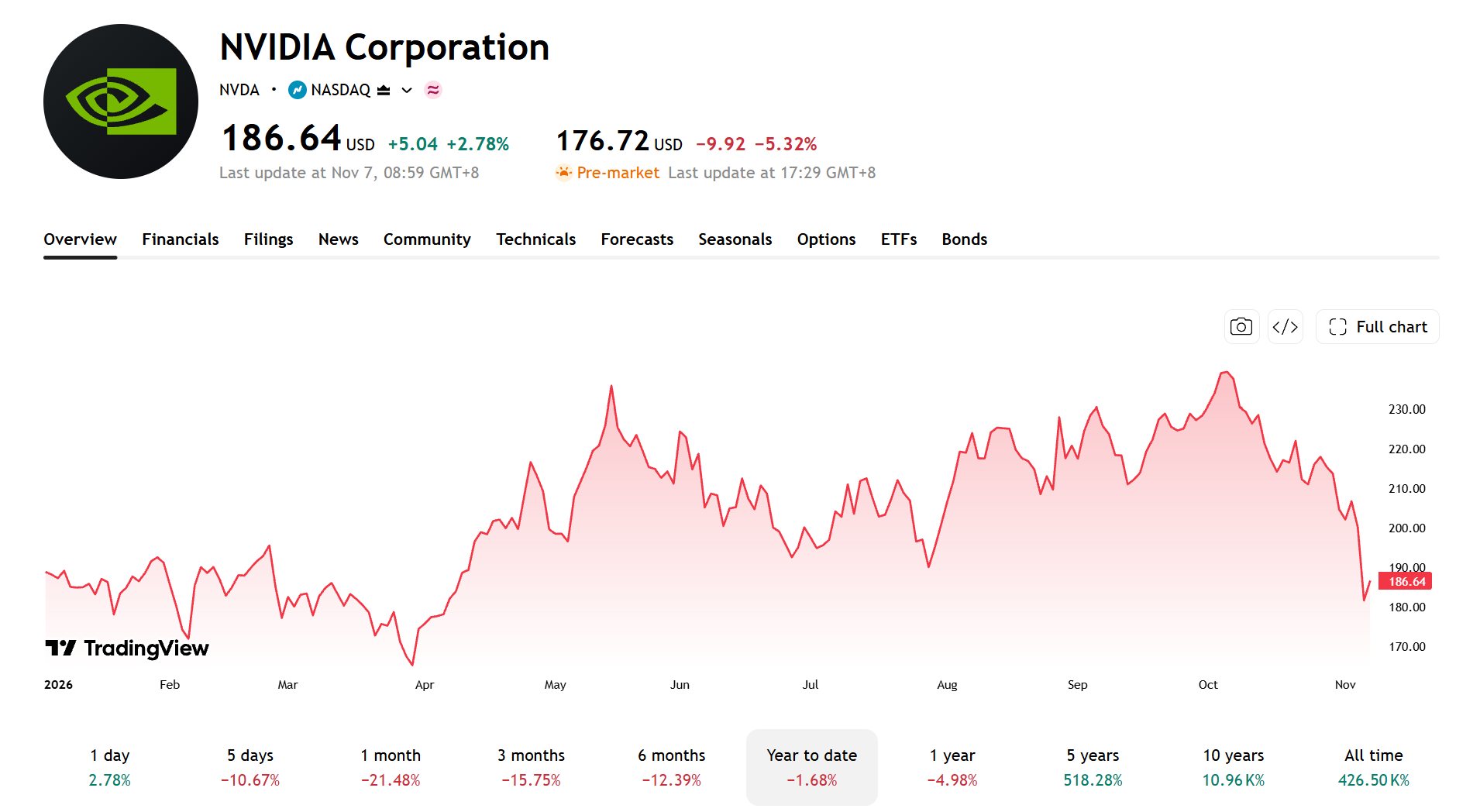
[Source: TradingView]
After Nvidia CEO Jensen Huang admitted being unfaithful to his wife and apologized to his family and employees, the company's board of directors announced an independent investigation to review reports that he had been targeted by foreign intelligence operations, and whether Nvidia's trade secrets and U.S. national security were affected.
Meanwhile, the U.S. Congress asked Huang to provide explanations regarding relevant contacts and the company's security measures, further increasing management and regulatory uncertainty for Nvidia.
Jensen Huang Admits Extramarital Affair as Board Launches Independent Investigation
According to an Associated Press report on November 8, Jensen Huang admitted in an internal memo to employees that he was unfaithful to his wife, stating that his actions had hurt his wife and children and that he takes full responsibility. He also apologized to employees, the board of directors, partners, and shareholders, expressing his full commitment to Nvidia and his determination to regain their trust.
The incident also involves Nvidia's customer relations and export compliance issues concerning advanced AI chips.
According to The New York Times' earlier reporting, U.S. intelligence agencies suspected that a businessperson named Alice Huang might be involved in intelligence activities targeting Nvidia. She had previously served as an executive at Megaspeed, a Singapore data center company, and had a close relationship with Jensen Huang.
Megaspeed is a major customer of Nvidia. According to The New York Times, the company's Malaysian affiliate procured at least $4.8 billion in advanced AI equipment between June 2024 and February 2026, which included Nvidia chips and related technology.
U.S. authorities had previously scrutinized whether relevant companies allowed export-restricted advanced AI chips to flow into restricted markets through reselling or other means. The allegations regarding intelligence activities have not been independently verified.
Nvidia's board of directors has announced the launch of an independent investigation, overseen by a committee composed of independent directors and assisted by outside independent legal counsel.
The board stated that there is currently no reason to believe that national security or Nvidia's trade secrets have been compromised, but the investigation will review all available information. Jensen Huang supports the investigation and has pledged full cooperation. Meanwhile, the board expressed continued confidence in Huang and his management team.
CEO Position Temporarily Stable as Succession Risks Draw Focus
Since co-founding Nvidia in 1993, Jensen Huang has served as CEO, long spearheading the company's strategy formulation, product planning, and key customer partnerships.
At present, Nvidia's board of directors maintains confidence in Jensen Huang and his management team, and an Nvidia spokesperson stated that Huang will continue as CEO. Therefore, there is no indication at this stage that the company is preparing for a leadership change.
However, the incident has also drawn attention to Nvidia's succession risks. Bernstein analyst Stacy Rasgon noted that Nvidia relies heavily on Jensen Huang to set long-term strategy and drive growth, with about 60 executives reporting directly to him. If Huang is unable to continue in his role, who could succeed him in leadership would become a key question for the market.
Meanwhile, the chairs of three U.S. House committees sent a joint letter to Jensen Huang on November 4, requesting that he attend a closed-door briefing on November 18 to explain his interactions with former Megaspeed executive Alice Huang, as well as Nvidia's security measures against foreign intelligence infiltration.
Currently, this remains a request for a closed-door briefing from lawmakers, and Jensen Huang has yet to confirm his attendance. If subsequent inquiries expand further, Nvidia could face tighter political and regulatory scrutiny.
Export Controls and AI Business Growth Key to Nvidia Stock Price
In the short term, Nvidia's stock price may continue to be weighed down by board investigations, congressional inquiries, and management uncertainty. If U.S. regulators further tighten scrutiny over relevant customers, chip transactions, and end uses, Nvidia could face stricter compliance requirements, adding uncertainty to parts of its business.
However, there is currently no evidence indicating that Nvidia's trade secrets have been leaked, nor are there signs that the incident has had a material impact on chip sales or customer orders.
Over the medium to long term, Nvidia's stock price will still primarily depend on AI chip demand and the growth of its data center business.
Investors need to focus on shipments of Blackwell series products, data center revenue, gross margins, and the mass production and delivery progress of the next-generation Vera Rubin lineup. Capital expenditures by major cloud service providers and the return on investment in AI infrastructure will also affect Nvidia's future revenue growth.
Looking ahead, Nvidia's third-quarter financial results and guidance to be released on November 17, along with whether Jensen Huang accepts the request for a closed-door congressional briefing on November 18, will serve as key focal points for the market to assess the company's operating performance, management risks, and regulatory pressure.
Recommended Articles


