


KKR’s Fee Growth Faces an Earnings Test as Shares Hover Above $95.89
TradingKey - KKR & Co. (NYSE: KKR) closed November 6 at $96.48, down 1.85%. Friday’s low came within a cent of $95.89 support. With third-quarter results due before the November 9 opening bell, the question for shareholders is how much of the capital KKR raised is already earning management fees.
The deal announcements tell a different part of the story. KKR has found a buyer for a railcar business and agreed to invest in a fund administrator. Both deals have 2027 closing timetables. The November report gives investors a chance to measure the earnings power of the business already in place.
The Fee Base Behind $796 Billion in Assets
At June 30, KKR managed $796 billion, of which $638 billion earned management fees. That works out to roughly 80 cents of every dollar under management. Total assets grew 16% over the preceding year and fee-paying assets grew 15%, according to KKR’s second-quarter report.
KKR raised $34 billion in the quarter and invested $24 billion. Subtracting one from the other would tell investors little about future fee income. Some funds charge on committed capital, while others start charging as money goes to work. I would look first at the growth in fee-paying assets and then at the management fees those assets actually produced.
Which Second-Quarter Earnings Can Repeat?
Fee-related earnings rose 37% to about $1.2 billion. KKR deducts compensation and other operating expenses in calculating that figure, so a larger pool of client assets can lift earnings faster than revenue if costs grow more slowly. Adjusted net income reached $1.63 per adjusted share, compared with $1.18 a year earlier. GAAP diluted earnings were $0.70 per share.
One detail complicates the comparison. In real assets, KKR earned $52 million of management fees retroactive to the start of funds’ investment periods. Those fees count as earnings, but some of the work they paid for took place earlier. I would give more weight to a sustained increase in fees on capital already invested than to another quarter helped by catch-up payments.
What the Infinity Sale Could Return
Ares-managed funds agreed to buy Infinity Transportation at a $2.9 billion enterprise value. Global Atlantic has invested in the railcar business since 2016. The parties expect to close in the first quarter of 2027, subject to approvals and other conditions.
For shareholders, the missing number is how much cash the seller receives after debt and other adjustments. The enterprise value alone cannot answer that. Closing would give Global Atlantic capital to reinvest. The price it can earn on replacement investments will help determine how much the exit adds to future insurance earnings.
Gen II Adds Exposure to the Business of Running Funds
KKR’s Core Private Equity strategy agreed to acquire Gen II Fund Services at a $5.1 billion enterprise value. Gen II earns money administering private funds. Its clients can hire it to maintain records and handle reporting while a different manager continues to make investment decisions. That distinction matters when assessing how the acquisition, expected to close in 2027, could benefit KKR.
TeamSystem offers a separate route into business software. KKR agreed to join as a minority shareholder, with Francisco Partners leading the new minority investment. The companies did not disclose terms, leaving little basis for assigning a near-term earnings contribution.
Insurance Spreads Belong on the Earnings Call
Global Atlantic earned $288 million in second-quarter insurance operating earnings, including about $40 million from investment realizations. Higher portfolio yields helped investment income, while newer business carried higher funding costs. On the November 9 call at 10 a.m. Eastern, I’ll watch whether the spread between those two sides is widening enough to support earnings without another large asset sale.
KKR Technical Analysis: Buyers Defend $95.89
KKR’s Friday low of $95.90 put buyers within one cent of the support marked on my daily chart. They held it, but the $96.48 close left little room for disappointment heading into earnings. The earlier rally had already failed near $103.75, where the descending trendline meets horizontal resistance. Thursday traded as high as $103.84, so I treat $103.75 as a resistance level rather than the exact intraday high.
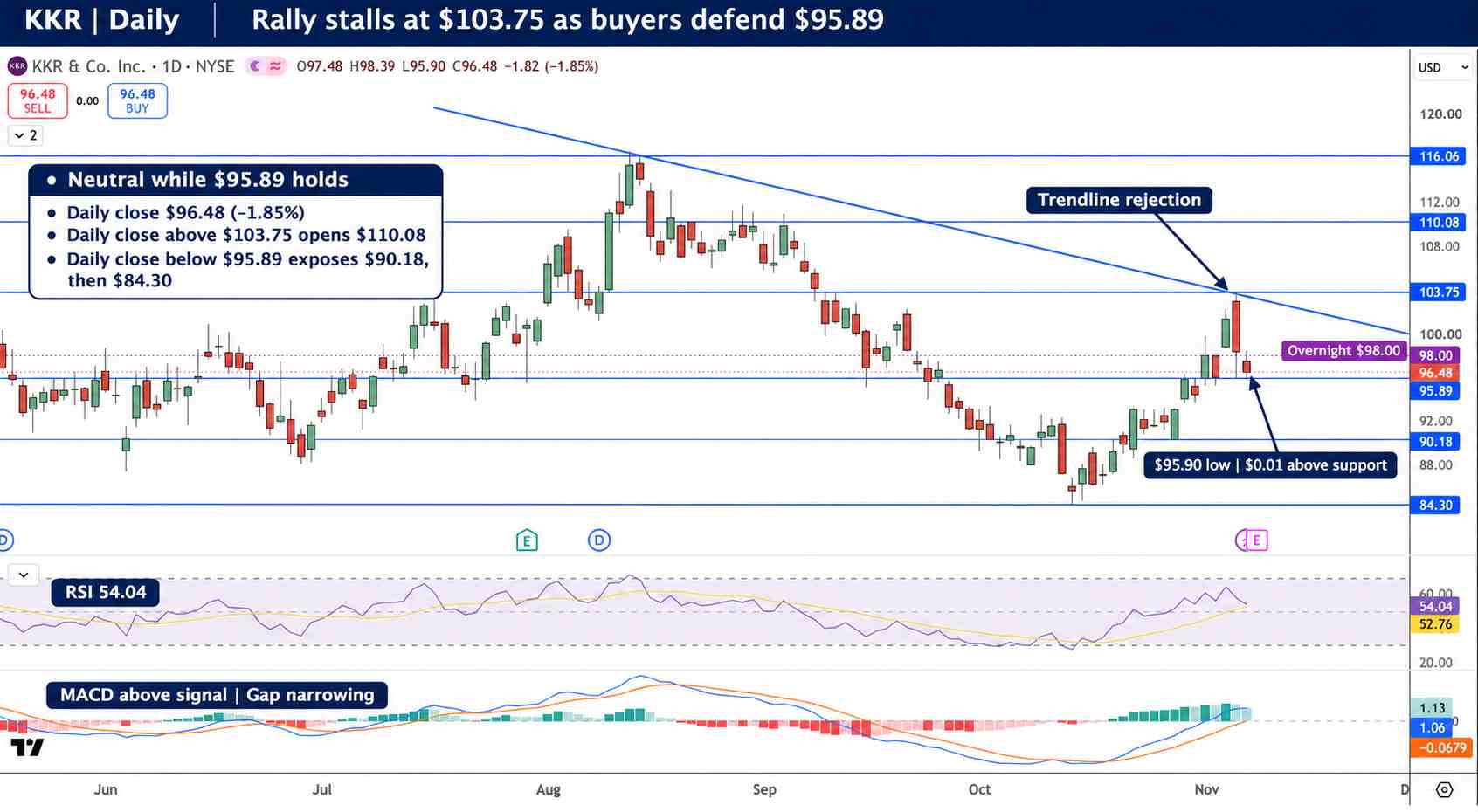
IKKR Price Chart - Source: Tradingview
\’m neutral while $95.89 holds. RSI at 54.04 leaves room for a recovery, although the narrowing distance between MACD and its signal line suggests the rebound has lost some momentum. With earnings due, an opening move through support could reverse before the close. A daily finish below $95.89 would put $90.18 in play, followed by $84.30 if buyers step aside there. To turn bullish, I would want a daily close above $103.75. That would clear the area where sellers stopped the last rally and open a path toward $110.08.
Key Levels
- Latest completed close: $96.48 on November 6
- Immediate resistance: $103.75
- Upside target: $110.08
- Immediate support: $95.89
- Downside targets: $90.18 and $84.30
- Daily RSI: 54.04, modestly above neutral
FAQ
When is KKR scheduled to report earnings?
KKR scheduled its third-quarter release for November 9 before the NYSE opens. The conference call starts at 10 a.m. Eastern, or 8 p.m. in Pakistan.
Will the Infinity sale lift third-quarter earnings?
The parties announced the agreement in October, after quarter-end, and expect it to close in early 2027. Investors will need the closing figures to assess any realized gain.
Bottom Line
Fee growth makes me constructive on KKR’s business, provided compensation and insurance funding costs leave more of that income for shareholders. The stock is a closer call. I stay neutral above $95.89 and would turn bullish on a daily close above $103.75.
Recommended Articles


