


South Korean AI Stocks Plunge as Kospi Tumbles 7% Below 6,000, SK Hynix Slumps Over 9%
TradingKey - On October 13, South Korean stock market losses deepened, with the KOSPI Index expanding its intraday decline to over 7% and breaking below the 6,000-point mark. Semiconductor leaders faced heavy selling, as SK Hynix fell over 9% and Samsung Electronics dropped more than 8%. Earlier, the Korea Exchange activated a sell-side Sidecar mechanism, temporarily halting KOSPI program sell orders. The overnight weakness in US chip stocks also further dampened market sentiment.
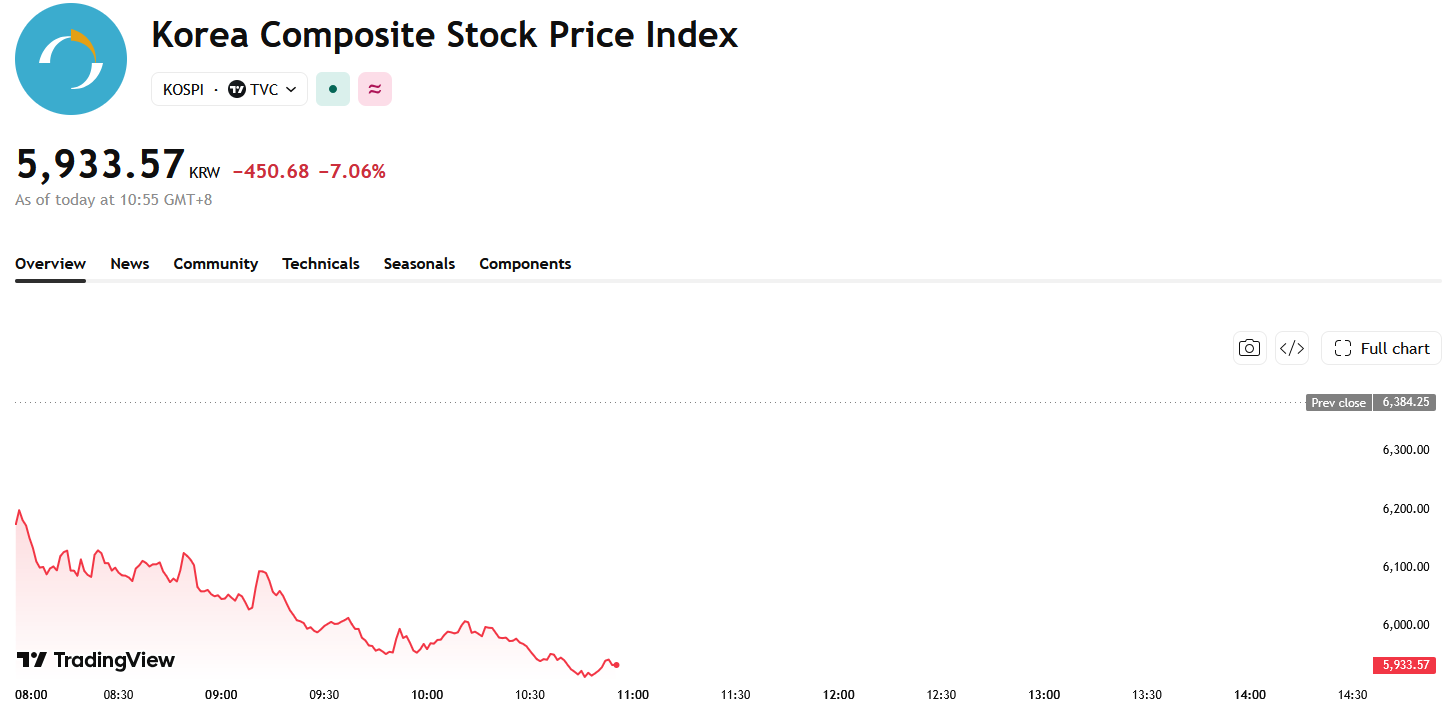
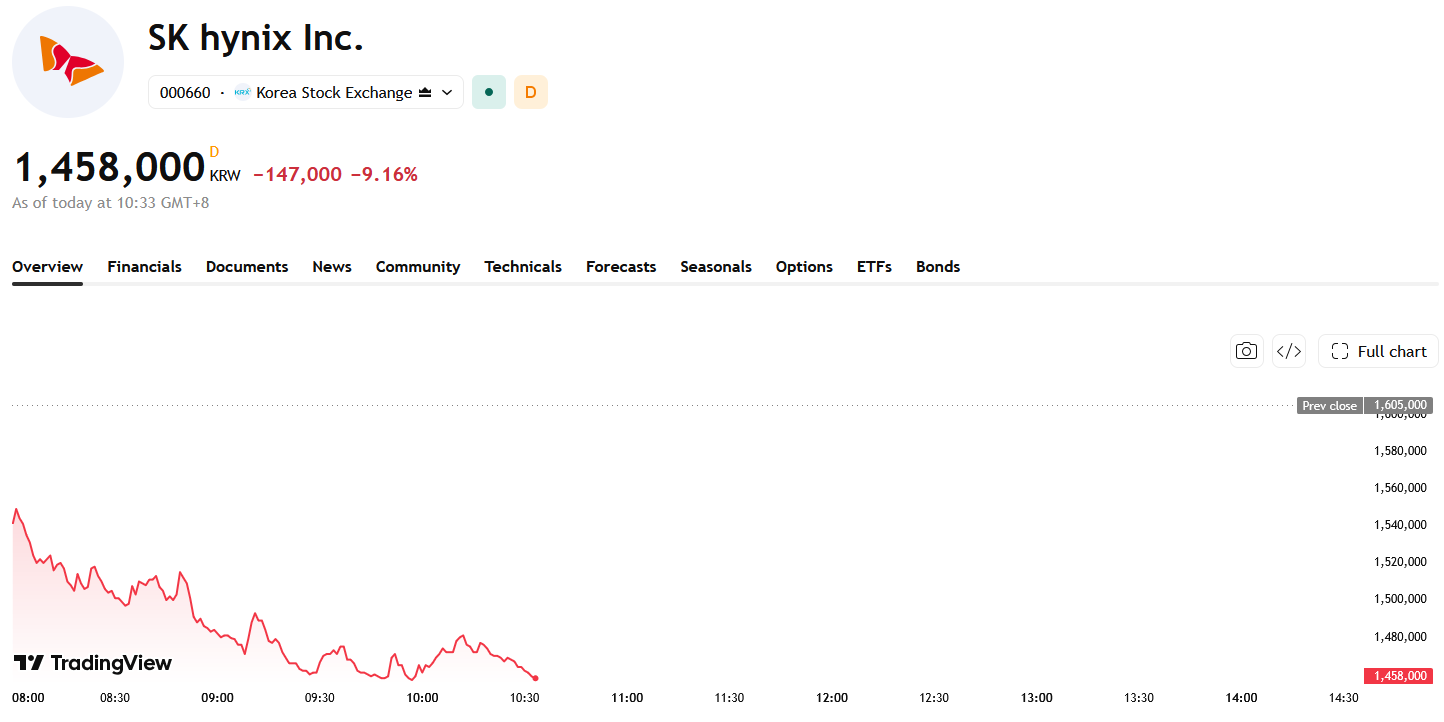
Source: TradingView
This decline reflects growing investor concerns over the future growth prospects of the AI supply chain. In recent times, investment in AI infrastructure has driven demand growth for products such as High Bandwidth Memory (HBM), making South Korean memory chipmakers market favorites. However, following sharp stock price gains, investors have begun to reassess whether current valuations can be supported by future earnings and whether the memory industry's boom cycle can persist into 2028 and beyond.
AI Trade Cools as Competition and Funding Pressures Mount
Reports of progress made by China's ChangXin Memory Technologies in new memory architectures have deepened market concerns over future competition. The relevant technology can increase the memory density per chip, and Samsung Electronics and SK Hynix are also developing similar architectures. Although CXMT still needs to improve yield rates and obtain customer qualifications before entering the high-end server memory market on a large scale, investors have already begun pricing in the potential risks of increased supply and price competition.
Meanwhile, Broadcom's (AVGO) CEO's warning regarding speculative AI investments further dampened market risk appetite. He believes that some capital chasing AI concepts lacks judgment regarding specific business models and profitability, with investment behavior becoming increasingly akin to betting.
Ha Seok-keun, chief investment officer at Eugene Asset Management, stated that market uncertainty regarding the duration of the memory industry's upcycle is weighing on the valuations of South Korean chipmakers. Even if corporate earnings continue to grow, stock prices may not necessarily maintain their previous upward momentum if investors believe future growth rates could slow.
The South Korean stock market's reliance on the semiconductor sector has also amplified the impact of this correction. Samsung Electronics and SK Hynix together account for more than half of the KOSPI index weight, and share price movements in these two companies are sufficient to significantly impact the entire market. As the AI memory trade cools down, the South Korean stock market has also lost a key upward driver.
In the first half of this year, AI demand drove profit growth in memory chips, attracting heavy buying from overseas institutions and leveraged retail investors, sending the KOSPI index up by about 100% at one point. However, entering the second half, the market reversed sharply, with the index falling cumulatively by about 22%, making it one of the weaker-performing major markets over the same period. Meanwhile, the KOSPI has pulled back significantly from its all-time high set in June and has broken below its 200-day moving average, signaling a clear shift in market trend.
According to data compiled by Bloomberg, foreign investors have continuously reduced their holdings in South Korean equities this year, with cumulative net sales reaching $131 billion. As U.S. stocks continue to attract substantial capital, some overseas investors have begun reallocating assets, leaving the South Korean market facing simultaneous pressure from foreign capital outflows and weakening liquidity.
In addition, retail investors' trading capacity has declined. Outstanding margin loans in the South Korean stock market have dropped from a peak of 38.6 trillion won in June to around 33 trillion won, while cash in brokerage accounts has fallen from nearly 140 trillion won to approximately 100 trillion won. As stock prices declined, some leveraged funds were forced to liquidate, adding further selling pressure. Retail capital that previously supported the rally is diminishing, making it difficult for the market to fully absorb selling through new buying power in the short term.
Recommended Articles


