


Mark My Words: ASML Stock Is the Most Overlooked Way to Play the AI Infrastructure Boom
Key Points
ASML is the world's only commercial supplier of extreme ultraviolet (EUV) lithography systems.
As AI models become more sophisticated, the need for increasingly powerful semiconductors should only grow.
Analysts have high expectations for ASML when it reports earnings later this month.
- These 10 stocks could mint the next wave of millionaires ›
When investors think about artificial intelligence stocks, the first ones that come to mind are often giants such as Nvidia, Microsoft, and Alphabet. But other companies also play important roles in the AI revolution.
One in particular tends to fly under the radar. That company is ASML (NASDAQ: ASML), a Dutch manufacturer of advanced semiconductor equipment. And I believe it's one of the most compelling ways to invest in the AI infrastructure boom.
Missed Nvidia in 2009? This Rare Signal Is Flashing Again. In 2009, a "Double Down" signal flashed for a little-known chipmaker called Nvidia. For the first time in years, that same "Total Conviction" signal is flashing for a company 1/100th the size of Nvidia. Continue »
ASML helps make the world's most advanced chips
AI requires enormous computing power, so semiconductor manufacturers are continually developing smaller, faster, and more energy-efficient chips. For example, Nvidia Hopper processors were once considered state-of-the-art GPUs for training and running AI programs. In 2024, Nvidia unveiled its more advanced Blackwell architecture, and this year, the company is unleashing its next-generation Vera Rubin platform, with Rubin GPUs and Vera CPUs.
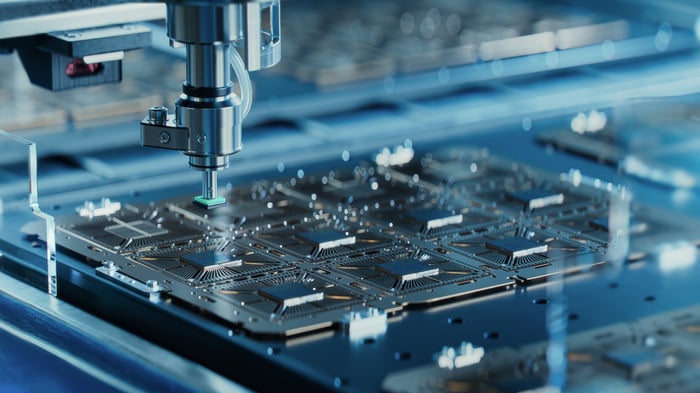
Image source: Getty Images.
Each generation of chips is more powerful and energy efficient. And this is where ASML enters the picture.
ASML makes lithography machines that use light to print tiny patterns on silicon wafers. These patterns become the transistors and connections that allow semiconductor chips to function. ASML is the world's only commercial supplier of extreme ultraviolet (EUV) lithography systems, which are essential for manufacturing many of today's most advanced semiconductors.
Fabricators such as Taiwan Semiconductor Manufacturing, Samsung, and Intel rely on ASML's equipment to produce leading-edge chips. And as AI models become more sophisticated, the need for increasingly powerful semiconductors should only grow.
ASML is already preparing for the next generation
ASML is an important partner for chipmakers and foundries today. And it's working to remain just as relevant for the next generation of chips.
In September, ASML announced an expanded collaboration with Intel Foundry to accelerate the adoption of High Numerical Aperture EUV (High-NA EUV), a more advanced version of its existing technology.
Intel has already processed more than 1 million wafers using High-NA EUV across testing, development, and manufacturing activities. The technology is also being used to produce selected layers of Intel's Panther Lake processors.
ASML also announced an expanded partnership with Samsung, which plans to introduce High-NA EUV into advanced DRAM memory manufacturing by 2028.
Memory is particularly important for AI because powerful processors require enormous amounts of data to be delivered quickly to perform complex calculations.
Taiwan Semiconductor, the industry's leading foundry, is collaborating with ASML on larger photomasks that could improve manufacturing productivity and lower costs. TSMC intends to introduce High-NA EUV into high-volume manufacturing for advanced nodes beginning in 2030.
The investment opportunity
Throughout this period, ASML is delivering strong returns that are expected to improve further. When the company reports third-quarter results on Oct. 14, analysts expect revenue of 11.68 billion euros ($13.1 billion), a 55% gain from the third quarter of 2025. Earnings are expected to be 10.66 euros per share, versus just 5.49 euros per share a year ago.
Second-quarter revenue for the Dutch company was 9.3 billion euros, with net income of 2.9 billion euros, versus 7.7 billion euros in Q2 2025, with net income of 2.3 billion euros.
ASML faces risks, including semiconductor spending cycles, export restrictions, and the high cost of developing increasingly complex manufacturing equipment. But its technological leadership creates an extraordinary competitive moat.
Nvidia is the leading company in designing the processors powering AI, and Taiwan Semiconductor unquestionably has the top foundry. But those companies -- and their competitors -- depend on advanced lithography equipment to keep pushing semiconductor technology forward.
That's why I believe ASML deserves considerably more attention from long-term AI investors. The AI infrastructure boom isn't just about the companies building chips. It's also about the company making those chips possible.
Don’t miss this second chance at a potentially lucrative opportunity
Ever feel like you missed the boat in buying the most successful stocks? Then you’ll want to hear this.
On rare occasions, our expert team of analysts issues a “Double Down” stock recommendation for companies that they think are about to pop. If you’re worried you’ve already missed your chance to invest, now is the best time to buy before it’s too late. And the numbers speak for themselves:
- Nvidia: if you invested $1,000 when we doubled down in 2009, you’d have $596,081!*
- Apple: if you invested $1,000 when we doubled down in 2008, you’d have $64,217!*
- Netflix: if you invested $1,000 when we doubled down in 2004, you’d have $379,123!*
Right now, we’re issuing “Double Down” alerts for three incredible companies, available when you join Stock Advisor, and there may not be another chance like this anytime soon.
See the 3 stocks »
*Stock Advisor returns as of October 12, 2026.
Patrick Sanders has positions in Nvidia. The Motley Fool has positions in and recommends ASML, Alphabet, Intel, Microsoft, Nvidia, and Taiwan Semiconductor Manufacturing. The Motley Fool has a disclosure policy.
Recommended Articles


