


3 Overlooked Growth Stocks Powering Every AI Chip Nvidia and AMD Build
Key Points
ASML is enjoying strong demand for the machines that print the circuits on GPUs.
Synopsys provides the software that every GPU is designed on.
Micron supplies the high-bandwidth memory packaged with those GPUs.
- These 10 stocks could mint the next wave of millionaires ›
Nvidia (NASDAQ: NVDA) and Advanced Micro Devices (NASDAQ: AMD) are seeing booming demand for graphics processing units (GPUs). The consensus estimate has both companies growing revenue roughly 90% and 45%, respectively, this year. But you don't have to choose between winners and losers in this GPU rivalry.
Every chip still has to be designed, printed, and paired with fast memory before it can train or run an AI model. ASML (NASDAQ: ASML), Synopsys (NASDAQ: SNPS), and Micron Technology (NASDAQ: MU) provide these essential steps in the chipmaking process, offering investors another way to ride the growing demand across the chip industry.
Missed Nvidia in 2009? This Rare Signal Is Flashing Again. In 2009, a "Double Down" signal flashed for a little-known chipmaker called Nvidia. For the first time in years, that same "Total Conviction" signal is flashing for a company 1/100th the size of Nvidia. Continue »
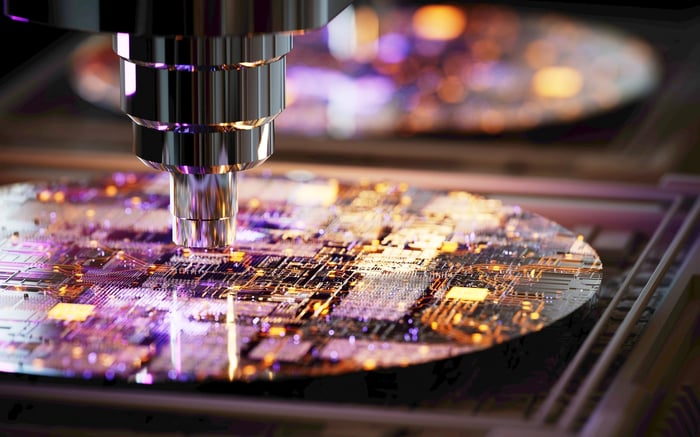
Image source: Getty Images.
ASML
ASML supplies the extreme ultraviolet lithography systems that print circuit patterns on chips. Taiwan Semiconductor Manufacturing builds Nvidia and AMD GPUs, and it buys that equipment from ASML. Without those tools, the GPUs do not get made.
Management sees surging demand for AI chips, prompting customers to add manufacturing capacity. Analysts expect full-year 2026 sales to grow 32% over 2025, then another 27% in 2027. Order momentum was "extremely strong" in the first half of 2026, driving backlog growth across a broad mix of customers.
The shares trade at a price-to-earnings (P/E) ratio of 57 as of Oct. 1, 2026. That valuation leaves downside risk if growth stalls. However, CEO Christophe Fouquet said on the second-quarter earnings call that the company has demand visibility extending several years.
In 2027 estimates, though, the multiple falls to 30 times earnings. Analysts expect 31% annualized earnings growth, a P/E-to-growth (PEG) ratio of about 1.0. That valuation leaves room for upside as the semiconductor industry continues to grow.
Synopsys
Synopsys is a leading supplier of electronic design automation (EDA), the software Nvidia and AMD use to design chips before being sent to TSMC. Growth is accelerating as AI and high-performance compute customers run more designs.
Revenue surged 42% year over year to nearly $2.5 billion in the fiscal third quarter of 2026. It converts that revenue into robust profits, earning an adjusted operating margin of 41.6%. A $10.9 billion backlog indicates more growth ahead.
AMD designed its Instinct MI4155X AI GPU with Synopsys' 3DIC Compiler. Synopsys offers innovation that sets it apart in a competitive industry. Its Multiphysics Fusion is the only product that integrates thermal analysis into the design flow, and Nvidia, Cisco Systems, MediaTek, and Samsung Foundry have validated it.
Revenue has grown steadily over the past 10 years, including during the 2022 chip industry downturn. Its consistent revenue growth reflects recurring software licenses that smooth out its revenue generation. The stock still looks like a solid buy, trading at a forward P/E of 28 on 2027 estimates, against expected annualized earnings growth of 22%.
Micron Technology
Micron supplies DRAM and NAND flash memory for high-speed data retrieval and storage in AI data centers. Advanced versions are co-packaged with Nvidia and AMD GPUs, so a stronger GPU cycle pulls memory with it. Micron is also the only U.S.-based supplier of high bandwidth memory, which makes it a natural partner for both.
Fiscal 2026 revenue hit a record $133 billion, up 256% from the prior year. Gross margin expanded 40 percentage points to 81% for the year as a supply shortage lifted memory prices and profits.
Management expects higher gross margins in fiscal 2027, though only a moderate rise in prices. Selling prices are the key risk. Long-term custom agreements account for over 35% of revenue through 2030, leaving a large share exposed to pricing swings.
Management still expects fiscal 2027 to be another record year. Micron is collaborating with Nvidia on the first custom HBM4E memory for next-generation GPUs.
Overbuilding supply to meet demand could eventually put pressure on memory prices. The prospect of another downturn in selling prices and earnings is why the market is pricing the stock at a conservative 7 times forward earnings. Still, there could be substantial upside if Micron can sign more customer agreements, thereby extending visibility into future revenue.
Don’t miss this second chance at a potentially lucrative opportunity
Ever feel like you missed the boat in buying the most successful stocks? Then you’ll want to hear this.
On rare occasions, our expert team of analysts issues a “Double Down” stock recommendation for companies that they think are about to pop. If you’re worried you’ve already missed your chance to invest, now is the best time to buy before it’s too late. And the numbers speak for themselves:
- Nvidia: if you invested $1,000 when we doubled down in 2009, you’d have $621,091!*
- Apple: if you invested $1,000 when we doubled down in 2008, you’d have $63,501!*
- Netflix: if you invested $1,000 when we doubled down in 2004, you’d have $364,023!*
Right now, we’re issuing “Double Down” alerts for three incredible companies, available when you join Stock Advisor, and there may not be another chance like this anytime soon.
See the 3 stocks »
*Stock Advisor returns as of October 6, 2026.
John Ballard has positions in Nvidia. The Motley Fool has positions in and recommends ASML, Advanced Micro Devices, Cisco Systems, Micron Technology, Nvidia, Synopsys, and Taiwan Semiconductor Manufacturing. The Motley Fool has a disclosure policy.
Recommended Articles


