


Bill Ackman's Pershing Square Took a New Stake in Netflix in 2026, Years After a Money-Losing Bet on the Stock. Why He Says This Time Is Different.
Key Points
A change in business strategy pushed Ackman to exit Netflix in 2022.
Meanwhile, his investment thesis on the stock played out exactly as he predicted.
He recently saw another opportunity to buy the stock with greater confidence in his thesis.
- 10 stocks we like better than Netflix ›
Back in early 2022, Bill Ackman plowed about $1.25 billion worth of Pershing Square's (NYSE: PS) capital into Netflix (NASDAQ: NFLX). In his letter to shareholders, he expressed confidence in the competitive advantages of the streaming video leader and its ability to translate that into strong earnings growth. Just a few weeks later, however, he sold the position entirely, taking a significant loss on the investment.
Ackman never stopped following the company, though. Earlier this year, he bought a new position in Netflix worth about $1 billion. Here's what pushed Ackman out of the stock the first time and why he thinks it's worth buying now.
Missed AI’s "Act 1"? Act 2 Could Be 15x Bigger. Most investors think they missed the AI boat because they didn't buy Nvidia in 2005. But according to our analysts, we’re only at the end of "Act 1"—the R&D phase. "Act 2" is the global rollout. Continue »
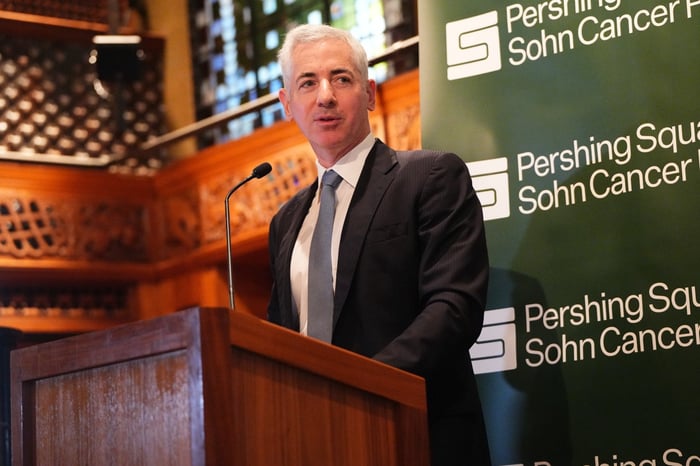
Bill Ackman. Image source: Getty Images.
A big strategy change pushed Ackman out of Netflix
When Ackman bought Netflix in early 2022, slower-than-anticipated subscriber growth had recently led to a steep sell-off in the stock. But Ackman saw Netflix's long-term potential to reach a massive audience, and viewed its recent performance issues as merely a hiccup.
Netflix's scale enables it to invest vast sums in content while keeping its per-subscriber costs low. It had also demonstrated its ability to serve a global audience, taking local-language content from international markets -- like South Korea's Squid Game -- and turning it into global hits.
But when the company reported its first-quarter earnings that year, not only did it disappoint investors once again, but it also shared a big strategic change. It planned to start developing an ad-supported tier with a lower monthly subscription price. Ackman loved the simplicity of Netflix's subscription-only model. Introducing advertising into the mix made the business more difficult to predict.
"We require a high degree of predictability in the businesses in which we invest due to the highly concentrated nature of our portfolio. While Netflix's business is fundamentally simple to understand, in light of recent events, we have lost confidence in our ability to predict the company's future prospects with a sufficient degree of certainty," he wrote to investors announcing Pershing Square's Netflix sale.
More than four years on, Ackman's original bull thesis has come to fruition.
"Netflix has since effectively won the streaming wars," he wrote in his letter to shareholders in August. Its scale vastly exceeds that of its closest competitors, and its push into advertising has enabled it to expand into live programming. That's been a key driver of new subscriptions.
Meanwhile, Netflix was just starting to show positive free cash flow in 2021, and Ackman expected management to grow free cash flow and use excess capital to buy back shares. Indeed, management has executed exactly that, and free cash flow has ballooned to approximately 90% of earnings.
Ackman's expectations for Netflix today aren't quite as high as they were in early 2022, when he expected earnings per share to compound at more than 20% annually for the foreseeable future. That turned out to be an accurate assessment: Earnings per share have compounded by 27% since the end of the first quarter that year.
But with steady margin expansion and consistent share repurchases, he believes Netflix can come close to that 20% annualized EPS growth. After the stock's valuation sank back to levels last seen in 2022, Ackman took the opportunity to buy shares again, this time with greater confidence in the advertising business.
Should you buy stock in Netflix right now?
Before you buy stock in Netflix, consider this:
The Motley Fool Stock Advisor analyst team just identified what they believe are the 10 best stocks for investors to buy now… and Netflix wasn’t one of them. The 10 stocks that made the cut could produce monster returns in the coming years.
Consider when Netflix made this list on December 17, 2004... if you invested $1,000 at the time of our recommendation, you’d have $412,074!* Or when Nvidia made this list on April 15, 2005... if you invested $1,000 at the time of our recommendation, you’d have $1,314,319!*
Now, it’s worth noting Stock Advisor’s total average return is 935% — a market-crushing outperformance compared to 210% for the S&P 500. Don't miss the latest top 10 list, available with Stock Advisor, and join an investing community built by individual investors for individual investors.
See the 10 stocks »
*Stock Advisor returns as of September 17, 2026.
Adam Levy has positions in Netflix. The Motley Fool has positions in and recommends Netflix. The Motley Fool has a disclosure policy.
Recommended Articles


