


This AI Chip Giant Quietly Became Worth More Than Tesla, and Many Investors Still Overlook It
Key Points
Broadcom is now worth more than Tesla, with a market value above $2 trillion.
Its AI revenue more than doubled last quarter, driven by custom chips and networking.
The stock trades at about 87 times earnings, leaving little room for error.
- 10 stocks we like better than Broadcom ›
While Nvidia and Tesla dominate the headlines, another company has quietly joined them at the very top. As of this writing, Broadcom (NASDAQ: AVGO) is worth about $2.1 trillion -- nearly half a trillion dollars more than Tesla, and one of only a handful of companies ever to reach that mark. Yet for a business this size, it draws a fraction of the attention. Its products don't sit in driveways or living rooms; they sit deep inside the data centers that train and run artificial intelligence (AI). And that is exactly where the money is flowing.
Broadcom has quietly become the most important AI chip company after Nvidia, the world's most valuable company. The stock is up about 85% over the past year and recently touched a record high, far outpacing the S&P 500. The question is whether the overlooked giant still has room to run -- or whether the market has finally caught up to it.
Will AI create the world's first trillionaire? Our team just released a report on the one little-known company, called an "Indispensable Monopoly" providing the critical technology Nvidia and Intel both need. Continue »
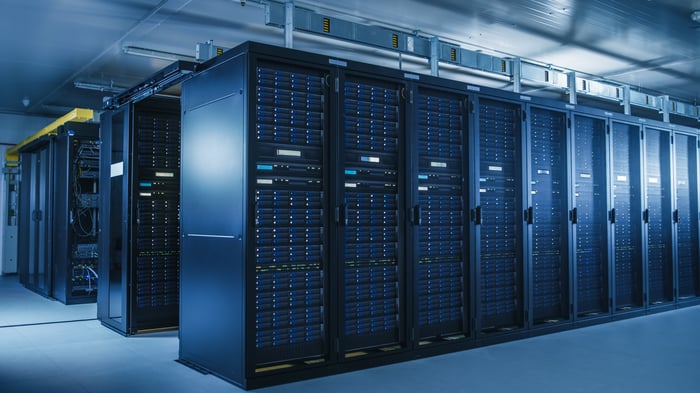
Image source: Getty Images.
A different kind of AI chip company
Nvidia sells general-purpose graphics processing units (GPUs) that almost any customer can buy off the shelf. Broadcom does something narrower and, for a few enormous customers, harder to replace: it co-designs custom AI accelerators -- chips tailored to a single company's workloads -- and sells the networking silicon that stitches thousands of those chips into one giant cluster.
That combination is driving staggering growth. In its fiscal first quarter of 2026 (the period ended Feb. 1, 2026), Broadcom's revenue rose 29% year over year to a record $19.3 billion. The semiconductor solutions segment, where the AI products sit, jumped 52% to $12.5 billion. AI revenue alone more than doubled, soaring 106% to $8.4 billion -- ahead of the company's own forecast. The custom-accelerator business climbed 140%, and AI networking revenue, up 60%, now makes up a third of all AI sales and is headed toward 40%.
Even as it scales, the chipmaker mints cash.
Broadcom's free cash flow reached $8.0 billion last quarter, 41% of revenue, and non-GAAP (adjusted) earnings per share rose 28%. Further, Broadcom handed $10.9 billion back to shareholders through buybacks and dividends, and the board authorized another $10 billion for share repurchases.
But it's likely the forward picture that has lifted the stock more recently. Broadcom now builds custom chips for six large customers, a list that includes Alphabet's Google, Meta, Anthropic, and, recently, OpenAI. Management has told investors it sees a path to more than $100 billion in AI chip revenue in 2027, and that it has already secured the manufacturing capacity -- from advanced wafers to high-bandwidth memory -- to deliver through 2028. When it last reported, Broadcom guided for revenue to jump 47% year over year the following quarter, to $22 billion, with AI chip sales accelerating to $10.7 billion.
Overlooked, but not cheap
If the business is this strong, why does Broadcom stay under the radar?
Probably because it sells to other companies, not to consumers. There is no Broadcom car or phone, and CEO Hock Tan isn't the household name that Tesla's Elon Musk or Nvidia's Jensen Huang are. So even as the company sailed past Tesla in value, plenty of everyday investors have never given it a look.
But that doesn't make the stock cheap.
As of this writing, Broadcom trades at a price-to-earnings ratio of about 87 -- a rich valuation multiple that assumes the AI build-out keeps running for years and that these custom-chip programs keep ramping. At that price, there is little room for disappointment.
The biggest risk? Customer concentration. A handful of customers account for most of the AI business, and there's always a chance that each could try to design chips in-house or shift spending elsewhere.
Broadcom management, however, argues they won't.
"To them, as to every one of my customers in this space, it is a strategic play. It is not optionality," said Broadcom CEO Hock Tan in the company's fiscal first-quarter earnings call, describing the custom-silicon programs those customers are building with the chipmaker.
Still, the semiconductor industry has historically moved in cycles. Further, investors can't rule out the possibility that AI spending cools faster than the market expects; if Broadcom's large customers slow their orders, both the company's growth and its valuation could come down quickly.
For investors who believe the AI infrastructure boom has years left to run, Broadcom may be one of its clearest beneficiaries -- a business firing on all cylinders, with visibility few of its peers can match. But after such a huge run-up, the stock's margin of safety is thin.
This is a remarkable company. At today's price, though, it is far from a low-risk stock.
Should you buy stock in Broadcom right now?
Before you buy stock in Broadcom, consider this:
The Motley Fool Stock Advisor analyst team just identified what they believe are the 10 best stocks for investors to buy now… and Broadcom wasn’t one of them. The 10 stocks that made the cut could produce monster returns in the coming years.
Consider when Netflix made this list on December 17, 2004... if you invested $1,000 at the time of our recommendation, you’d have $463,900!* Or when Nvidia made this list on April 15, 2005... if you invested $1,000 at the time of our recommendation, you’d have $1,294,401!*
Now, it’s worth noting Stock Advisor’s total average return is 978% — a market-crushing outperformance compared to 211% for the S&P 500. Don't miss the latest top 10 list, available with Stock Advisor, and join an investing community built by individual investors for individual investors.
See the 10 stocks »
*Stock Advisor returns as of May 30, 2026.
Daniel Sparks has clients with positions in Tesla. The Motley Fool has positions in and recommends Alphabet, Broadcom, Meta Platforms, Nvidia, and Tesla. The Motley Fool has a disclosure policy.
Recommended Articles


