


Trumpflation Isn't Close to Peaking -- and That's Terrible News for a Stock Market That's Priced for Perfection
Key Points
The Dow Jones Industrial Average, S&P 500, and Nasdaq Composite have skyrocketed under President Trump.
Trump's tariffs and his decision to attack Iran have facilitated two price shocks and sent the prevailing inflation rate soaring.
A historically expensive stock market is unlikely to tolerate the prospect of higher interest rates.
- 10 stocks we like better than S&P 500 Index ›
The stock market delivering outsize returns under President Donald Trump is nothing new. During his first, non-consecutive term, the ageless Dow Jones Industrial Average (DJINDICES: ^DJI), benchmark S&P 500 (SNPINDEX: ^GSPC), and growth stock-propelled Nasdaq Composite (NASDAQINDEX: ^IXIC) gained 57%, 70%, and 142%, respectively.
Since Trump's second term began, the Dow, S&P 500, and Nasdaq Composite have surged another 16%, 25%, and 34%, respectively. On an annualized basis, Dow/S&P 500 returns under Trump have outpaced most other presidents since the late 1890s.
Will AI create the world's first trillionaire? Our team just released a report on the one little-known company, called an "Indispensable Monopoly" providing the critical technology Nvidia and Intel both need. Continue »
There's little question that the rise of artificial intelligence (AI) and Trump's Tax Cuts and Jobs Act, which permanently lowered the peak marginal corporate income tax rate, are helping to fuel this outperformance. The all-important question is: How much longer can it continue, given the stock market's historical valuation premium?
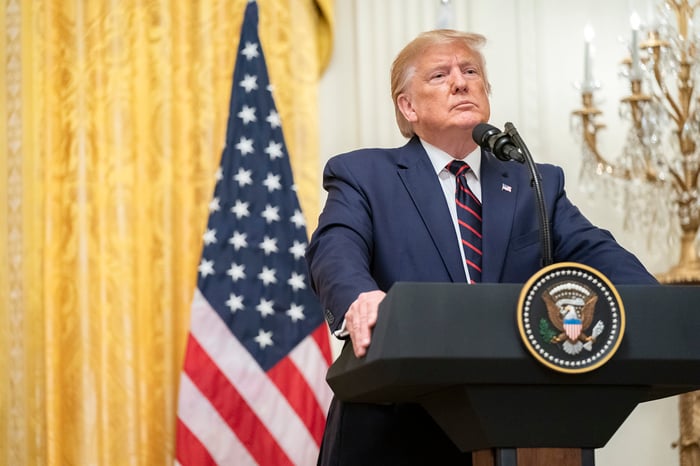
President Trump delivering remarks. Image source: Official White House Photo by Shealah Craighead, courtesy of the National Archives.
Based on the trajectory of inflation, spurred by two decisions from the president (i.e., Trumpflation), Wall Street's bull market rally appears tenuous, at best.
Trumpflation is showing no signs of slowing
To preface this discussion of inflation, it's important to note that some level of rising prices is normal and healthy. The Federal Reserve's 2% long-term inflation target often serves as the benchmark for the U.S. economy.
While not all aspects of rising prices can be directly linked to Donald Trump's decisions, two specific actions by the president have led to concurrent price shocks.
The first inflationary shock stems from President Trump's tariff and trade policy, which he introduced in early April 2025. His initial plan entailed a sweeping global tariff, along with dozens of higher reciprocal tariffs on countries deemed to have adverse trade imbalances with America. Although the U.S. Supreme Court struck down a majority of Trump's tariffs in a February 2026 ruling, the president imposed sweeping global tariffs using a different justification shortly thereafter.
The problem with imposing a duty on unfinished imported goods, such as steel, is that it can increase domestic production costs, which are then passed on to consumers. Now-former Fed Chair Jerome Powell frequently cited the price stickiness of Trump's tariffs on the goods sector as a reason behind elevated inflation.
But tariffs aren't the bigger issue at the moment. The Iran war is what's had Wall Street on edge.
⛽ Average U.S. gas prices per gallon on May 6, per AAA:
-- NBC News (@NBCNews) May 6, 2026
• Regular: $4.54 (⬆️ $1.56 since war in Iran began on Feb. 28)
• Premium: $5.39 (⬆️ $1.85 since war began)
• Diesel: $5.67 (⬆️ $1.81 since war began)
On Feb. 28, Trump gave the U.S. military a green light to attack Iran. Shortly after these military operations began, Iran closed the Strait of Hormuz to virtually all commercial traffic. This shutdown, which continues as of this writing on May 23, has stymied the movement of approximately 20 million barrels of petroleum liquids per day (roughly 20% of global demand).
Fuel prices have soared since the start of the Iran war and have been the primary driver of inflation. But energy price shocks often have multiple phases. In particular, the inflationary impact on businesses often lags by a few months. Once the effects of higher transportation and production costs are accounted for in economic data, inflation can rise further.
Between February and April, trailing 12-month (TTM) inflation has surged from 2.4% to 3.8%. According to the Cleveland Fed's proprietary Inflation Nowcasting tool, which uses economic data to estimate front-month inflation, TTM inflation for May is expected to jump another 38 basis points to 4.18%. This would mark a three-year high.
Despite the president's claim that inflation would be short-term, Trumpflation isn't close to peaking -- and that's terrible news for a stock market that's priced for perfection.

Image source: Getty Images.
Wall Street is caught in the crosshairs of historic Trumpflation
Though the Dow Jones Industrial Average, S&P 500, and Nasdaq Composite have been able to shrug off these inflationary concerns to this point, this is unlikely to remain the case, based on what history tells us.
The stock market entered 2026 at its second-priciest valuation in history, dating back to January 1871, and it's only gotten pricier since then. The S&P 500's Shiller Price-to-Earnings (P/E) Ratio, also known as the Cyclically Adjusted P/E Ratio (CAPE Ratio), recently exceeded 42, which is within eyeshot of the all-time high of 44.19 that was set in the months leading up to the bursting of the dot-com bubble.
Two catalysts have supported premium valuations. One, as you can probably guess, is the AI revolution. America's most influential companies are spending a small fortune on the AI data center build-out, raising future growth prospects.
Shiller PE is now less than 5% away from surpassing the level reached during the Dot Com Bubble which would give the stock market its most expensive valuation in history 🚨🚨🚨 pic.twitter.com/Qd8rvlVvUn
-- Barchart (@Barchart) May 14, 2026
The other catalyst has been the expectation that the Federal Open Market Committee (FOMC) will commit to further rate cuts. When 2026 began, investors were counting on several rate cuts to spur the AI infrastructure build-out.
But due to the effects of Trumpflation, rate cuts have been all but wiped off the slate. Though the FOMC's easing bias remains in place, the latest Fed meeting minutes indicated strong opposition to this statement. Given Fed Chair Kevin Warsh's hawkish monetary approach and clues from the Fed minutes, it seems increasingly likely that the FOMC is on the verge of a major monetary policy shift.
Higher interest rates, or even the prospect of higher rates, could prove disastrous for a pricey stock market. The five previous times the Shiller P/E exceeded 30, the Dow, S&P 500, and/or Nasdaq eventually lost 20% or more of their value.
Wall Street is currently caught in the crosshairs of Trumpflation, and the puzzle pieces are in place for an expensive stock market to roll over.
Should you buy stock in S&P 500 Index right now?
Before you buy stock in S&P 500 Index, consider this:
The Motley Fool Stock Advisor analyst team just identified what they believe are the 10 best stocks for investors to buy now… and S&P 500 Index wasn’t one of them. The 10 stocks that made the cut could produce monster returns in the coming years.
Consider when Netflix made this list on December 17, 2004... if you invested $1,000 at the time of our recommendation, you’d have $465,733!* Or when Nvidia made this list on April 15, 2005... if you invested $1,000 at the time of our recommendation, you’d have $1,313,467!*
Now, it’s worth noting Stock Advisor’s total average return is 985% — a market-crushing outperformance compared to 211% for the S&P 500. Don't miss the latest top 10 list, available with Stock Advisor, and join an investing community built by individual investors for individual investors.
See the 10 stocks »
*Stock Advisor returns as of May 30, 2026.
Sean Williams has no position in any of the stocks mentioned. The Motley Fool has no position in any of the stocks mentioned. The Motley Fool has a disclosure policy.
Recommended Articles


