


What Is the Required Minimum Distribution (RMD) for a $750,000 Retirement Account?
Key Points
In general, anyone with a tax-deferred retirement account must take withdrawals known as required minimum distributions (RMDs) beginning at age 73.
RMDs are determined by dividing the retirement account balance from the previous year by the applicable IRS life expectancy factor based on current age.
The 2025 RMD for a 73-year-old with $750,000 in a traditional IRA as of December 31, 2025, will equal $28,302.
- The $23,760 Social Security bonus most retirees completely overlook ›
Tax-deferred retirement accounts like traditional IRAs and 401(k) plans let workers delay taxes on qualified contributions, though individuals with IRAs must have modified adjusted gross income (MAGI) below certain thresholds. The limits for 2026 are detailed below:
- Single taxpayers covered by a workplace retirement plan: $91,000
- Married taxpayers filing jointly (you have a workplace retirement plan): $149,00
- Married taxpayers filing jointly (only your spouse has a workplace retirement plan): $252,000
- Married taxpayers filing separately: $10,000
The government will not let you withhold tax payments indefinitely. At a certain age, anyone with a tax-deferred retirement account must take required minimum distributions (RMDs), which means they must withdraw a percentage of the account balance each year. Contributions and investment gains are subject to income tax.
Will AI create the world's first trillionaire? Our team just released a report on the one little-known company, called an "Indispensable Monopoly" providing the critical technology Nvidia and Intel both need. Continue »
Read on to learn more about RMDs, including when they begin and how to calculate the withdrawal amount for a retirement account with a balance of $750,000.
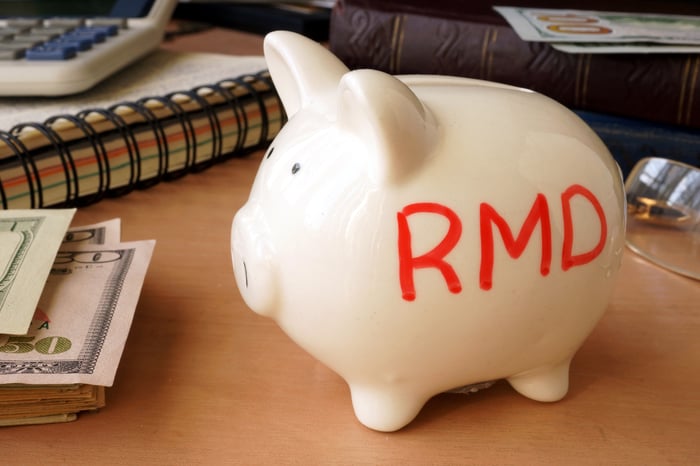
Image source: Getty Images.
Which account types are subject to required minimum distributions (RMDs)?
A required minimum distribution (RMD) is the smallest amount of money that retirees must withdraw from tax-deferred accounts each year. RMD rules apply to account holders and beneficiaries with the following plans:
- Traditional IRAs
- SEP IRAs
- SIMPLE IRAs
- Traditional 401(k)
- Traditional 403(b)
- 457(b)
- Profit-sharing plans
Importantly, RMD rules do not apply to Roth accounts while the original owner is alive, but beneficiaries of Roth accounts must adhere to RMD rules.
In general, account holders must take RMDs by December 31 each year. The only exception is the first RMD can be postponed until April 1. For instance, anyone that turned 73 in 2025 could delay their first RMD until April 1, 2026. However, all subsequent RMD
At what age do required minimum distributions (RMDs) begin?
The age at which required minimum distributions begin depends on when you were born. Details are provided in the chart below:
|
Account Holder's Birth Date |
Age When RMDs Begin |
|---|---|
|
Before July 1, 1949 |
70 ½ |
|
July 1, 1949, to December 31, 1950 |
72 |
|
January 1, 1951, to December 31, 1959 |
73 |
|
After December 31, 1959 |
75 |
Data source: Internal Revenue Service.
Anyone that does not take their RMD before the deadline will be penalized with an excise tax equal to 25% of the amount not withdrawn. The penalty can be reduced to 10% if the error is corrected within two years. The penalty can also be waived entirely if the account holder can show the shortfall was due to a reasonable error. In either scenario, the account holder must file a Form 5329 with their tax return.
How much is the required minimum distribution (RMD) on a $750,000 retirement account?
Required minimum distribution amounts are calculated by dividing a life expectancy factor into the relevant account balance from December 31 of the preceding year. As an example, RMD amounts due by December 31, 2026, will be calculated using account balances from December 31, 2025.
Individuals with more than one IRA must calculate the RMDs separately, but the total sum can be withdrawn from one account or spread over multiple accounts. However, that rule does not apply to defined contribution plans like 401(k), 403(b), and profit sharing. In those cases, RMDs must be calculated and withdrawn separately.
The IRS publishes three life expectancy tables. Beneficiaries use Table I (Single Life Expectancy). Account holders whose spouses are their only beneficiary and at least 10 years younger use Table II (Joint and Last Survivor Life Expectancy). All other account holders use Table III (Uniform Lifetime).
The chart shows an abbreviated reproduction of Table III (Uniform Lifetime) from the IRS. I will use this chart in examples below.
|
Age in Current Year |
Distribution Period |
|---|---|
|
73 |
26.5 |
|
74 |
25.5 |
|
75 |
24.6 |
|
76 |
23.7 |
|
77 |
22.9 |
|
78 |
22.0 |
|
79 |
21.1 |
|
80 |
20.2 |
Data source: Internal Revenue Service. Uniform Lifetime Table.
Here is an example: Brad turns 73 in 2026. He had $750,000 invested in a traditional 401(k) plan as of December 31, 2025. His RMD amount is calculated as $500,000 divided by 26.5, which equals $28,302. As a reminder, because this will be Brad's first RMD, he can delay the withdrawal until April 1, 2027. But his second RMD must still be withdrawn by December 31, 2027.
Here is another example: Megan turns 75 in 2026. She had $250,000 in a traditional IRA and $500,000 in a traditional 401(k) as of December 31, 2025. The RMD on her IRA is calculated as $250,000 divided by 24.6, which equals $10,163. The RMD on her 401(k) is calculated separately as $500,000 divided by 24.6, which equals $20,325.
Here is a final example: Travis turns 75 in 2026. He had $250,000 in one traditional IRA and $500,000 in another traditional IRA as of December 31, 2025. The RMD amounts will be the same as in the previous example, but Travis is allowed to combine the sums and withdraw the total (i.e., $30,488) from a single account.
The $23,760 Social Security bonus most retirees completely overlook
If you're like most Americans, you're a few years (or more) behind on your retirement savings. But a handful of little-known "Social Security secrets" could help ensure a boost in your retirement income.
One easy trick could pay you as much as $23,760 more... each year! Once you learn how to maximize your Social Security benefits, we think you could retire confidently with the peace of mind we're all after. Join Stock Advisor to learn more about these strategies.
View the "Social Security secrets" »
The Motley Fool has a disclosure policy.
Recommended Articles


