


What Dividend Investors Need to Know About Costco
Key Points
Costco is a large and successful global retailer.
The company uses a club store model.
If you own Costco, sales aren't the only thing you should be focused on.
- 10 stocks we like better than Costco Wholesale ›
Costco (NASDAQ: COST) just rewarded its shareholders with another huge dividend increase. The 13% hike is inline with the 12% average annualized increase over the past decade. Dividend growth investors should be very pleased.
However, Costco isn't just another retailer. It is a club store, and that changes the equation in a very important way. If you own the stock, this is what you need to know.
Will AI create the world's first trillionaire? Our team just released a report on the one little-known company, called an "Indispensable Monopoly" providing the critical technology Nvidia and Intel both need. Continue »
Costco's model is different
As noted, Costco is a club store. That means its customers pay an annual membership fee for the privilege of shopping at the company's stores. This single fact changes everything, but some numbers will help show why.

Image source: Getty Images.
Through the first half of fiscal 2026, Costco generated revenues of $136.9 billion. That's a big number, noting that Costco is one of the world's largest consumer staples businesses, second only to retail juggernaut Walmart (NASDAQ: WMT). However, Costco breaks down sales into two distinct categories, product sales and membership fees. Membership fees are a tiny fraction of the top line, making up just under 2% of revenues.
That seems like a number you could ignore, but it isn't. Merchandise and SG&A costs totaled $131.8 billion in the first half of the fiscal year, resulting in gross profit of roughly $5 billion. But almost all of those costs are associated with operating the company's stores. The membership fees largely fall directly into gross profit. That 2% of revenues figure noted above translates to nearly $2.7 billion in income, or more than half of the company's gross profit!
Costco has to keep its customers happy
Once you see how important the membership fees are, you realize that Costco has an annuity-like income stream underpinning its retail business. That's not the norm in the retail sector, where price competition is often a major factor. Costco is highly incentivized to do whatever it takes to get its customers to renew their memberships. And, as an investor, you need to pay attention to its success rate. The worldwide renewal rate was 89.7% in the fiscal second quarter of 2026, steady with the first quarter but down from 90.5% in the same fiscal quarter of 2025.
The year-over-year drop isn't the end of the world, but it's worth monitoring. That's especially true given world events, with the geopolitical conflict in the Middle East likely to push costs higher across the board. The most obvious direct impact will be on transportation costs, as high oil prices quickly get reflected in gas prices. However, the full impact of the tensions will eventually flow through the entire value chain, from farmers paying more for fertilizer to rising packaging costs. Customers are already tightening their budgets, but those efforts could intensify further.
Costco versus other retailers
That said, the membership fees Costco relies on so much allow it to be extra aggressive with its product prices. Simply put, the company can accept lower margins than its peers that do not use a membership model. That's a big part of the story behind Costco's long-term growth. Despite the small year-over-year decline in the membership renewal rate, the retailer's customers still seem very happy with the Costco shopping experience.
COST data by YCharts
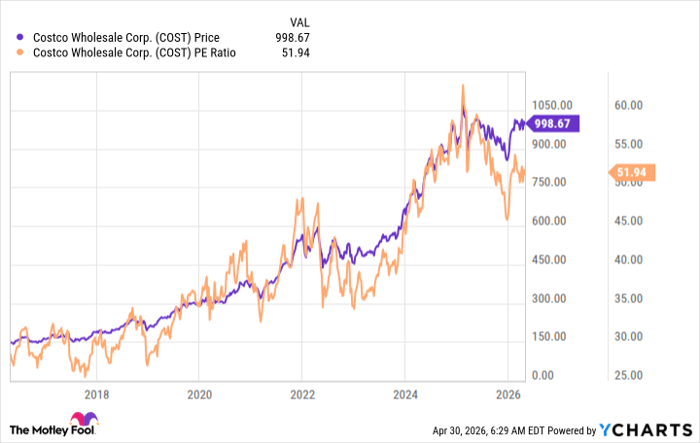
All of that said, there is another small problem for investors. Costco's stock price has risen dramatically over the past decade, as Wall Street recognizes its long history of success. Its price-to-earnings ratio is a shockingly high 51x. That's lower than it was not too long ago, but the retailer's stock is still expensive. For reference, the average retail stock has a P/E ratio of around 18x.
The dividend yield, meanwhile, is a scant 0.6%. That is even lower than the S&P 500 index's (SNPINDEX: ^GSPC) miserly 1.1%. The dividend yield is near the lowest levels in Costco's history, which also hints at a rich valuation.
If you buy Costco today, you are basically buying it near the highest valuation levels in the company's history. Even a great business like Costco can be a bad investment if you pay too much for it. There's no reason to sell it if you are a long-term focused dividend-growth investor. But it is probably best left on the wish list for anyone who doesn't yet own the stock.
Should you buy stock in Costco Wholesale right now?
Before you buy stock in Costco Wholesale, consider this:
The Motley Fool Stock Advisor analyst team just identified what they believe are the 10 best stocks for investors to buy now… and Costco Wholesale wasn’t one of them. The 10 stocks that made the cut could produce monster returns in the coming years.
Consider when Netflix made this list on December 17, 2004... if you invested $1,000 at the time of our recommendation, you’d have $496,473!* Or when Nvidia made this list on April 15, 2005... if you invested $1,000 at the time of our recommendation, you’d have $1,216,605!*
Now, it’s worth noting Stock Advisor’s total average return is 968% — a market-crushing outperformance compared to 202% for the S&P 500. Don't miss the latest top 10 list, available with Stock Advisor, and join an investing community built by individual investors for individual investors.
See the 10 stocks »
*Stock Advisor returns as of May 3, 2026.
Reuben Gregg Brewer has no position in any of the stocks mentioned. The Motley Fool has positions in and recommends Costco Wholesale and Walmart. The Motley Fool has a disclosure policy.
Recommended Articles


