


TradingKey Daily Market Brief: US-Iran Negotiations Rejected Again, US Stocks Turn From Gains to Losses, Trump Announces Ceasefire Extension
TradingKey - Markets' concerns over the breakdown of U.S.-Iran negotiations and the heightened risk of renewed conflict intensified, causing the three major U.S. indices to close lower for the second consecutive day. After Trump issued a threat to bomb Iran, the three major indices turned from gains to losses during the session. The S&P 500 fell 0.63% to 7,064, the Dow dropped 0.59% to 49,149.3, and the Nasdaq slipped 0.59% to 24,259.9.
In after-hours trading, U.S. index futures turned positive after Trump announced an extension of the ceasefire.
The semiconductor index rose for the 15th consecutive trading day, AMD rose nearly 3.5%, but Nvidia (NVDA) retreated more than 1%. Impacted by news that CEO Tim Cook will step down, Apple (AAPL) fell 2.5%; while the better-than-expected first-quarter performer UnitedHealth (UNH) rose nearly 7%.
European and U.S. bond markets weakened in sync. After Trump threatened to bomb Iran, the U.S. Dollar Index accelerated its rebound, hitting a more than one-week high during the session. Bitcoin once approached $75,000, falling more than 2% from its intraday high.
In commodities, Trump's threat to resume the bombing of Iran pushed crude oil from losses to gains during the session, marking a second consecutive day of rebound after last Friday's plunge, with WTI crude once rising more than 5%.
Gold and silver trended lower, with spot gold once falling over 3% and spot silver dropping over 5%, before seeing some recovery after Trump announced the ceasefire extension. During the Asian session on April 22, spot gold rose 0.5% and spot silver gained 1%.
Market Headlines
Trump Announces Extension of Ceasefire and Maintenance of Naval Blockade Pending Iran’s Unified Negotiation Proposal. Trump stated that given "serious divisions" within the Iranian government, the U.S. has decided to extend the ceasefire until the Iranian side submits a unified negotiation proposal and talks are concluded. During this period, the U.S. military will maintain its naval blockade of Iran while remaining in a state of military readiness.
Iran Formally Declines to Attend May 22 U.S.-Iran Talks; White House Says Future Arrangements Remain Uncertain. Iranian media reported that Tehran believes the U.S. is obstructing a substantive agreement, rendering participation in negotiations meaningless, and has thus formally declined to attend the talks on the 22nd. The White House stated that following Trump’s announcement of the ceasefire extension while waiting for Iran’s proposal, Vice President Vance and the U.S. delegation will not travel to Pakistan on Tuesday, leaving subsequent arrangements uncertain.
Iran Blockades Entrances and Exits of the Strait of Hormuz, Declaring No Right of Passage Until Blockade is Lifted. According to a report by Iran's Tasnim News Agency on the 21st, no vessels have the right to transit the Strait of Hormuz until Iran receives necessary guarantees for the complete lifting of the naval blockade. The strait is currently under the strict control of the Islamic Revolutionary Guard Corps Navy, with its entry and exit points blocked.
Warsh Hearing Emphasizes Fed Independence, Vows Never to Be Trump’s "puppet," Denies Rate-Cut Pressure, and Calls for Institutional Reform. At the hearing, Warsh stated that the President and lawmakers expressing views on interest rates does not threaten the independence of the Federal Reserve; the real risk lies in the Fed engaging in fiscal and social policies that lack statutory authority. He emphasized that he has never been asked for rate-cut commitments and would never become Trump’s "puppet." Warsh called for "institutional change," including updating the inflation framework and improving communications, arguing that Fed officials speak too much and that four policy meetings per year are too few.
U.S. March Retail Sales Rise 1.7% MoM, the Largest Increase in Over a Year Driven Primarily by Soaring Oil Prices; Economists Warn of Tests to Consumer Resilience. Driven by the Iran conflict pushing oil prices higher, U.S. gas station spending surged 15.5% in March, propelling overall retail sales up 1.7% month-over-month—the largest monthly gain in over a year. Additionally, tax refunds from the "Make America Beautiful" Act and a stabilizing U.S. stock market provided support for consumption. However, economists warn that as the tax refund dividend fades, high oil prices persist, and hiring slows, K-shaped consumer divergence could intensify; whether this strong momentum is sustainable remains to be seen in late-April GDP data.
Cook Says He Is in Good Health and Will Serve as Executive Chairman for the Long Term; Incoming CEO Ternus Says AI Will Help Apple Change the World Again. Apple Inc. moved to reassure markets as CEO Tim Cook stated he is in good health and will remain for a long period after transitioning to Executive Chairman. Hardware chief John Ternus, set to succeed him as CEO, said AI will create "nearly unlimited potential," bringing new opportunities to Apple’s products and services, and vowed that "Apple will change the world again."
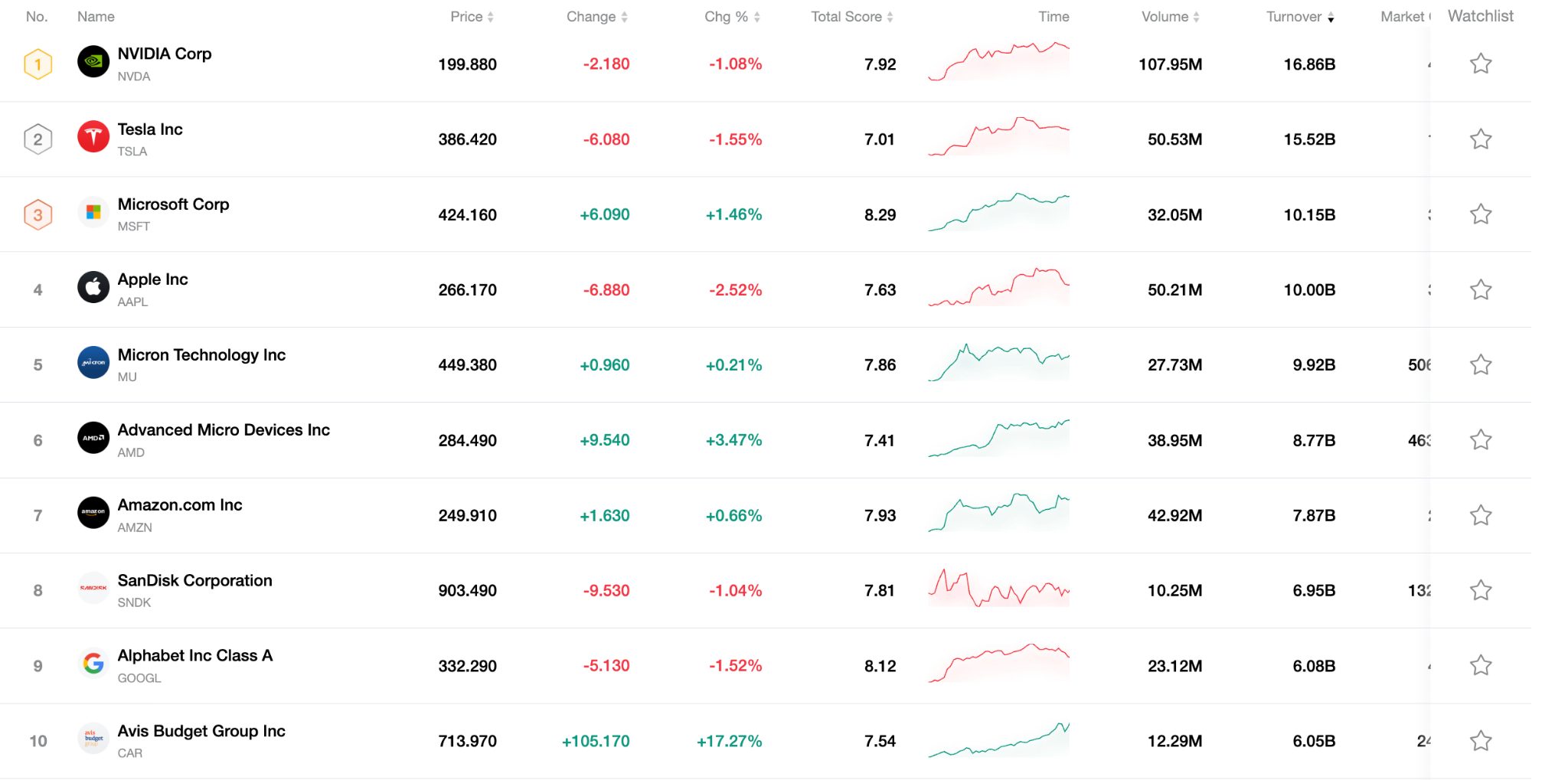
Top 10 Most Active Stocks
The chart below lists the ten most actively traded stocks in the market last Friday. Bolstered by massive trading volume and exceptional liquidity, these assets have become key benchmarks for tracking global market dynamics.
Recommended Articles


