


Here Are All 48 Stocks Warren Buffett's Successor, Greg Abel, Is Overseeing in Berkshire Hathaway's $320 Billion Portfolio
Key Points
It's an entirely new era for Berkshire Hathaway, with longtime CEO Warren Buffett retiring on Dec. 31 and his understudy, Greg Abel, taking the reins.
The Oracle of Omaha and Abel share similar investment philosophies, right down to devoting an outsize share of capital to their best ideas.
Many of the billion-dollar wagers in Berkshire's portfolio are driven by sustainable competitive advantages.
- 10 stocks we like better than Berkshire Hathaway ›
This year marks a new era in Berkshire Hathaway's (NYSE: BRKA)(NYSE: BRKB) storied history. After leading Berkshire for well over half a century and seeing the company he built reach a $1 trillion market cap, billionaire Warren Buffett retired as CEO on Dec. 31.
The person responsible for filling some impossibly big shoes is the Oracle of Omaha's longtime understudy, Greg Abel. Abel has been with Berkshire for over a quarter-century, and he has a nose for value just like his predecessor.
Will AI create the world's first trillionaire? Our team just released a report on the one little-known company, called an "Indispensable Monopoly" providing the critical technology Nvidia and Intel both need. Continue »
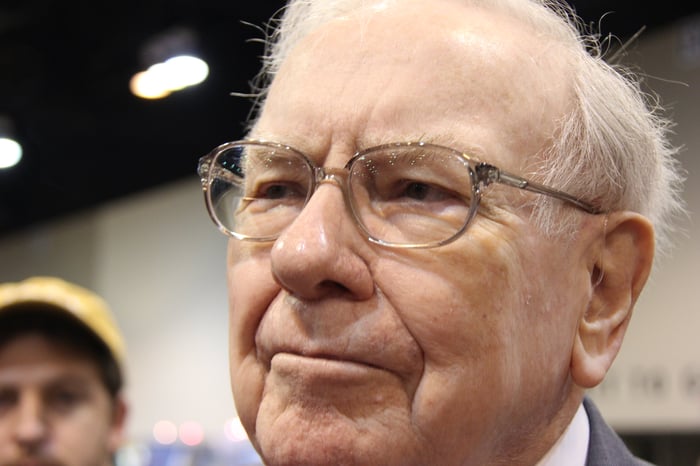
Warren Buffett retired as CEO of Berkshire Hathaway on Dec. 31, 2025. Image source: The Motley Fool.
Although Buffett remains chairman of the board, Berkshire Hathaway's day-to-day operations, including the management and oversight of its $320 billion investment portfolio, fall to Abel. As of the closing bell on April 16, Berkshire's new boss has the final say over 48 positions.
Greg Abel's portfolio is highly concentrated in 10 core holdings
Warren Buffett's and Greg Abel's investment philosophies are very similar. In addition to value being of the utmost importance, both favor robust capital-return programs, strong management teams, and companies with sustainable competitive advantages.
Perhaps most importantly, Berkshire's former and current bosses believe in apportioning an outsize percentage of the company's capital into their best ideas. Just 10 positions account for nearly 79% of Berkshire Hathaway's invested assets:
- Apple (NASDAQ: AAPL): $60,033,550,627 in market value (as of April 16)
- American Express (NYSE: AXP): $49,388,701,632
- Coca-Cola (NYSE: KO): $30,072,000,000
- Bank of America: $27,680,505,428
- Chevron: $24,488,919,510
- Occidental Petroleum: $15,067,219,181
- Mitsubishi (OTC: MSBHF): $12,426,926,313
- Chubb: $11,248,116,681
- Moody's (NYSE: MCO): $11,062,421,851
- Mitsui (OTC: MITSF): $10,944,462,095
Several of these "best idea" stocks share similarities. For instance, all 10 pay dividends to their shareholders, with some also actively repurchasing their shares. Apple has the largest share repurchase program on Wall Street, with the iPhone maker spending roughly $841 billion since 2013 to retire over 44% of its outstanding shares.
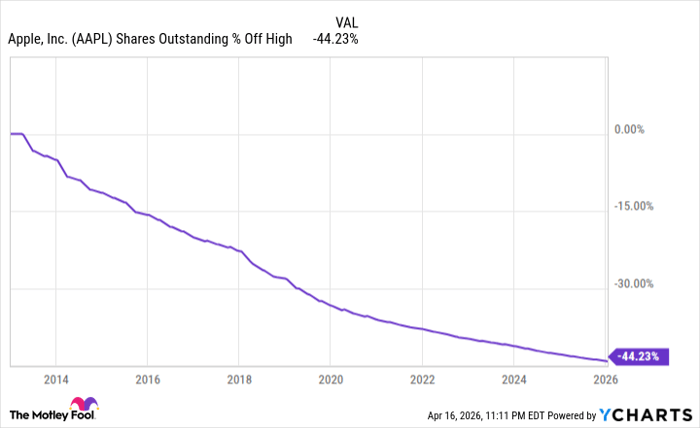
AAPL Shares Outstanding data by YCharts.
Buffett and Abel also view seven out of these 10 core positions as indefinite holdings. With the exception of Bank of America, Chevron, and Chubb, the remaining seven companies are expected to be fixtures in Berkshire's portfolio for decades to come. This includes Coca-Cola, American Express, and Moody's, the three longest-tenured holdings that are currently generating annual yields on cost of 63%, 45%, and 41%, respectively.
Investors can see Abel's influence among these 10 core holdings, as well. Abel is a huge fan of Japan's five trading houses, commonly known as the "sogo shosha," and was instrumental in building up sizable stakes in Mitsubishi and Mitsui.
Berkshire Hathaway has 20 additional billion-dollar wagers
On top of overseeing 10 positions that range from nearly $11 billion to $60 billion, Abel is responsible for 20 additional billion-dollar wagers in Berkshire Hathaway's $320 billion investment portfolio:
- Itochu: $8,542,909,322
- Kraft Heinz: $7,356,090,539
- Alphabet: $5,996,660,635 (Class A shares, GOOGL)
- Marubeni: $5,859,803,545
- DaVita: $4,458,799,656
- Sumitomo: $4,304,149,575
- Kroger: $3,388,500,000
- Sirius XM Holdings (NASDAQ: SIRI): $3,086,480,003
- Visa (NYSE: V): $2,614,529,646
- VeriSign (NASDAQ: VRSN): $2,461,878,638
- Constellation Brands: $2,135,250,000
- Tokio Marine Holdings: $2,110,853,256
- Mastercard (NYSE: MA): $2,067,236,454
- UnitedHealth Group: $1,594,518,050
- Capital One Financial: $1,435,076,500
- Domino's Pizza (NASDAQ: DPZ): $1,236,150,000
- Nucor: $1,229,326,646
- Ally Financial: $1,216,840,000
- Aon: $1,208,228,343
- Liberty Live Series C: $1,060,323,236
You'll note that the other three members of the sogo shosha are in this grouping (Itochu, Marubeni, and Sumitomo), and that they collectively make up five of Berkshire's 16 largest holdings by market value.
But what really stands out about these billion-dollar wagers is the emphasis on sustainable competitive advantages. For instance, Sirius XM and VeriSign operate as legal monopolies. Sirius XM is the only licensed satellite radio operator, while VeriSign is the registrar of ".com" and ".net" domains. Growth may not be off the charts for either company, but they possess unmatched competitive edges.
Abel is also overseeing close to $4.7 billion in combined investments in payment facilitators Visa and Mastercard. Whereas many of their peers double dip and act as lenders, Visa and Mastercard are solely focused on collecting merchant fees for facilitating payments. This means neither Visa nor Mastercard has to worry about setting aside capital for credit delinquencies or loan losses during periods of economic turbulence.
And we can't forget about Domino's Pizza, which is a stock the Oracle of Omaha added to for six consecutive quarters leading up to his retirement. Domino's ability to build consumers' trust and its track record of meeting or exceeding five-year growth initiatives made it a go-to investment for Berkshire's now-retired billionaire boss.
Image source: Getty Images.
Abel's smaller holdings
Rounding things out are the 18 relatively smaller holdings that Greg Abel oversees, ranging from $5 million to approximately $692 million:
- Pool Corp.: $692,463,211
- Lennar: $626,124,360
- Amazon (NASDAQ: AMZN): $568,317,200
- Liberty Live Series A: $471,581,627
- Louisiana-Pacific: $410,754,140
- The New York Times Co.: $394,621,458
- Heico Class A: $279,726,815
- Liberty Formula One Series C: $271,488,837
- Charter Communications: $250,336,326
- Lamar Advertising: $162,505,712
- Allegion: $110,404,422
- NVR: $74,490,292
- Liberty Latin America Series A: $20,227,853
- Jefferies Financial Group: $20,186,460
- Diageo: $18,229,110
- Lennar Class B: $15,685,537
- Liberty Latin America Series C: $11,055,412
- Atlanta Braves Holdings Series C: $5,230,043
Many of these "smaller" positions fall into two categories: companies that have been reduced or are being removed from Berkshire's investment portfolio, or investments made by Ted Weschler or Todd Combs, the latter of whom left Berkshire to join JPMorgan Chase in December 2025.
For example, Berkshire's stake in e-commerce and cloud infrastructure services titan Amazon was slashed by 77% during the December-ended quarter. Historically, a 77% reduction in a mid-tier position in Berkshire Hathaway's portfolio has been a strong signal that a company would soon be getting the heave-ho. Though Amazon is historically inexpensive relative to its future cash flow, it's not a value stock in the traditional sense of the term -- and that may be a problem for Greg Abel.
While it's possible that some of these smaller positions can eventually become billion-dollar wagers, these investments are better viewed as trading opportunities for Weschler and his team.
Should you buy stock in Berkshire Hathaway right now?
Before you buy stock in Berkshire Hathaway, consider this:
The Motley Fool Stock Advisor analyst team just identified what they believe are the 10 best stocks for investors to buy now… and Berkshire Hathaway wasn’t one of them. The 10 stocks that made the cut could produce monster returns in the coming years.
Consider when Netflix made this list on December 17, 2004... if you invested $1,000 at the time of our recommendation, you’d have $524,786!* Or when Nvidia made this list on April 15, 2005... if you invested $1,000 at the time of our recommendation, you’d have $1,236,406!*
Now, it’s worth noting Stock Advisor’s total average return is 994% — a market-crushing outperformance compared to 199% for the S&P 500. Don't miss the latest top 10 list, available with Stock Advisor, and join an investing community built by individual investors for individual investors.
See the 10 stocks »
*Stock Advisor returns as of April 21, 2026.
Bank of America is an advertising partner of Motley Fool Money. JPMorgan Chase is an advertising partner of Motley Fool Money. American Express is an advertising partner of Motley Fool Money. Ally is an advertising partner of Motley Fool Money. Sean Williams has positions in Alphabet, Amazon, Bank of America, Mastercard, Sirius XM, and Visa. The Motley Fool has positions in and recommends Alphabet, Amazon, Apple, Atlanta Braves Holdings, Berkshire Hathaway, Chevron, Domino's Pizza, Heico, JPMorgan Chase, Jefferies Financial Group, Lennar, Mastercard, Moody's, NVR, The New York Times Co., VeriSign, and Visa and is short shares of Apple. The Motley Fool recommends Capital One Financial, Constellation Brands, Diageo Plc, Kraft Heinz, Kroger, Occidental Petroleum, Pool, and UnitedHealth Group. The Motley Fool has a disclosure policy.
Recommended Articles


