


Rivian Stock: Can It Beat the Market in 2026?
Key Points
Rivian has a new vehicle coming in 2026.
The company's balance sheet is in a tough spot, but it does have funding commitments.
Shares will beat the market this year if it can show strong demand for this new vehicle.
- 10 stocks we like better than Rivian Automotive ›
Is a comeback brewing for Rivian Automotive (NASDAQ: RIVN)? The electric vehicle (EV) upstart has seen its share price crater since going public, and is down just about 90% from its all-time high. Competitive intensity and declining demand for EVs have caused Rivian's delivery growth to stagnate in recent years while the company remains highly unprofitable.
However, it is not taking this beating sitting down. Rivian has an ambitious product road map and key partners that could help it finally scale its EV ambitions and reach profitability. Does that mean the stock will beat the market in 2026?
Will AI create the world's first trillionaire? Our team just released a report on the one little-known company, called an "Indispensable Monopoly" providing the critical technology Nvidia and Intel both need. Continue »
Upcoming new models need to spur growth
Rivian's vehicle deliveries have stalled in recent years. The company sells high-quality but expensive EV trucks and SUVs, which has limited its addressable market as they are unaffordable for most Americans. Revenue has barely grown since the start of 2024, and it only delivered around 10,000 vehicles last quarter. For comparison, Tesla delivers hundreds of thousands of vehicles every quarter.
Management aims to address this stagnation with its upcoming R2 SUV models, which will be significantly cheaper than its original vehicles. It is initially priced at $60,000 for models coming out this spring, with plans to drop them to under $50,000 by 2027. The hope is that these more affordable models will help deliveries (and revenue) begin to grow again, with management expecting 62,000 to 67,000 deliveries in 2026.
Long-term, Rivian is developing even cheaper EV models and is diving into numerous initiatives across cars, including vehicle software, computer chips, and autonomous vehicles. It just signed a deal with Uber to deploy 10,000 robotaxis in the future, while recently spinning out a robotics subsidiary valued at $2 billion. Like Tesla, Rivian has massive ambitions to be not just an EV seller, but a full-on technology player. This will be expensive and risky, but could lead to massive profits one day.

Image source: Getty Images.
Balance sheet troubles to continue
The problem with Rivian is that it has little cash left to fund these ambitions. At the end of 2025, it had roughly $6 billion in cash on the balance sheet, despite a negative free cash flow of $2.5 billion. Free cash flow is likely to move in the wrong direction in 2026 as manufacturing for the R2 begins to scale.
To bridge the gap to positive cash flow, Rivian has funding commitments from Volkswagen Group and a $6 billion loan from the Department of Energy, which it hasn't yet drawn down. This should give the company a few years to build up its manufacturing capabilities alongside its ambitions in vehicle software. If successful, we could see Rivian's revenue start to move higher this year, with the potential to grow from $5.4 billion to tens of billions of dollars in future annual revenue.
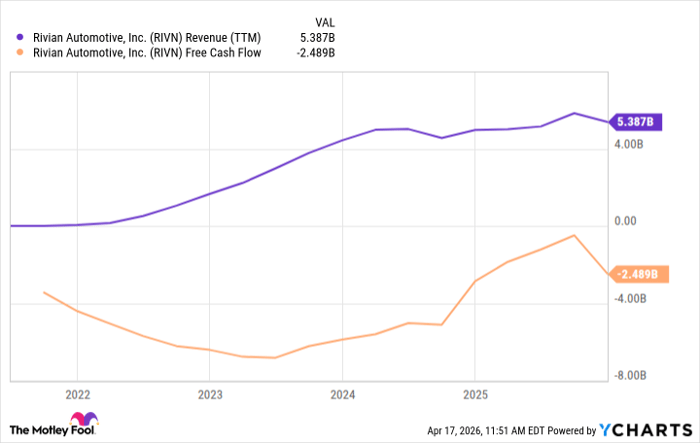
RIVN Revenue (TTM) data by YCharts
Can Rivian stock beat the market?
Long-term, the most important factor for Rivian's stock will be the successful scaling of its manufacturing and software businesses, which should lead to profitability and positive cash flow. With a market cap of just $22 billion, if the company gets on a path to tens of billions in annual revenue and healthy cash generation, the stock will likely do well over the next decade.
But what about this year? Shorter-term stock price movements are harder to analyze, but let's take a stab at it nonetheless. If Rivian proves there is solid demand for its R2 vehicle platform (the cheaper vehicles coming out soon), Wall Street may rerate Rivian stock and send it much higher than its current beaten-down levels.
This would be the key to beating the S&P 500 index this calendar year. It is rare for the index to go up or down by more than 20% in a single year, while a single stock like Rivian could moon 100% if momentum builds. For this to happen, investors need to see a catalyst in delivery growth and demand for the R2 vehicle in 2026.
Should you buy stock in Rivian Automotive right now?
Before you buy stock in Rivian Automotive, consider this:
The Motley Fool Stock Advisor analyst team just identified what they believe are the 10 best stocks for investors to buy now… and Rivian Automotive wasn’t one of them. The 10 stocks that made the cut could produce monster returns in the coming years.
Consider when Netflix made this list on December 17, 2004... if you invested $1,000 at the time of our recommendation, you’d have $524,786!* Or when Nvidia made this list on April 15, 2005... if you invested $1,000 at the time of our recommendation, you’d have $1,236,406!*
Now, it’s worth noting Stock Advisor’s total average return is 994% — a market-crushing outperformance compared to 199% for the S&P 500. Don't miss the latest top 10 list, available with Stock Advisor, and join an investing community built by individual investors for individual investors.
See the 10 stocks »
*Stock Advisor returns as of April 20, 2026.
Brett Schafer has no position in any of the stocks mentioned. The Motley Fool has positions in and recommends Tesla and Uber Technologies. The Motley Fool has a disclosure policy.
Recommended Articles


