


The Case for Data Centers in Space Is Getting Stronger
Key Points
What was once a seemingly ridiculous idea is slowly but surely becoming defensible.
Indeed, environment hawks have very good reasons to support the idea.
It comes as no surprise that SpaceX founder and chief Elon Musk is leading the charge by lowering the cost.
- These 10 stocks could mint the next wave of millionaires ›
It's never been impossible to operate a data center from the earth's orbit. It's just been a logistical and fiscal impracticality.
As is so often the case, though, time has allowed technology to catch up with the idea.
Will AI create the world's first trillionaire? Our team just released a report on the one little-known company, called an "Indispensable Monopoly" providing the critical technology Nvidia and Intel both need. Continue »
From impractical to ideal
If you're wondering, yes, the idea has been floated...more than once. Unsurprisingly, Tesla and SpaceX CEO Elon Musk publicly supports the premise, but so does Amazon and space-launch outfit Blue Origin founder Jeff Bezos. And they're hardly alone.
The upside of the idea is clear, too. That's heat -- earthbound data centers create a massive amount of it, so much so that they require high-performance cooling solutions. This is bad for the environment, of course. However, space is inherently cold. The chief concern would just be keeping equipment out of direct sunlight, which can be accomplished with basic heat-shielding.
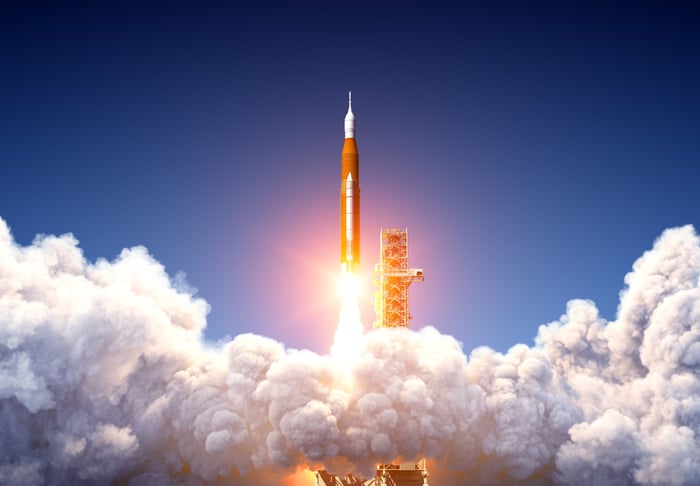
Image source: Getty Images.
The sun's light solves another problem challenging artificial intelligence data centers on terra firma. That's the need for power. Solar panels are well-developed enough now to provide a constant source of electricity for data centers operating in orbit. Indeed, practically all satellites are already powered by the sun.
You might think that sending and receiving information to and from an orbiting data center isn't quick enough or reliable enough. But AST SpaceMobile (NASDAQ: ASTS) is now successfully providing broadband-speed internet connectivity from its satellites to ordinary mobile phones. Even if this company isn't the go-to solutions provider, the communications technology is clearly ready and capable.
The chief stumbling block, therefore, has been -- and seemingly still is -- simply getting heavy computing equipment off the ground and into space. But even that problem is on the verge of being solved.
The final piece of the puzzle
When the United States' space program was in its infancy, the cost of getting anything into orbit was wildly high. The cost of launching the Saturn V rockets used for the Apollo moon missions was about $5,400 per kilogram, according to numbers from the Center for Strategic and International Studies (CSIS) Aerospace Security Project. This figure raced to $65,400 with the space shuttle, although the shuttle could do considerably more than a basic rocket.
Since then, though, this cost has been steadily whittled down. And 2010 marked a major leap: That's when then-nascent SpaceX's Falcon 9 rocket only needed $2,600 per kilogram to carry something into orbit. In 2018 SpaceX's Falcon Heavy rocket did it for a mere $1,500 per kilogram. (Falcon Heavy is able to launch up to 63,800 kilograms into low earth orbit.) Musk thinks he can get the per-kilogram cost down to something well under $1,000.
And it's not just SpaceX. With better materials, other space-launch companies are lowering launch costs as well. One of them is Rocket Lab (NASDAQ: RKLB). After 85 launches of its smaller Electron rocket, it's readying a reusable medium-lift rocket called Neutron that will be capable of putting 13,000 kilograms' worth of equipment into orbit. That's enough lifting power for a space-based data center.
We're still at least a few years away from turning the concept into a commonplace reality. Smart investors, however, would be wise to put this idea on their radars now.
Don’t miss this second chance at a potentially lucrative opportunity
Ever feel like you missed the boat in buying the most successful stocks? Then you’ll want to hear this.
On rare occasions, our expert team of analysts issues a “Double Down” stock recommendation for companies that they think are about to pop. If you’re worried you’ve already missed your chance to invest, now is the best time to buy before it’s too late. And the numbers speak for themselves:
- Nvidia: if you invested $1,000 when we doubled down in 2009, you’d have $523,131!*
- Apple: if you invested $1,000 when we doubled down in 2008, you’d have $51,457!*
- Netflix: if you invested $1,000 when we doubled down in 2004, you’d have $524,786!*
Right now, we’re issuing “Double Down” alerts for three incredible companies, available when you join Stock Advisor, and there may not be another chance like this anytime soon.
See the 3 stocks »
*Stock Advisor returns as of April 19, 2026.
James Brumley has no position in any of the stocks mentioned. The Motley Fool has positions in and recommends AST SpaceMobile, Amazon, Rocket Lab, and Tesla. The Motley Fool has a disclosure policy.
Recommended Articles


