


VTI Holds Every Corner of the U.S. Market -- Including the Small-Caps Getting Hit Hardest. Is That a Problem or an Opportunity?
Key Points
Small-caps are showing signs of life. Earnings growth is accelerating, and they're outperforming large-caps.
Given this improved quality and inherent value, small-caps could be in for an extended stretch of outperformance.
That makes the Vanguard Total Stock Market ETF a better bet than the Vanguard S&P 500 ETF right now.
- 10 stocks we like better than Vanguard Total Stock Market ETF ›
When people look to invest in U.S. stocks, they're usually referring to the S&P 500. That means they're only investing in a subset of the U.S. equity market. That index gives you exposure to 500 of the largest companies in the United States, but it leaves out about 3,000 that aren't quite large enough to make the cut.
For many years, investors didn't really mind leaving those extra 3,000 out. They've been chronic underperformers that would have been a drag on performance. Mega-caps, tech, and the Magnificent Seven stocks have driven the major indexes higher. Smaller, emerging companies have largely been left behind.
Will AI create the world's first trillionaire? Our team just released a report on the one little-known company, called an "Indispensable Monopoly" providing the critical technology Nvidia and Intel both need. Continue »
But that's the past. The next 10 years may look entirely different than the last 10. In fact, over the past 12 months, the Russell 2000, the popular benchmark for small-cap stocks, has pretty steadily outperformed the S&P 500.
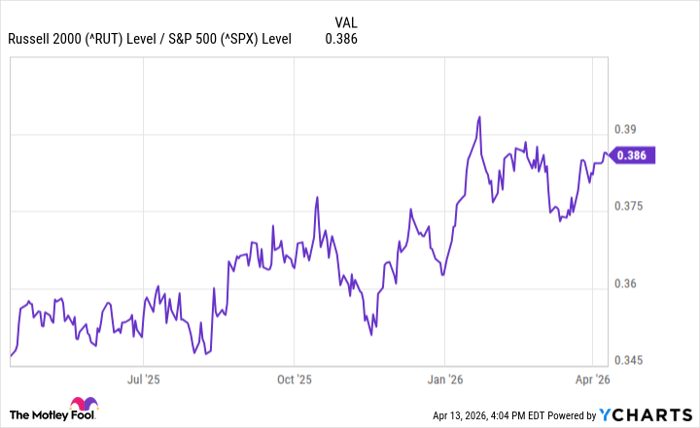
Fundamental Chart data by YCharts.
Because the Vanguard Total Stock Market ETF (NYSEMKT: VTI) owns the entire U.S. market, including large-caps and small-caps, that means it's time to reconsider it as the better opportunity over the Vanguard S&P 500 ETF (NYSEMKT: VOO).
Key takeaways
- VTI holds virtually the entire U.S. stock market of roughly 3,500 U.S. stocks, including large-, mid-, and small-caps.
- About 25% of the fund's portfolio is dedicated to medium- and small-sized companies, something the S&P 500 doesn't include.
- The economy is currently facing higher inflation and higher interest rates. These could hit small-caps especially hard, given that there are so many unprofitable companies in that group.
- The Russell 2000, however, trades at a forward price-to-earnings (P/E) of just 16, making it an attractive value.
- Small-caps belong in a long-term asset allocation alongside large-caps.

Image source: Getty Images.
The investment case for small-caps
While short-term performance can vary due to any number of factors, long-term performance is heavily driven by one factor: earnings growth. If you want to understand why large-caps have outperformed small-caps by such a wide margin over the past several years, look no further than the earnings trajectory for the two groups.
In 2023 and 2024, the S&P 600 small-cap index delivered consistently negative year-over-year earnings growth. For comparison, the Nasdaq-100 had mostly been delivering annualized earnings growth in the 15% to 30% range. But now, that trend is starting to even out. In 2026, FactSet is forecasting year-over-year earnings growth of 29% for the S&P 600. That's even better than the forecast for the vaunted Nasdaq-100.
Earnings growth is picking up substantially, and it's being made that much better due to valuations. Currently, the S&P 600 trades at a forward P/E ratio of 16, about a 25% discount to that of the Nasdaq-100. In other words, you could get better earnings growth at a bargain price. That's a strong reason to have small-caps in your portfolio.
VTI vs. VOO: Side-by-side comparison
| Metric | VTI | VOO |
|---|---|---|
| Index | CRSP U.S. Total Market | S&P 500 |
| # holdings | 3,503 | 504 |
| Expense ratio | 0.03% | 0.03% |
| Small/mid-cap exposure | ~25% | ~0% |
| 10-year annualized return | 14.2% | 14.7% |
| Dividend yield | 1.2% | 1.2% |
| Best use | Total U.S. market coverage | Large-cap U.S. market coverage |
Data source: VOO website and VTI website.
The other big advantage of owning large-caps and small-caps together is that they're generally sensitive to different cycles. The S&P 500, of course, has about a 32% allocation in tech stocks, with the largest chunk coming from the Magnificent Seven stocks. In the small-cap universe, tech accounts for just 13%. The biggest sectors include industrials (18%), financials (18%), consumer discretionary (14%), and tech.
Small-caps are more cyclically sensitive than large-caps, and more value-oriented. That makes them a great diversifier when paired together.
The Vanguard Total Stock Market ETF has long been my preferred way to invest in stocks, and this demonstrates why. Small-caps are undervalued, they have higher potential long-term growth, and they can mitigate overall portfolio risk. With earnings growth only beginning to accelerate, it's time to have small-caps in your portfolio.
Should you buy stock in Vanguard Total Stock Market ETF right now?
Before you buy stock in Vanguard Total Stock Market ETF, consider this:
The Motley Fool Stock Advisor analyst team just identified what they believe are the 10 best stocks for investors to buy now… and Vanguard Total Stock Market ETF wasn’t one of them. The 10 stocks that made the cut could produce monster returns in the coming years.
Consider when Netflix made this list on December 17, 2004... if you invested $1,000 at the time of our recommendation, you’d have $581,304!* Or when Nvidia made this list on April 15, 2005... if you invested $1,000 at the time of our recommendation, you’d have $1,215,992!*
Now, it’s worth noting Stock Advisor’s total average return is 1,016% — a market-crushing outperformance compared to 197% for the S&P 500. Don't miss the latest top 10 list, available with Stock Advisor, and join an investing community built by individual investors for individual investors.
See the 10 stocks »
*Stock Advisor returns as of April 17, 2026.
David Dierking has positions in Vanguard Total Stock Market ETF. The Motley Fool has positions in and recommends Vanguard S&P 500 ETF and Vanguard Total Stock Market ETF. The Motley Fool has a disclosure policy.
Recommended Articles


