


Should Rivian Worry About Its Brand New Competitor? Hint: Not One Bit.
Key Points
Kia decided to jump into the lucrative U.S. truck market by the end of this decade.
Kia aims to boost overall U.S. sales to over 1 million vehicles, with 90,000 of those being pickup trucks.
Rivian is pivoting away from producing trucks after the R1T.
- 10 stocks we like better than Rivian Automotive ›
Not much can spoil a good mood more quickly for a manufacturer such as Rivian (NASDAQ: RIVN) than hearing that more competition is on the way. At a time when the young electric vehicle (EV) maker is focused on building its brand and its scale, and accelerating the production of its recently launched R2, the less competition, the better.
South Korean car manufacturer Kia, on the other hand, has different objectives and plans to enter new electric segments in the U.S., including the lucrative truck market, and to drive its total sales to over 1 million with the help of new EVs. Some Rivian investors might be worried, but here's why they should still be able to sleep at night.
Will AI create the world's first trillionaire? Our team just released a report on the one little-known company, called an "Indispensable Monopoly" providing the critical technology Nvidia and Intel both need. Continue »
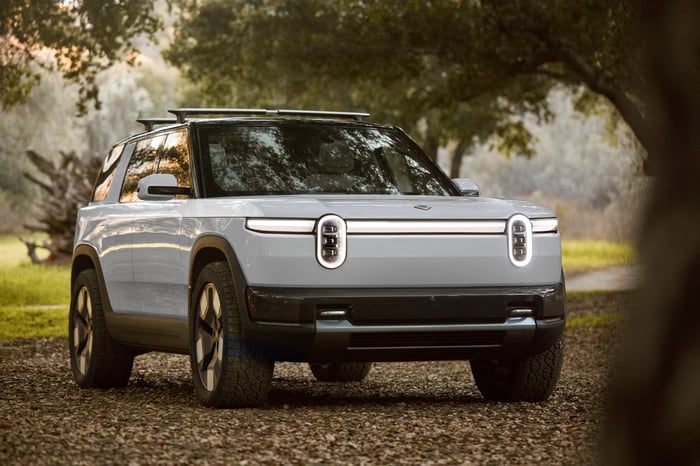
Image source: Rivian.
Kia has acquired its target
Kia hopes to splash into the U.S. pickup market with a midsize electric and range-extender truck by the end of this decade, according to the company's CEO, Ho Sung Song. It's part of Kia's broader plan to boost its annual U.S. sales to over 1 million vehicles and sell 90,000 pickups annually in North America. Kia's electric pickup would likely face off against EV pickups like the Chevrolet Colorado, Ford Ranger, Toyota Tacoma, and Rivian's R1T.
The U.S. truck segment is both lucrative and historically dominated by Detroit automakers, with a smaller niche covered by the Japanese. Kia's first punch into the valuable U.S. truck market won't be easy, but the company's CEO believes that its growing brand reputation and compelling electrified powertrains can rope in new customers. Song may be right, but for Rivian, each passing day makes that notion more irrelevant -- as things stand now. There are a few reasons for that.
Rivian investors should consider this
Some investors might be surprised to find that the truck industry economics get flipped on their head when comparing electric pickups to their gasoline counterparts. On one hand, internal combustion engine (ICE) trucks cost only marginally more to produce than a sedan, carry two to three times the price tag, and generate significantly higher margins. On the other hand, for electric pickups, it means a much larger battery than a sedan's, since trucks need to pull significant weight. That eats right into those juicy margins, as batteries are the biggest cost of these vehicles.
That is primarily why Rivian's rival Lucid (NASDAQ: LCID) never developed a truck and currently has no plans to. Furthermore, by the time Kia's new electric truck hits the streets in America, the R1T will be much more of an afterthought, and the R2T ... well, it doesn't exist. As it stands now, Rivian has no plans to introduce a smaller or more affordable truck model, such as a hypothetical R2T. At one point, Rivian's CEO even commented that there are no plans for a truck version of the R2.
What it all means for Rivian investors
Right now, Rivian is focused on reducing production costs while building scale, and has made incredible progress, including reaching its first full-year gross profit in 2025. Rivian's best pathway to proving it is capable of generating profits for investors is to accelerate production of the R2, a midsize platform that covers the most broadly appealing segment, and the R3, a compact crossover.
Rivian figured out pretty quickly what EV consumers want and pivoted away from offering electric trucks. It's a wise move from the young EV maker for now, enabling more resources to be invested in products that more people want, such as derivatives of its R2 or R3, or developing its software stack and driverless vehicle technology.
Should you buy stock in Rivian Automotive right now?
Before you buy stock in Rivian Automotive, consider this:
The Motley Fool Stock Advisor analyst team just identified what they believe are the 10 best stocks for investors to buy now… and Rivian Automotive wasn’t one of them. The 10 stocks that made the cut could produce monster returns in the coming years.
Consider when Netflix made this list on December 17, 2004... if you invested $1,000 at the time of our recommendation, you’d have $573,160!* Or when Nvidia made this list on April 15, 2005... if you invested $1,000 at the time of our recommendation, you’d have $1,204,712!*
Now, it’s worth noting Stock Advisor’s total average return is 1,002% — a market-crushing outperformance compared to 195% for the S&P 500. Don't miss the latest top 10 list, available with Stock Advisor, and join an investing community built by individual investors for individual investors.
See the 10 stocks »
*Stock Advisor returns as of April 16, 2026.
Daniel Miller has positions in Ford Motor Company and General Motors. The Motley Fool recommends General Motors. The Motley Fool has a disclosure policy.
Recommended Articles


